
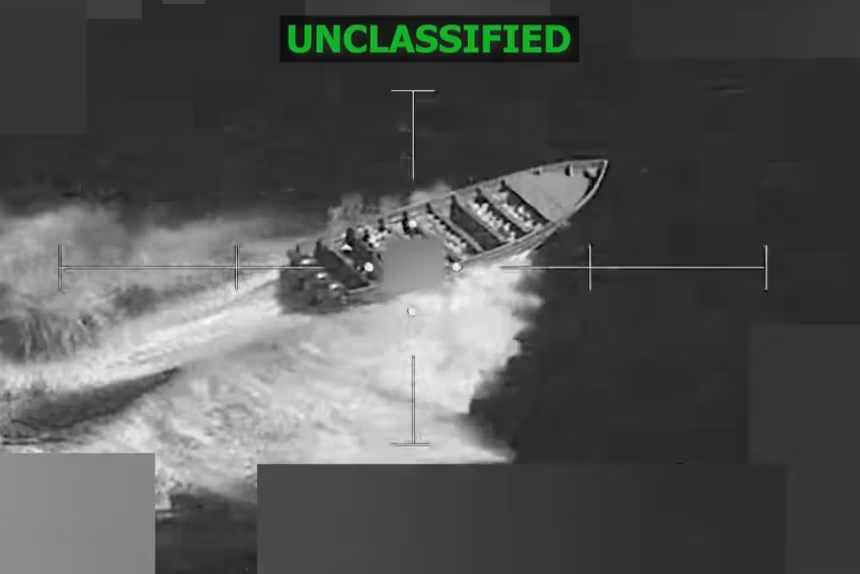

On September 2, President Donald Trump announced from the Oval Office that the US Navy had carried out an air strike on a boat in international waters. That boat strike rewrote US policy for Latin America overnight. Three months later, 26 boats have been hit, killing more than 90 people. The United States has codified its justification for the boat strikes as part of a new National Security Strategy, published in early December 2025. In the National Security Strategy, Trump announced a new Trump Corollary to the Monroe Doctrine, which he hopes can propel the United States and the US military to preeminence in the hemisphere. Trump’s actions suggest he believes he has broad latitude to take whatever measures he deems necessary, regardless of international law, the sovereignty of other nations, or the impact on human life. This reenvisioning of US policy for Latin America has disastrous implications for the region. More missile strikes. Loss of innocent lives. And even wrapping the United States into war close to home.
Under the Shadow is an investigative narrative podcast series that walks back in time, telling the story of the past by visiting momentous places in the present. Season 2 will respond in real time to the Trump Administration’s onslaught in Latin America. We begin today where we started in the last episode of Season 1… in Panama.
Hosted by Latin America-based journalist Michael Fox. Edited by Heather Gies.
This podcast is produced in partnership between The Real News Network and NACLA.
Theme music by Monte Perdido and Michael Fox. Monte Perdido’s new album Ofrenda is now out. You can listen to the full album on Spotify, Deezer, Apple Music, YouTube or wherever you listen to music. Other music from Blue Dot Sessions.
Resources for Under the Shadow
- You can check out the first season of Under the Shadow by clicking here
- The Beginning: Monroe And Migration | Under The Shadow, Episode 1
- Panama. Us Invasion. | Under The Shadow, Episode 13
- The Legacy Of Monroe | Under The Shadow, bonus Episode 4
- Michael Fox’s recent reporting on the boat strikes and the ramp-up for war in Venezuela:
Other Resources
- Emperors in the Jungle: The Hidden History of the U.S. in Panama (Duke, 2003), is John Lindsay Poland’s expose on the U.S. military involvement in Panama.
- You can watch the documentary, The Panama Deception, here.
- This is a link to Democracy Now! coverage of the U.S. push toward war on Venezuela.
Support Under the Shadow
You can see pictures of host Michael Fox’s reporting in Panama City, here.
You can check out Michael’s latest episode of Stories of Resistance about the annual protests demanding justice for the 1989 U.S. invasion of Panama.
You can also listen to his new podcast, Panamerican Dispatch on his Patreon page. There, you can follow and support him and Under the Shadow: https://www.patreon.com/mfox
Transcript
PRESIDENT DONALD TRUMP [RECORDING]: When you leave the room, you’ll see that over the last few minutes, we literally shot out a boat. A drug-carrying boat. A lot of drugs in that boat. You’ll be seeing that. You’ll be reading about that. It just happened moments ago…
MICHAEL FOX [NARRATION]: On Sept. 2, President Donald Trump announced from the Oval Office that the US Navy had carried out an air strike on a boat in international waters.
The boat allegedly carried drugs off the coast of Venezuela.
Trump later posted on Truth Social a video of the alleged air strike. The footage is black and white. The post is labeled “unclassified.” A missile hits the boat, and it explodes. The White House said, without providing evidence, that 11 alleged “narcoterrorists” were killed.
PRESIDENT DONALD TRUMP [RECORDING]: And there’s more where that came from. We have a lot of drugs pouring into our country. Coming in for a long time. And we just, these came out of Venezuela. Coming out very heavily from Venezuela. A lot of things coming out of Venezuela.
MICHAEL FOX [NARRATION]: Trump promised more boat attacks. And he’s made good on that promise.
Over the last three months, the United States has hit 26 alleged “drug boats” in the Caribbean and Pacific. They’ve killed at least 99 people.
Trump — Without evidence — Says Venezuelan president Nicolás Maduro is the head of an international terrorist group running drugs into the United States. He says Maduro’s days are numbered.
The drums for war are beating across Washington and Fox News….
SPEAKER [CLIP]: First, tensions continue rapidly escalating with Venezuela, and anxious leftists in Cuba and Nicaragua who rely on Venezuelan oil are starting to shake a little in their jackboots…
MICHAEL FOX [NARRATION]: The United States has now amassed the largest military buildup in the Caribbean since the Cuban Missile Crisis in 1962. That includes the world’s largest warship, the US aircraft carrier USS Gerald Ford. 15,000 US troops are stationed in the region, on the ready.
Here’s the thing…
Trump’s campaign for war is, unsurprisingly, largely built on lies. And it’s part of a nearly complete about-face for U.S. foreign policy.
That US attack on that boat in early September was the very first time the United States has launched a unilateral air strike or carried out a deadly military operation on its own in Latin America in nearly four decades. Not since the 1989 invasion of Panama.
According to a new national security strategy, the Trump administration is planning to ramp up US intervention in the Americas, with a new “Trump Corollary” to the Monroe Doctrine — Monroe Doctrine 2.0. Monroe on steroids. Roosevelt redux.
A promise to force into submission countries that are unwilling to bend to US interests.
And it’s already begun….
That… in a minute.
[THEME MUSIC]
This is Under the Shadow — An investigative narrative podcast series that looks at the role of the United States abroad in the past and the very present.
This podcast is a co-production in partnership with The Real News and NACLA.
I’m your host, Michael Fox — Longtime radio reporter, editor, journalist. The producer and host of the podcasts Brazil on Fire and Stories of Resistance. I’ve spent the better part of the last twenty years in Latin America.
I’ve seen firsthand the role of the US government abroad. And most often, sadly, it is not for the better: invasions, coups, sanctions. Support for authoritarian regimes. Politically and economically, the United States has cast a long shadow over Latin America for the past 200 years. It still does….
This is Season 2: Trump’s Attack.
If you listened to Season 1 about the US role in Central America, you know that in each episode I take you to a location where something historic happened, diving into the past to try and decipher what it means today. I’ll still do that here. But Season 2 is also going to be a little different. Because my goal is to respond in real time to the Trump administration’s onslaught in Latin America.
PRESIDENT DONALD TRUMP [CLIP]: We have Venezuela acting up in a different way. They continue to send people that we rebuff…
MICHAEL FOX [NARRATION]: Just in recent months, we’ve seen the boat strikes; threats of a US invasion of Venezuela; the seizure of a tanker carrying Venezuelan oil; US intervention in the Honduran elections; Trump’s pardon of the convicted drug trafficker ex-president of Honduras, Juan Orlando Hernández; US tariffs on Brazil in defense of Trump ally and former president Jair Bolsonaro.
That’s not to mention everything happening in the United States. The ICE raids, for example, have detained tens of thousands of people. And they’ve largely targeted Latin American workers and families, among other immigrant groups
These are concerning days.
I asked Alexander Aviña about this recently. He’s an associate professor of Latin American history at Arizona State University. I’ve been talking to him about all of this A LOT lately.
MICHAEL FOX [INTERVIEW CLIP]: Alex, I was just thinking, like, if on a scale of like one to 10, if we could like analyze where we are in terms of like US active intervention in the region.
ALEXANDER AVIÑA: I don’t know, we’re high, man. Like it’s seven, eight. I mean, I think this is… You know, if you think about it, like the US hasn’t directly gotten involved militarily in Latin America since the end World War II many times, right? Dominican Republic in 1965. They invaded Grenada in 1983. Panama, right, 1989.
So, the fact that we are where we’re at now, I think it’s, especially taking on, these are all… They’re smaller countries, right? The fact that we’re at a point now where the there’s a possibility that the US will militarily invade or engage Venezuela, a huge country, economically important, significant country, that… That pushes my ranking up high, man, to like seven or eight. And it’s, again, it’s a really scary moment.
MICHAEL FOX [NARRATION]: There is so much to unpack about what Trump is trying to do in the region…
My goal is to help make sense of it all.
This is Episode 1 — “Monroe 2.0: Trump Corollary.”
In today’s episode I’m going to look at the big picture. I want to understand what’s happening right now and how it fits into the longer story of the US role in the region that I’ve discussed on this show in the past. I’ll look at Trump’s new corollary to the Monroe Doctrine, the policy that administration after administration has used as the justification for countless US interventions in Latin America over the past 200 years, and how Trump’s revival beefs up an old excuse for political, economic, and military domination in the region today.
I’ll look at the boat strikes and the threats of US invasion in Venezuela.
And to do that we start where I left off in the end of Under the Shadow Season 1 — In a narrow, winding country in Central America, squeezed between the Caribbean and Pacific oceans. A country known as Panama.
The year is 1989. Dec. 20.
26,000 US troops descend on Panama.
They attack key locations around the country.
They rain down missiles and bombs on the military barracks in Panama City and on the surrounding working-class neighborhood of El Chorrillo. I visited El Chorrillo for the first season of Under the Shadow.
JOHN LINDSAY POLAND: El Chorrillo was a massive fire in El Chorrillo, a very densely populated neighborhood right on the edge of the Canal Zone.
MICHAEL FOX [NARRATION]: John Lindsay Poland is the author of the book Emperors in the Jungle: The Hidden History of the U.S. in Panama.
JOHN LINDSAY POLAND: The Black population, many people who had worked in the Canal Zone, but a poor neighborhood and, as a result, hundreds and hundreds of people die there.
MICHAEL FOX [NARRATION]: US forces destroy 20,000 homes. They kill hundreds of innocent Panamanians, dumping bodies into mass graves. Omar Gonzalez was 12 years old at the time.
OMAR GONZALEZ: [Speaking Spanish] So many innocent people died. Friends of ours. Children we knew. People. Men and women. Some people who were sleeping at that moment. Elderly people who couldn’t stand up or run away because they lived close to the barracks. And this is the history. And it’s painful, more than anything else.
MICHAEL FOX [NARRATION]: Victims and their families are still demanding justice.
PRESIDENT GEORGE H.W. BUSH [RECORDING]: My fellow citizens. Last night I ordered US military forces to Panama. No president takes such action lightly. This morning, I want to tell you what I did and why I did it.
MICHAEL FOX [NARRATION]: At that time, the United States invaded Panama under the pretext of removing, detaining, and extraditing President Manuel Noriega for alleged drug trafficking.
The Trump administration is using the same rhetoric today against Venezuela President Nicolás Maduro, alleging without evidence that he and other top-ranking officials are running fentanyl and cocaine into the United States.
Now, I’ll dig deeper into this flimsy claim in a second, but first, I want to stay in Panama….
The United States invaded Panama in 1989 just one month after the fall of the Berlin Wall. The operation marked a major shift away from the Cold War fight against communism and toward a new, so-called War on Drugs.
PRESIDENT GEORGE H.W. BUSH [RECORDING]: At this moment, US forces, including forces deployed from the United States last night, are engaged in action in Panama…
MICHAEL FOX [NARRATION]: Bush wanted to look tough. The United States needed a campaign to send the message that it still called the shots in Latin America and the Caribbean.
Manuel Noriega was a perfect target. A former CIA and US Army intelligence asset whose relationship with the United States soured after he stopped serving US interests.
The thing is, US intelligence knew about Noriega’s alleged drug ties going back to the 1970s… And they turned a blind eye, just as long as he was their guy.
The administration only decided to take him out when it became politically convenient to do so.
The drug war connection provided an excuse to make a big display of it — And it became a major justification for US intervention going forward.
But it had disastrous repercussions inside Panama. The 1989 US invasion wreaked havoc on the country and set the scene for the wars to come in the Middle East and around the world today.
Walking the streets of El Chorillo and in my reporting on the legacy of the US invasion of Panama…
I’ve spoken with victims who saw their neighbors killed or trapped in their homes as they were engulfed by flames. I’ve spent hours watching videos from that invasion. They’re shot from above, missiles and gunfire riddling the city below, the victims little more than blurry dots on a screen.
They don’t seem like people; they’re targets — As if in a video game.
Panama was a training ground. Whether in El Chorillo or Iraq and Afghanistan or the Caribbean today, the US military slaps a drug trafficker or terrorist label on people and then issues their death sentences without trial or evidence. No due process. No jury. No judge. No conviction. No appeal. No regard for international law.
Back in September, US Defense Secretary Pete Hegseth told Fox News that the first air strike in the Caribbean was just the beginning.
PETE HEGSETH [CLIP]: We’ve got assets in the air, assets in the water, assets on ships, because this is a deadly serious mission for us. And it won’t stop with just this strike. Anyone else trafficking in those waters that we know is a designated narcoterrorist will face the same fate.
MICHAEL FOX [NARRATION]: 35 years after the invasion of Panama, the last such unilateral military action by the United States in Latin America… It’s a dangerous return to a devastating past.
Now, look, don’t get me wrong… the United States has still backed coups d’état and supported other countries’ military operations, often in the name of battling drug trafficking.
The United States provided billions of dollars of military aid and assistance to Colombia for years starting in the early 2000s for counternarcotics and counterinsurgency initiatives.
In Mexico, US Special Forces helped Mexican Marines recapture drug kingpin El Chapo in 2016.
And the US Drug Enforcement Administration has often collaborated with local forces, including in a deadly attack on civilians in Honduras in 2012.
But for decades, the United States did not carry out its own raids or lethal actions.
Things have clearly changed.
And in early December, we got a glimpse into exactly how and why….
That in a minute.
[BREAK]
MICHAEL FOX [NARRATION]: On Dec. 4, the White House released a 33-page document titled the “National Security Strategy.”
It lays out US military goals and foreign policy strategies for the world.
“In everything we do, we are putting America First,” it reads on Page 2. “This document is a roadmap to ensure that America remains the greatest and most successful nation in human history.”
The “National Security Strategy” condemns US foreign policy since the end of the Cold War. It champions the interests of the US economy and military and says that the United States “must be preeminent” in the Americas and around the world.
If there is one overarching principle it’s the concept of “peace through strength.”
I know how Orwellian this sounds…
“Strength is the best deterrent,” the document reads. “The United States must maintain the strongest economy, develop the most advanced technologies, bolster our society’s cultural health, and field the world’s most capable military.”
And they plan to use that military might….
In the document, the Western Hemisphere is front and center, more so than any other region in the world. China isn’t even mentioned until two-thirds the way through.
One detail in the document stands out more than any other — A reference to a new “Trump Corollary” to the Monroe Doctrine.
“The National Security Strategy” actually mentions this twice — First as a top priority among the overall policy goals and then again in the section on the Western Hemisphere.
Now, the term “corollary” may seem like an odd choice of words here, but it is actually a clear historical nod to the Monroe Doctrine.
OK. Quick history lesson here.
I dug into Monroe a lot in the first episode of Season 1 of Under the Shadow. If you’re interested, you can go back and listen to that now.
But here’s a recap.
On Dec. 2, 1823, US President James Monroe issued his State of the Union address. In it, he articulated a foreign policy position that would come to be known as the Monroe Doctrine.
Essentially, the Doctrine was a message to European countries following the independence of most of their former colonies in the Americas: Former powers had no right to interfere in the politics of the newly independent nations of the Western Hemisphere.
The Doctrine was applauded by many independence leaders in the Western Hemisphere.
I spoke with historian Greg Grandin about this in the first season of Under the Shadow.
GREG GRANDIN: But the more important thing is that they read in the Monroe Doctrine a corollary to their own anticolonialism. They didn’t read it as a doctrine of neocolonialism; they read it as a doctrine as anticolonialism, that no part of the Americas is eligible for reconquest. They saw it as analogous to their own anticolonialism. So, there was a lot of… Celebratory messages to Monroe from Latin American leaders thanking him for the… Not the Doctrine but for the pronouncement.
MICHAEL FOX [NARRATION]: But by the beginning of the 20th century, the United States had grown in prominence, power, and ambition.
In 1904, President Theodore Roosevelt vastly reinterpreted the Monroe Doctrine, with his own “Roosevelt Corollary.” It essentially turned the Monroe Doctrine into a tool to justify US intervention across the region.
We had a voice actor read an excerpt.
THEODORE ROOSEVELT [VOICE ACTOR]: Any country whose people conduct themselves well can count upon our hearty friendship. If a nation shows that it knows how to act with reasonable efficiency and decency in social and political matters, if it keeps order and pays its obligations, it need fear no interference from the United States.
Chronic wrongdoing or an impotence which results in a general loosening of the ties of civilized society may, in America, as elsewhere, ultimately require intervention by some civilized nation. And in the Western Hemisphere, the adherence of the United States to the Monroe Doctrine may force the United States, however reluctantly, in flagrant cases of such wrongdoing or impotence, to the exercise of an international police power.
MICHAEL FOX [NARRATION]: The United States would roll out exactly that police power — Deploying Marines, invading and occupying countries, intervening again and again across the Americas under the guise of offering stability and security while advancing US interests.
Alan McPherson is a professor of Latin American history at Temple University.
ALAN MCPHERSON: Teddy Roosevelt adds his corollary, and he basically says, our goal is still to kind of keep the Europeans out. But in order to do that, we’re going to be proactive. We’re going to be unilateral. We’re going to be kind of a cop on the beat. And the beat is going to be, our neighborhood’s going to be the Caribbean. We’re going to patrol it and walk softly, carry a big stick. And we’re going to have this sort of international police power to keep foreigners out. But sometimes you have to do it ahead of time.
MICHAEL FOX [NARRATION]: In his 1951 book on the history of the Marines, US Marine Corps captain George P. Hunt wrote about this time that “It became an American policy to intervene in the affairs of these countries and send the Marines to keep order by military force.”
Throughout the first decades of the 20th century, the United States would invade and occupy the Dominican Republic, Cuba, Nicaragua, Haiti, and many, many more countries under the pretext of upholding the Monroe Doctrine.
That is the era that Trump seems to be a champion of now.
This is shocking, because if you remember just over a year ago, when I finished Season 1 of this podcast, there were actually lawmakers on Capitol Hill who were talking about trying to do away with the Monroe Doctrine once and for all.
Now Trump is putting it on steroids.
PRESIDENT DONALD TRUMP [RECORDING]: They continue to send drugs into our country, Venezuela, they’ve been very nasty, and we can’t let that happen.
MICHAEL FOX [NARRATION]: Trump’s use of the word “corollary” in his National Security Strategy is not an accident. It’s a direct reassertion of a Monroe Doctrine where the US flexes military, political, and economic power to achieve its goals in the region.
Though those goals may still seem unclear, the Trump Corollary reads as a thinly veiled threat against countries who might be unwilling to bend to US interests.
“We will assert and enforce a ‘Trump Corollary’ to the Monroe Doctrine,” the “National Security Strategy” document states. “We want to ensure that the Western Hemisphere remains reasonably stable and well-governed enough to prevent and discourage mass migration to the United States; we want a Hemisphere whose governments cooperate with us against narcoterrorists, cartels, and other transnational criminal organizations; we want a Hemisphere that remains free of hostile foreign incursion or ownership of key assets, and that supports critical supply chains; and we want to ensure our continued access to key strategic locations,” the document reads.
In other words, says historian Alexander Aviña…
ALEXANDER AVIÑA: Trump is just saying, you’re going to do what we tell you to do because we are more powerful than you. This is about sheer revanchism and power. And if you don’t do what we tell you to do, we’re going to make you pay. And I think this is why it’s difficult to define what a Trump corollary is other than do what we tell you to do, in the way that you expressed it.
MICHAEL FOX [NARRATION]: All of the Trump administration’s visible actions toward Latin America in recent months fit into this rubric: The boat attacks, threats of war with Venezuela, tariffs on Brazil.
In the lead up to the Honduran elections in late November, Trump suddenly got very vocal about the Central American country, attacking the left candidate and telling Hondurans who they should vote for. And on Dec. 10, the United States seized a tanker in the Caribbean carrying more than 1.6 million barrels of Venezuelan crude oil. Just the latest in the US ramping up of actions and rhetoric against Venezuela.
Do what we tell you to do.
Like the Roosevelt Corollary, which, following 1904, would be used for years to justify intervention after intervention across the region, the new National Security Strategy is a means of rationalizing and validating the policies, threats, and attacks Trump may unleash across the region.
Historian Alan McPherson.
ALAN MCPHERSON: It’s going to take a while to digest this, but it’s easy to think of this as a return to imperialism — Sort of neoimperialism — Where the United States is using its military force to get what it wants.
MICHAEL FOX [NARRATION]: But here’s the thing… All of this is happening under a president who is supposedly peace-loving and anti-war. A self-described isolationist.
Remember, Trump recently won a FIFA peace prize.
But as historian Alexander Aviña explains…. Isolationism, for the United States, doesn’t actually mean isolation. It means the US shifting its attention back onto its own hemisphere.
ALEXANDER AVIÑA: Any time we have a US president who proclaims themselves to be an isolationist, it’s always bad news for Latin America because isolationism just means constant US intervention in what the US has consistently referred to as at its own backyard.
That’s the way that I’m reading all of this. Like it’s a combination of late 19th, early 20th century reassertion of the Monroe Doctrine, reassertion of US police power with what the US generally does after it’s defeated: it comes back to Latin America and it reasserts its power in the region.
If we think back historically, that moment of so-called US isolationism in Latin America that was actually a period of constant US military intervention to the tune of 34 invasions.
MICHAEL FOX [NARRATION]: That, he says, was over a period from the end of the 19th century until roughly the mid-1930s.
Another great example was in the wake of the Vietnam War. By the early 1980s, Central America was the top focus for US foreign policy, with the United States spending billions of dollars a year in interventionist policies across the region — Backing bloody authoritarian dictators and training and supporting paramilitary groups fighting left governments.
In 1983, the US invaded the tiny Caribbean island of Grenada. Quick victory post-Vietnam. Build up US confidence.
Now, Trump is again hoping to return to overtly dominate the region.
Secretary of State Marco Rubio told Fox’s Sean Hannity just this in early December.
MARCO RUBIO [CLIP]: I would say that if you’re focused on America and America First, you start with your own hemisphere, where we live. What happens here — I’m not saying things that are happening halfway around the world are not important. I’m saying what happens in our hemisphere impacts us faster and more deeply than something that’s happening halfway around the world.
ALEXANDER AVIÑA: It’s a combination of a recognition that they can’t take on China head on. This is going to be a long-term struggle. So the way to take on China is to retrench US power and dominance in the Americas. No more space or tolerance for alternative government or state forms or ideas of governance, as represented perhaps by a place like Venezuela or Brazil. And it’s just all about sheer US power.
MICHAEL FOX [NARRATION]: But Alan McPherson says there’s a twist.
ALAN MCPHERSON: The “National Security Strategy” that the Trump Administration just published is essentially saying, we’re going to use our military to get more out of Latin America. You know, in a sort of raw, realist way, it makes sense because the military is the thing that the United States does the best in the world. Its economy is actually not what it does the best. It’s the military. So, it makes sense to use the military as leverage to get more raw resources, more markets.
But at the same time, what’s also happening is not a return to the past. It’s an intensification of neoliberalism. Because what really comes out of the national security strategy, at least in terms of Latin America, is that the priority of the US government is US corporations … What essentially this government is saying is that governments are neoliberal puppets of corporations.
And so we need to then apply this to foreign policy. So, they’re saying, for instance, if you are an ambassador, if you are a diplomat abroad, your primary job now is not to process visas or help Americans in trouble, or even have good diplomatic relations or do some soft power, it’s helping American corporations. That is your main job as a diplomat. That, to me, is a radical departure.
MICHAEL FOX [NARRATION]: And this brings us to Venezuela.
It is not by accident that this South American country of roughly 30 million people is Trump’s top target.
Venezuela’s government is one of the most antagonistic to US interests in the region. It’s also the country with the largest proven oil reserves on the planet. It’s just across the Caribbean from the United States. And it has been a thorn in the side of the United States since leftist former president Hugo Chávez won the presidency in 1998.
Back in the mid-2000s, Venezuelan oil regulations required foreign oil companies to form joint ventures with the Venezuelan state oil company, PDVSA. Those that didn’t would be nationalized. Among them was Exxon Mobil, which took Venezuela to international arbitration to receive compensation. It seems that Trump is also now trying to use this as an excuse to intervene.
On Dec. 16, Trump demanded over social media that Venezuela “return to the United States of America all of the oil, land, and other assets that they previously stole from us.” Although, as many people have pointed out, it’s still unclear what he’s actually talking about.
And a lot has changed in Venezuela since the mid-2000s. The country the country has never gone back to a status quo where foreign companies pillaged its oil riches. Today, Chevron is the only US oil company operating in Venezuela.
Now, though, Trump allies are excited for a bonanza for US corporations if Venezuelan President Nicolás Maduro is removed.
MARIA SALAZAR [CLIP]: Venezuela, for the American oil companies, will be a field day.
MICHAEL FOX [NARRATION]: Florida Republican Congresswoman Maria Salazar rooted for the US overthrow of Venezuelan president Nicolás Maduro on Fox Business in late November.
MARIA SALAZAR [CLIP]: This is a number one goal for this administration from the economic standpoint.
MICHAEL FOX [NARRATION]: Alexander Aviña explains that within the context of the renewed US focus on the Western Hemisphere…
ALEXANDER AVIÑA: Venezuela emerges as a really juicy target, not just for oil, but for gold, for rare earth minerals, et cetera.
MICHAEL FOX [NARRATION]: Trump’s push to gobble up natural resources across the region for the United States won’t stop there… He’s also threatening to roll out militarized operations in Colombia and Mexico. But Venezuela is where he’s trying to start.
The threats against Venezuela have been increasing in recent months.
Trump has accused President Maduro of being a narco kingpin running drugs into the United States. In August, Trump doubled a bounty for the arrest of Maduro to $50 million.
But the United Nations and even the president’s own National Intelligence Council have denied any links between members of the Venezuelan government and the Venezuelan cartel Tren de Aragua.
The United States recently declared the Venezuelan “Cartel of the Suns” a terrorist organization. But that’s not even a thing. The Venezuela-based international analyst Phil Gunson explained this to Democracy Now!’s Amy Goodman in late November.
PHIL GUNSON [CLIP, DEMOCRACY NOW!]: It’s not an organization at all. It’s a term. It’s a label that was applied, has been applied over the last few decades, even from before Hugo Chávez came to power in 1999, applied to corrupt military officers who were taking money from drug traffickers. But it’s not an organization. It’s a state of mind, if you like, and maybe, in the most extreme case, maybe networks of military officers who collaborate. But it’s certainly not a cartel. It’s not a drug trafficking organization.
MICHAEL FOX [NARRATION]: Fentanyl doesn’t come from South America, and Venezuela isn’t a major cocaine-trafficking hub. Nor is it a threat to the United States.
A report by the UN Office on Drugs and Crime details that most of the routes for cocaine trafficking into the US go through Colombia, Peru, and Ecuador — Not Venezuela.
In 2024, the US DEA said that more than 80 percent of seizures of cocaine in the United States, confiscated drugs that originally came from Colombia.
Ricardo Vaz is a journalist based in Caracas with the independent news outlet Venezuelanalysis.
RICARDO VAZ: There’s no real credible evidence of serious drug trafficking, not only coming from Venezuela, but even less so having any ties to high-ranking Venezuelan officials. So, it’s really a matter of how much the US wants to escalate.
MICHAEL FOX [NARRATION]: The Trump administration also hasn’t provided any evidence that the more than two dozen boats Washington has hit in the Caribbean and Pacific are actually running drugs. On the contrary, the family members of many of the people killed say their loved ones were just fishermen.
Alexander Main is the director of international policy at the Center for Economic and Policy Research in Washington.
ALEXANDER MAIN: They just say that they’re drug traffickers, but no evidence is provided for that. But it doesn’t seem to matter. It’s a good show. It seems that Trump at least has become convinced that these videos have been helpful in showing that he’s tough on crime, tough on drug trafficking, killing those drug traffickers that are killing Americans, never mind that there’s actually no evidence that they’re involved in the fentanyl trade.
MICHAEL FOX [NARRATION]: It is ironic. Because while the United States rails against Maduro, without providing evidence, Trump’s own allies have actual ties to drug trafficking.
The most blatant example is this: On Dec. 1, President Trump pardoned the former right-wing Honduran president Juan Orlando Hernández, who was serving time in the United States as a convicted drug trafficker.
You can’t make this stuff up.
If you remember, I did a whole bonus episode about Hernández’s conviction in Season 1.
There’s also Ecuadorian president Daniel Noboa.
Secretary of State Marco Rubio met with him a few months ago. He’s one of Trump’s top allies in Latin America, alongside El Salvador’s Nayib Bukele and Argentina’s Javier Milei.
Trump invited him to his inauguration in January. But according to a March expose by the Colombian magazine Revista RAYA, multiple shipments of cocaine were seized between 2020 and 2022 from containers belonging to the Noboa family’s banana export business.
Trump officials have no problem ignoring all of that while ratcheting up the campaign against Maduro and Venezuela.
Historian Alexander Aviña.
ALEXANDER AVIÑA: It’s such a ridiculous argument they’ve made by saying that Venezuela is the region’s biggest narco state and responsible for introducing drugs into the United States. It’s just that we have so many sources to throw at them to disprove this, but in the end that doesn’t really matter. What matters is that they seemingly want to get involved in regime change operations in Venezuela as part of a broader movement to retrench its hemispheric power in the Americas.
MICHAEL FOX [NARRATION]: Here’s the thing about the US buildup for war against Venezuela: Venezuela is not Panama under Manuel Noriega, or the Dominican Republic in 1965, or Grenada in 1983. It is not a tiny country that the United States can just sweep into without resistance.
A US invasion of Venezuela would be disastrous. Venezuela has a substantial military force — One of the largest in Latin America — And hundreds of thousands of members in the reserve.
In recent weeks, videos have shown long lines of people signing up as new recruits to join the reserves to defend Venezuela against a possible US threat.
In August, Maduro said he had deployed 4.5 million militiamen around the country. Although that figure is likely an exaggeration, the number is still high.
All of this, I fear, is being underestimated by Trump, Department of War Director Pete Hegseth, Secretary of State Marco Rubio, and other top officials in Washington.
And at the same time, the race for war is being encouraged by leading members of the Venezuelan opposition, like Maria Corina Machado. She recently won the Nobel Peace Prize, but she has long backed violent destabilization efforts in Venezuela, and she applauds calls for a US overthrow of the Maduro government.
As the totalitarian state in George Orwell’s book 1984 preaches, “War is Peace.”
Say what you will about President Nicolás Maduro. Like him or not, believe he was democratically reelected in the last elections or not. Millions of Venezuelans are willing to defend their country and the Bolivarian revolution against a US threat.
It should shock people in the United States that the US would carry out illegal targeted assassinations of more than 90 people in international waters. And that the president would share videos of those extrajudicial executions freely on social media.
That Sept. 2 boat strike rewrote US policy for Latin America overnight. And the United States codified its justification for it as the “National Security Strategy” three months later.
Trump clearly feels he has carte blanche to take whatever measure he deems necessary without regard for international law, the sovereignty of other nations, or people’s lives.
This reinvisioning of US policy for Latin America has disastrous implications for the region. More missile strikes. Loss of innocent lives. And even wrapping the United States into a war close to home.
ALEXANDER MAIN: Yeah, we’re seeing a Monroe Doctrine that’s reached a new level, similar to what we were seeing at the end of the 19th and early 20th century when gunboat diplomacy was in full swing.
But having said that, I think this could even go beyond that if some of these land strikes actually take place. We should remember that the US, while they’ve intervened militarily quite heavily in the Caribbean and Central America, they’ve never carried out military attacks against any South American countries. There’s no record of that that I’m aware of. So, it would be unprecedented, even by sort of late 19th and early 20th century standards.
[MUSIC]
MICHAEL FOX [NARRATION]: Hi, folks. Thanks for listening. That is all for this first episode of Under the Shadow Season 2: Trump’s Attack.
Next time….
SPEAKER [CLIP]: I think the feeling in Trinidad is tense. I think we’re not accustomed to this type of war-like language and these actions. So, narco strikes in the Caribbean is odd and bodies washing up on shores.
MICHAEL FOX [NARRATION]: We head to the Caribbean and elsewhere around the region to look at the resistance not only to Trump’s buildup against Venezuela, but also to his threats against Colombia and Mexico.
That’s next time on Under the Shadow.
I’m your host Michael Fox.
I just want to say how excited I am to be back with this new season. I think it’s more important than ever as there’s so much misinformation out there and those lies are being used to fuel the race to war.
I hope you appreciate my reporting here. A couple of things to mention.
First… Much of today’s episode is based off of a series of stories I’ve written in recent months for The Nation and Truthout. I’ll add links in the show notes.
Many thanks to those outlets for their ongoing coverage of this situation.
Second… As you may have noted, many things I discussed today I covered at length in the first season of Under the Shadow, which looked at US intervention in Central America, in particular throughout the 1980s. If you haven’t heard that series yet, I highly recommend you go back and check it out. I think it’s great and still super relevant today, particularly with relation to everything about the Monroe Doctrine and Trump’s Corollary. I’ll add links in the show notes or you can find that by searching for Under the Shadow wherever you get your podcasts.
Finally, if you like what you hear, please head over to my Patreon page, patreon.com/mfox. There you can support my work, become a monthly sustainer, or sign up to stay abreast of all the latest on this podcast and my other reporting across Latin America. This really helps me to continue to do this important work.
Under the Shadow is a co-production of The Real News and NACLA.
This episode was edited by Heather Gies.
Thanks for listening. See you next time.

