

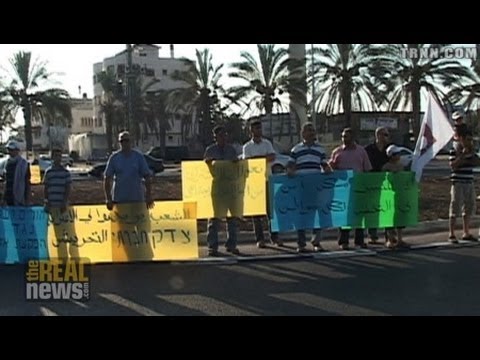
Last week an unofficial group of protesters released an 11 page
document to the media with a list of demands. The press conference was
held after five weeks of social protests in Israel as part of a movement that
started on July 14. While the document listed the end of privatization
policies as well as housing, education, health care, and taxation reforms,
it did not include previously discussed points about the rights of
Palestinian citizens of Israel that make up a fifth of the population. The
Real News’ Lia Tarachansky teamed up with Ha’aretz journalist David
Sheen during last Saturday’s protests to talk to demonstrators about why
in the fight for social justice they are avoiding speaking about equal rights
to all citizens of Israel, let alone the occupation of the Palestinian
territories. Tarachansky also interviewed +972 Magazine’s Joseph Dana
and Muhammad Jabali, an activist who, part of the J14 movement, set up
protest tents in the mixed Israeli-Palestinian city of Yafa.
Story Transcript
LIA TARACHANSKY, TRNN: I’m Lia Tarachansky with The Real News in Tel Aviv, where for the fifth weekend in a row, tens of thousands of Israelis have poured onto the streets. Last week, a press conference was held where protesters from the heart of the social mass movement released a draft of their demands to the media. While the demands listed tax reforms, the end of privatization policies, health care, housing, and education, they removed previously discussed demands addressing the Palestinian citizens of Israel. The Real News teamed up with Haaretz journalist David Sheen.
DAVID SHEEN: Many demands that referred to minorities were removed. What do you think about this?
UNIDENTIFIED (SUBTITLED TRANSL.): I think this movement started over the high cost of living. They call it a social movement, but I think it’s an economic movement. That’s how I see things. The fact that this opportunity is being exploited, like, to talk about my Ethiopian community or others, it’s a great opportunity.
UNIDENTIFIED (SUBTITLED TRANSL.): What was published in the list of demands wasn’t agreed upon. A group inside some leadership published, and it wasn’t agreed upon by all.
~~~
UNIDENTIFIED (SUBTITLED TRANSL.): Education, health, a fair tax system, housing, these are all things we’ve had.
UNIDENTIFIED (SUBTITLED TRANSL.): Yes, but it was a welfare state for Jews, basically, and there were many communities of others that didn’t participate.
UNIDENTIFIED (SUBTITLED TRANSL.): We need to understand that protest movements come as a wave, and when the wave comes and it only wants to focus on a welfare state for all–by the way, Arabs are present at all the protests, to my delight. Not to my delight, settlers are present to. I reject it, but they’re here. When the wave rises, I can’t tell young people how to behave. They wanted to bring a lot of people to protest.
UNIDENTIFIED (SUBTITLED TRANSL.): And they did.
UNIDENTIFIED (SUBTITLED TRANSL.): If they did a protest of 20,000 instead of 300,000 it wouldn’t work.
TARACHANSKY: Joseph Dana is a journalist with the +972 Magazine. In an article with American blogger Max Blumenthal, he criticizes the social protest movement for not rising up against the Israeli occupation of the Palestinian territories. He analyzes the history behind the separation policies in Israel that in the past decade led to the construction of the segregation wall in the West Bank. Ten years of separation have not only rendered the Palestinians invisible in a physical sense , it has erased them from the Israeli consciousness.
JOSEPH DANA, +972 MAGAZINE: Palestinians, in terms of segregation on a legal level, experience what we would call in the American context institutionalized discrimination. And so there’s a variety of laws inside of the Israeli government pertaining to land and distribution of resources that specifically discriminate against the Palestinian citizens of Israel.
~~~
DAVID SHEEN: You mentioned that you have actually read the latest list of demands that was published this week. So did you have any comments on those demands, anything that you thought was good, not so good?
UNIDENTIFIED: No, I think I was very impressed with it. So forward. Like, it’s got everything, most of everything that–.
TARACHANSKY: If this movement grows, it will be the biggest movement and the first of its kind in this country. Do you see any way that it could include in itself the topic that, you know, half of the population between the river and the sea depends on?
UNIDENTIFIED: I think there’s no–there’s no way out of it. Sometimes somebody has to say something about it. But little by little.
SHEEN: Little by little.
UNIDENTIFIED: If it happens too fast, then it [incompr.] everything, ’cause people are here because it’s hard to live here and it’s expensive to live here and people are trying to find other ways to live here.
~~~
UNIDENTIFIED: I asked Dana why the social protest movement does not at least address the occupation from an economic point of view. While the Israeli public pays over $9 billion a year on subsidizing the settlements in the West Bank, most of the profits go into the same private hands whose centralized control over the Israeli economy the movement opposes.
~~~
DANA: That’s very true. And unfortunately I have yet to see that statement clearly made in the way that you just made it in these demonstrations anywhere. And so this is what we’re talking about. Why isn’t the statement that you just made discussed, and why isn’t it openly discussed, and why aren’t there opinion pieces about it, and why aren’t the tent protesters organizing around this principle? We think that the barrier between connecting what’s going on in the streets of Tel Aviv and the tent protest and the statement that you just made is the separation principle.
TARACHANSKY: The Real News also spoke to Muhammad Jabali, an activist who part of the social movement helped start protest tents in Jaffa, a mixed Palestinian-Israeli city.
MUHAMMAD JABALI, ACTIVIST, FOUNDER OF YAFA TENT CITY: In the beginning of this movement, people did hear differing opinions, and thought, perhaps for the first time, about issues outside the Israeli daily discourse. This movement isn’t succeeding in getting out of the Zionist discourse that leaves the democracy only in the Jewish population.
~~~
UNIDENTIFIED (SUBTITLED TRANSL.): If there’ll be equal rights to every citizen.
UNIDENTIFIED (SUBTITLED TRANSL.): Yes, but on the one hand it’s equality, and on the other, a state of the Jews, and you can’t say these two things in one sentence.
UNIDENTIFIED (SUBTITLED TRANSL.): So it seems you have to remove one or the other?
UNIDENTIFIED (SUBTITLED TRANSL.): You need to remove the other.
UNIDENTIFIED (SUBTITLED TRANSL.): Which?
UNIDENTIFIED (SUBTITLED TRANSL.): If you want equality, remove the “Jews”; if you want a state for Jews, remove the “equality”.
UNIDENTIFIED (SUBTITLED TRANSL.): Exactly about that, there’s now a law proposed–exactly about that, there’s now a law proposed by Ze’ev Elkin, a parliamentarian with Likud, that if this law passes–.
UNIDENTIFIED (SUBTITLED TRANSL.): If he’s from Likud, he probably wants to remove “equality” and not “Jews”.
UNIDENTIFIED (SUBTITLED TRANSL.): Okay. Okay. That’s exactly it. And Arabic will no longer be an official language in Israel.
~~~
DANA: –this decentralized movement has so far been very, very explicit about not wanting to discuss the occupation, not wanting to discuss the separation principle and not wanting to discuss the social justice rights of all under Israeli society, I think, is significant.
~~~
JABALI: The municipal plans of Arab cities are the most critical problem in the state.
TARACHANSKY: But the protesters are saying that that’s political
JABALI: What’s even worse than that isn’t that they’re not coming against these issues. They’re not even rejecting the plans that already exists. For example, [Minister Eli] Yishai published a plan for Harish to establish a new city for Heridic (orthodox) Jews only, and every protest against it talks about it not being open to the secular. No one talks about how it basically continues the same policy of giving houseing solutions to the Jewish sector at the expense of Wadi Ara and the Arab sector.
DANA: We’re at a very crucial crossroads in this week, because the protests have weathered–not so great, but they’ve weathered a significant terror attack in the south and an escalation of violence with Gaza.
TARACHANSKY: And another terror attack this weekend.
DANA: They weren’t able to get nearly the same amount of people to go out on the streets after these things. And this Saturday they’re supposed to have 1 million people. I think this will be the watershed moment.
TARACHANSKY: On Saturday, protesters have called for Israel’s first million-person march. Many predict it will go a long way to demonstrate whether the movement will garner enough momentum to grow.
End of Transcript
DISCLAIMER: Please note that transcripts for The Real News Network are typed from a recording of the program. TRNN cannot guarantee their complete accuracy.

