


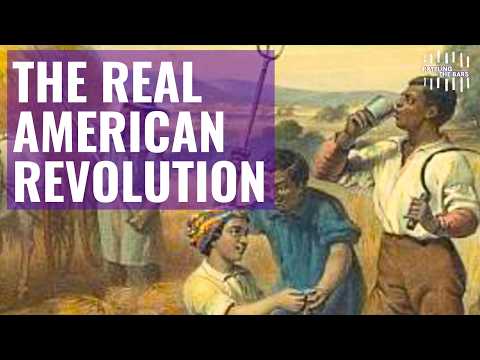
2026 marks the 250th anniversary of the American Revolutionary War. While the national mythology behind the “America at 250” celebrations focuses on the 18th-century battle between Patriot and Loyalist elites, what does the story of the American Revolution and the founding of the United States look like through the eyes of enslaved people? In this episode of Rattling the Bars, host Mansa Musa speaks with Professor Justene Hill Edwards, author of Unfree Markets: The Slaves’ Economy and the Rise of Capitalism in South Carolina.
Guests:
- Justene Hill Edwards is an associate professor of History in the Corcoran Department of History at the University of Virginia. Her research explores the intersection of African American history, the history of slavery, and the history of American capitalism. She is the author of Unfree Markets: The Slaves’ Economy and the Rise of Capitalism in South Carolina and Savings and Trust: The Rise and Betrayal of the Freedman’s Bank.
Credits:
- Producer / Videographer / Editor: Cameron Granadino
Transcript
The following is a rushed transcript and may contain errors. A proofread version will be made available as soon as possible.
Mansa Musa:
This year marks the 250th anniversary of the Revolutionary War, a conflict that we typically frame as a struggle between the colonialists and the British. However, we rarely examine the age of revolution from the perspective of the enslaved and the enslaved has a voice in this matter, as we will see. Join us today as the University of Virginia Professor of History, Justine Hill Edwards, an author of Unfree Market: The Slave Economy and the Rise of Capitalism in South Carolina. And Saviors and Trust. Professor, welcome to Rattling the Bars again.
Justine Hill Edwards:
Thank you for having me again.
Mansa Musa:
And we want to dial down because our last conversation, you educate our audience on the economics of slave from a different perspective, more from the perspective of how we as enslaved people not only view money, but viewed money with an economic plan that we had. Although it might have been embryonic and in terms of the collectivity of it, they made a relationship between money, freedom, and generational wealth. They might not have called it that, but in terms of application and practice, it was everything, that and some. So let’s talk about today, your book, Unfree Market. Okay. Unfree marketing explores the slave economy. What drew you to this subject and why did you focus specifically on South Carolina?
Justine Hill Edwards:
Yeah. Well, I mean, I didn’t realize until I began to do my PhD that I was really interested in the history of money. And I was drawn to ideas about how the enslaved were making money. And even though I really started this research when I was starting my PhD in 2008, I did a master’s degree in African diaspora studies before then. And I remember reading and being introduced to scholarship about what was called the slaves economy. And this was a tradition of enslaved men and women being able to and taking advantage of opportunities to make money for themselves, whether it was selling goods in a local marketplace, trading between and amongst themselves, trading with their enslavers, trading with anyone who would buy and sell goods to them and from them. And this kind of economy was actually not underground. It was not invisible. In some places, in places like Bridgetown Barbados, in places in Jamaica, even in places like Charleston, South Carolina, and Savannah, Georgia, this type of activity was actually very visible.
And so when I started to dig into the archive, look at primary sources, look at the historical record, I saw that not only was this economy visible, but it was incredibly important to the growth of the economy of slavery in general. And I focused on South Carolina because I knew that South Carolina as a slave holding colony and then state was at the forefront of pro- slavery activism, that the slaveholders and slaveholding politicians in South Carolina were vehement about protecting slavery as an institution and protecting their property rights in slaves and black slaves. And so I found these two ideas really fascinating that there was so much in the archive that revealed that the enslaved were managing money, they were making money, they were saving money. But at the same time, South Carolina was, at this period of time, during the period of legalized slavery, the most staunchly pro- slavery state in the nation.
And this continued up until the outbreak of the American Civil War. And so that’s how I came to this topic and this question of looking at the slaves’ economy in South Carolina.
Mansa Musa:
Okay. Now let’s talk about how the impact that the Revolutionary War had on disrupting the lives of enslaved people in South Carolina. Talk about the impact that the war had on Revolutionary War had on the slave economy and how the enslaved people leverage that in order to get the edge.
Justine Hill Edwards:
Yeah. I mean, studying the history of the American Revolution from the perspective and experiences of enslaved communities is incredibly fascinating because as you mentioned in the introduction, it kind of flips the narrative of this kind of patriotic moment on its head. Interestingly enough, most slaves in the American colonies, even in places like South Carolina, weren’t partisan. They didn’t care necessarily about the colonist or the loyalist cause. They didn’t care about the Patriots’ cause. They were only concerned with the ability to emancipate themselves and they would throw their political affiliation behind anyone who would promise them freedom. And interestingly enough, in a revolutionary period, by and large, this was the British. And so because the British forces were offering to free enslaved Africans if they would leave their enslavers and fight on the east sides of the loyalists. And so it kind of flips this narrative of the kind of patriotic moments of the American Revolution on its head.
And South Carolina was no different. The enslaved in South Carolina were actually similar. And they found ways to support themselves during the tumultuousness, the unpredictability of the war. They would trade and buy goods and sell goods to loyalists, to patriots. They continued
Their lives because by and large, they wanted their own protection and survival. And if trading with the British would help them do that, then that’s what they would do. If it meant staying on the plantations in which they were enslaved to stay out of this wartime conflicts, that’s what they did. And so again, looking at the American Revolution from the perspective of the enslaved, I think is a really fascinating exercise.
Mansa Musa:
And then we find ourselves after the war. Unpack that for our orders. How did the contradiction between the slave master or the institution of slavery and the slaves, how antagonistic was, and then how was it resolved? What’s your investigation or your historical study to come up with?
Justine Hill Edwards:
Yeah, I mean, I think one of the most interesting pieces of this, the story actually happens in Virginia. There was the royal governor of Virginia. He was the earl of Dunmore, and he issues a proclamation in December of 1775 off the coast of Virt Virginia, off the coast of Norfolk. And he actually says, “I will offer freedom to any slaves who leave their masters and join me in fighting for the British.” And he publishes this, this circulates, and this terrifies patriot enslavers like George Washington, for example. Because the idea of slaves taking up arms, leaving their enslavers, joining the British cause, and not only that, doing so to gain their freedom was a terrifying prospect.
And this happens. There are a few hundred that reach done more. He creates what he called an Ethiopian regiment of slaves who he later offered freedom. But yeah, but there are these moments during the American revolution where you have enslaved families thinking critically about, look, I will take my freedom if the British refers it to me, or I will wash my hands of both sides and just leave and flee. And so about a fifth of the enslaved population in the American colonies leaf, they go and seek ref refuge with Native American nations, they flee to Canada, they flee to Florida with the Spanish. And so we see actually an exodus of slaves who choose this moment of war to leave and take their freedom for themselves.
Mansa Musa:
And how did this impact the slave economy during that era? Because you got a situation where I can leverage my existence, I can leverage my existence, I’ve got people bidding on me going left or right. Well, like you say, we got a position that where I can remain on the plantation, I’m out the way of the conflict and when the dust settled, all of them killed each other, I can just get up and leave. How did this situation really impact the slave economy?
Justine Hill Edwards:
Yeah. Well, I mean, really, but between 1775 and 1783, which is the Treaty of Paris, which officially ends the revolution, we see the enslaved again, they either fight for either side for one side or the other. They choose to stay where they live, whether they live on plantations or not, or they choose to just flee. And so it is in this kind of eight-year period of time when we see the kind of economy of slavery, even the slaves economy weather this unstable moment. But after 1783, we shortly thereafter, well, four years after that, have the Constitutional Convention where we have the Constitution being debated about and ratified in the summer of 1787. And it is in that moment in particular that the kind of future of slavery starts to shift. We see delegates from the South and the North try to come to compromises about the future of slavery in this new nation.
And one of the major issues that they are talking about is whether the US would be invested in the transatlantic slave trade. They put this question off for about 20 years, but it is in this period of time, interestingly enough, between 1787 and 1807, when we see this massive kind of expansion and investment in bringing in more slaves
Mansa Musa:
Into
Justine Hill Edwards:
The nation. But interestingly enough, what happens in 1791, we have the outbreak of the Haitian Revolution, which absolutely terrifies enslavers like Thomas Jefferson, for example, he
Mansa Musa:
Writes
Justine Hill Edwards:
That he is incredibly scared of what’s going to happen, not just in modern day Haiti and it’s not in Domain, but in the US
Mansa Musa:
If
Justine Hill Edwards:
Rebellious slaves are allowed to infiltrate slave communities in the new nation. And so all of these things are going on at the same time.
Mansa Musa:
Talk about the skill level of slave and how their skill level impacted not only the economy, but our workers, like whites and other ethnic groups, how did their skill level? Because as we well know, we was innovative and we smart and we definitely … One thing about us, we always found a way to improve our situation, even though we don’t get the credit for it. In our mind, I can do this different, I’m going to do it different. And that’s my goal, to do it different, to make it easier for me to be able to do what I do, somebody else come along a patent and make it their invention. Talk about that.
Justine Hill Edwards:
Sure. No, and this is a great question. There is often the idea that the enslaved were not as skilled, but that’s absolutely not true. In places like South Carolina, the enslaved populations were highly skilled, skilled as blacksmiths, skilled as seamstresses, as dress makers, skilled as fishers and bakers. And so we are talking about an incredibly highly skilled community of slaves, both men and women, who were, again, trying to use their skills to make money for them, themselves and their families. And it was not uncommon for enslavers and slave traders to use the skills that the enslaved develop to try to get higher prices for them. And so the idea that you have an unskilled slave population was not at all true,
Mansa Musa:
Especially if
Justine Hill Edwards:
We look at low country South Carolina. It was the enslaved population that kind of helped to grow and expand the rice economy in South Carolina, which was incredibly important. South Carolina rice in the 18th and 19th century was seen as being an incredibly important commodity. All of that was grown and produced by slaves. And so we have a slave population that was incredibly highly skilled, so much so that those skills were often used to increase their prices within slave markets in visible ways.
Mansa Musa:
And what would T. Washington come to mind when Booker T. Washington’s, his perspective was that reconstruction, that we move into vocational, but was more take our skills and institutionalize them in form of doing things that we ultimately have control over that economy. Talk about the impact that this particular skill level had on white people in general and what type of regulations started coming out to try to control it. Because now you got, like you say, we looking at it from the perspective of, all right, I got a product to offer you that you can’t produce this. You don’t know how to manufacture you too lazy. Whatever your reason is that you can’t do this, I can do it. You need it and you can’t take it. So now you’re in a position where you in a violin system with me. I might not be getting the most out of it, but it’s creating anxiety within y’all that y’all depending on me now to provide y’all a service that you got to pay for.
Talk about the anxiety that came out there and what kind of revelations came out to try to control it from the slave
Institution. Sure.
Justine Hill Edwards:
Yeah. I mean, really at the beginning of the 19th century, we start to see there being kind of battles between skilled enslaved Black workers and their white counterparts, so much so that you have white or organizations who represented white mechanics, for example, petitioning state lawmakers saying that they wanted to bar black slaves from doing these same types of jobs. But of course, if you have an enslaver who wanted his or her slaves skilled in a certain trade, they would push back on this. And so this is one of the instances where you see white class conflicts, conflicts between the white working classes and the white elite classes who own slaves. And all of this was around the role and the place of skilled black slaves within this marketplace of labor. And so this begins at the beginning of the 19th century, and it increases really up until the breakout of the American Civil War.
These really contentious debates, again, between white skilled workers and black skilled workers around this kind of labor question. And so it is a kind of interesting way to look at how white class conflicts in the period of slavery erupts in this period.
Mansa Musa:
And that makes sense because, like you say, you got competing interests. You got the slave owners that they benefiting from it. And this is the reality of this country. Everybody don’t get along with everybody because you racialize. You just look at it, you got issues with us, but you got issues with your own class of people and your own ethnicity. Talk about, because you was real vivid on the picture that you painted the 18th, 19th century about the police and how policing became like the institution of this particular phenomenon. Talk about the fines, fees, and confinement, how they use these things to control slave black coal laws, and what was our response? What was people’s response to those things? Now I’m walking down the street, I’m going from one area to another. I’m working and I look up, I’m being leased out to somebody for the next 10 years because I got a fine of $5, but it’s growing every day.
Justine Hill Edwards:
Yeah. I mean, this is kind of the topic the history of policing in this country is really fascinating in the way that it dovetails with the history of slavery and slave regulation. And so you have what were called slave patrols. And slave patrols were kind of militias that were groups of white men primarily who were made responsible for regulating the movements of slaves when they were not on their plantations. And so these groups were first and foremost kind of non-elite white men, non-wealthy white men, white men without status within their communities. And they were often put on these patrols given the role to dominate the enslaved when they were not being directly dominated by their enslaver or wide overseer. And so slave patrols continued to evolve in the colonial period, really take on new meeting in the Antebellum period, which is the 1820s through the 1850s.
And we start to see groups of white men in the South take these roles really seriously because it felt like it gave them domination for slaves in these communities, especially slaves, as I just talked about, who were equally as skilled and were often taking their jobs and positions by employers who didn’t want to hire white workers.
Mansa Musa:
What was the impact of, because you talked about rights earlier, what was the impact of this particular product and then the cotton coming into it? What was the issue with that and how did it resolve that contradiction? Because that was a major shift. Like you say earlier that in South Carolina, we nominated, we had rights, we controlled it, we produced it. Wherever we went at, so they knew we had that skill level, nine times until they used it. Now you got cotton, cotton become king. How did that contradiction resolve on economic level?
Justine Hill Edwards:
Yes. I mean, so in the colonial period, in South Carolina, in Georgia, the major product that was exported was rice, short staple rice. And that was exported to regions of Western Europe, to the Caribbean. And this product was mostly cultivated and planted by enslaved Africans. When we talk about the beginning of the 19th century, really the 18 teens and 1820s, we’re talking about the introduction of a new product in that short staple cotton. And so because of technological innovations made to cotton ginning, this made the production of short staped staple cotton much, much easier, less time consuming, and more of it could be planted and harvested and then sold. And so this is what happens. And this dramatically transforms the American economy. It transforms the slave south and it transforms the lives and experiences of the enslaved, especially in the south. And so really from 1800 to 1860, a short staple cotton is the most important export of the US, the vast majority of which was planted and cultivated by the enslaved, so much so that by 1860, I think 60 or 65% of total American exports were cotton products.
And so it was incredibly important. And increasingly as the US is continuing to grow West, as new states are being added,
Mansa Musa:
Especially
Justine Hill Edwards:
In the South, all of these states are being dedicated. All of the land is being dedicated to producing cotton, and the vast majority of that cotton was being produced by slaves.
Mansa Musa:
And as you say, that changed the whole landscape in terms of treatment, because now you’re competing, whoever got the most acres going to get to have the most slaves going to try to produce the most cotton, because that’s the number one thing is generating the economy. So that shows that in and of itself kind of give you a perspective on how brutal the institution of slavery became because of the economics that’s now economic shift in terms of money because money now you got a lot of money being made off of cotton versus rice. Talk about Denmarkvest. How did his rebellion or his thinking impact the economy during that period there? And then tell all us a little bit about Democrats as you unpack that.
Justine Hill Edwards:
Yeah. I mean, the Denmark Vesey story is really interesting. So he was an enslaved boy and then man. Some believe that his early history began in the Caribbean. He was purchased apparently by a slave trader who brought him to Satin Doming, modern day Haiti, and they traveled around the Atlantic and made a stop in Charleston, South Carolina. In 1799, he is living and working as an enslaved young man in South Carolina. He purchases a lottery ticket, which slaves could do. And it just so happened that he got the winning ticket. I forgot how much he won, but it was a large sum, probably like a thousand dollars. And so he negotiates with his enslaver for his freedom. He buys his freedom, and then he lives between 1800 and about 1820 within the increasingly large free Black population of South Carolina of Charleston. And this is where the historical record gets a little fuzzy.
In 1821, there supposedly was a planned slave revolt and rebellion in Charleston. The plan was foiled, and he and his subsposed co-conspirators were arrested, found guilty and hung. And so this was kind of a foiled slave rebellion. Now, historians over the past 30 years or so have kind of looked at the historical record and they actually aren’t sure if one there was a slavery revolt. And if there was, they weren’t even sure if Veese was a part of it. But all of this is to say is that Vesi was hung … Well, he was tried, found guilty, and he was hung. And so his story kind of tells us quite a bit about just the culture of slavery, the threats against the lives of not just enslaved men and women, but free blacks as well, but also the fears that whites had within slave societies.
They feared what would happen to rebellious slaves. They were in constant fear about what would happen if slaves terrorize their masters in other whites. And so in many ways, the Denmark Vesey story kind of brings that to a head in I think really clear ways.
Mansa Musa:
And speaking of fear, talk about their fear of just mundane stuff like us learning how to read, those things that they fear
And how these things … We recognize that, and rightly so, they should have naturally, you should recognize Haiti, you should because this is an action that goes beyond your thinking, mainly in Haiti where you have a country that gain the independence that we can govern ourselves. And the threat with that is, not only can we govern ourselves, but once we get established, then we going to open the door for anybody to want to come here and get trained up to go back and do what they got to do. But talk about just this mundane, anxiety and their fear of just us doing this mundane stuff like reading and being educated.
Justine Hill Edwards:
Sure. Yeah. I mean, enslavers were under constant fears of what their slaves would do because they recognized the horrors of slavery. They were constantly afraid of slaves poisoning them, right? Their enslaved cooks poisoning them. They were constantly afraid of the enslaved women who cared for their children, killing their children out of spite. They were not just afraid of slaves running away, but afraid of slaves being armed and what they would do with weapons. And so this was a constant fear and they had a right to be afraid because the enslaved were constantly thinking about how to free themselves, whether with violence or not.
Mansa Musa:
Okay. And can you discuss the ratio of enslaved women in the colonial archives? How did you read against the grain of these forces to recover their stories?
Justine Hill Edwards:
Yeah. Well, I think about this a lot, and I think I’ve kind of shifted actually how I even talk about this. I think I am less and less convinced the more research that I do and the more that I read of colleagues in the field who study the history of slavery, that there really are silences. I think being a historian of slavery has forced me to think creatively about the sources that I use, helped me to think creatively about where I might find the voices of the enslaved in places where I might not think. And so when I researched my first book at Freemarket, I was surprised that I found court cases of slaves in court. They were testifying both in their own defense and against whites. They were there. There were thousands of records where I found slaves being tried for unruliness or selling liquor, buying liquor, being out, being drunk.
And so it just proved to me that I think these sources are there and And enslaved women, we’re there as well. They’re visible in so many of these sources. And so I think it requires us being creative and really committed to the process of research because I think those voices are there. We just have to be patient and know where to look for them.
Mansa Musa:
We recognize that the brutality of the institution of slavery in this country is not nothing that can undermine that in terms of that being what it is. You take people and strip them of their freedom and their identity and have complete control on. However, in our response, our response is a response that shows our resilience, that we always find a way to be resilient. We always find a way to self-actualize until we get to a space where we can really maximize on that.
Justine Hill Edwards:
And our humanity too. I mean, much of what you’ll find by going into the archive is you find despite the brutality and violence and the kind of traumatic foundations of slavery, you find very human stories about families and relationships and loss and celebrations and striving. And I think it is you can find the fullness of human experience
Mansa Musa:
Under
Justine Hill Edwards:
This horrible institution. I’m going
Mansa Musa:
To let you have the last word on that. And mainly in terms of our humanity, because that’s something that we, as a people, we need to really stay in that space. When we look at whatever going on, we should always remember that despite all that, we still maintain our commander, like Maya Angelou say, steal our rise.
Justine Hill Edwards:
I mean, I just think that I am happy to be here talking about a topic that I’ve spent much of my life to this point really trying to understand. And as always, it’s a privilege to be here and be in conversation with you about it.

