

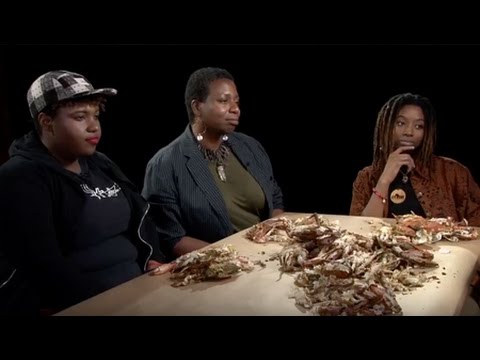
In the first episode of the Whole Bushel, Baltimore rapper Eze Jackson sits down with three local artists: singer Ama Chandra, rapper Ashley Sierra, and spoken word artist Neptune the Poet. They discuss the widespread disillusionment with electoral politics, the need for police accountability, and the distinction between White and Black feminism.
Story Transcript
EZE JACKSON: Hello. Welcome to the Whole Bushel. I’m your host, Eze Jackson. The Whole Bushel is an artist interview show, where we sit down with performing artists to discuss issues that matter to them the most. All while eating crabs the way we do here in Baltimore, Maryland. This week, I’m pleased to be joined by three amazing women: rapper Ashley Sierra is in the building, singer-songwriter and activist Ama Chandra, and spoken-word artist, poet and altogether amazing performer, Neptune the Poet. How y’all doing? AMA CHANDRA: Good. Good. Great crowd. EZE JACKSON: Yeah, right? WOMEN: Great. It’s going great. EZE JACKSON: Cool. Yeah, so we are sitting in a post… almost post-Obama America right now. We just had Donald Trump win the election. And, you know, a very popular presidential race with, what would have been the first female president, Hillary Clinton. How do y’all feel about it, you know, what’s going through your minds right now as women in America, first and foremost? Does it have any impact at all? ASHLEY SIERRA: It’s politics as usual. EZE JACKSON: Politics as usual. ASHLEY SIERRA: Politics as usual, to be honest. I mean, like, it’s… as disappointing as it was to see him take the White House, and I would’ve been just as disappointed her having it. I don’t feel like, there’s ever going to be a change, as long as that’s the go-to. You know what I mean? Republican, Democrat, it’s all two sides to the same coin. They all do the same thing in different ways that keep people oppressed, whoever you be, inner city, black or wherever you… out in the country, white, you know what I mean? We all go through some of the same struggles in certain ways as far as, like, financially and things of that nature. But they just want a way to keep… I don’t know, approve of either one of them, but this is real shitty that he’s there. EZE JACKSON: Did you vote? ASHLEY SIERRA: Yeah, I voted, most definitely. EZE JACKSON: Who’d you vote for, if you don’t mind me asking? ASHLEY SIERRA: Jill Stein. EZE JACKSON: You voted for Jill Stein? AMA CHANDRA: Mm-hmm. EZE JACKSON: Okay. AMA CHANDRA: Well, me, when I looked at it, it was really… it’s just information, information for the work that I’m already doing. Like, you know, I was already one of those people who knew that no matter what happened, we just had to keep going. Because everything I’m thinking about is local, and ground up. Just… I just know that that’s how we gotta build, but when I look at it, the thing that got me is all the people who didn’t vote. Not just, like, the people around us, but just countrywide. I said that’s because, you know, we’re not speaking to the… the people aren’t inspired. Yeah, and the people… we’re inspiring things, but folks aren’t inspired. We talk about… they talked about the Obama effect? It is a real Trump effect. And I don’t think that it was a situation of just, “hate”. It was about people wanting their needs met. Everybody’s got needs. Everybody’s got a desire, and a lot of times people can’t see other people’s stuff. So, I’m like, “Oh…” So, now that… it gives me a chance to say, “So, what does get you?” Because in the end I want them too, I want them too, for the world that I want. I want a world that includes everybody, which means, what do you need? And if we take care of your needs, my needs, all our needs are going to get met, too. But for me, it’s just… it just focused me, it really focused me back in my own work, you know. And why it was important. And I think it also galvanized the people. It shook people… EZE JACKSON: Yeah. AMA CHANDRA: …into… “Oh, we can really… this is really time. This is all we got.” Right? EZE JACKSON: I think there is a different kind of urgency right now, particularly in a progressive and liberal movement. You know, as a result that we can’t just… well, one is the Democratic Party, I think, has learned the lesson that we just can’t… they just can’t throw anybody to us. You know what I mean? But it just, even on the ground, you know, organize and make change, your thoughts? NEPTUNE THE POET: I don’t really feel like it was a surprise to me. You know, everybody has to play their part in society, and too many times we look outside of us, you know, to find solutions. And a lot of times the solutions that you need, are things that you can do with yourself. If I see trash in my neighborhood, I’m going to pick it up. You know what I’m saying? I live in Cherry Hill. We don’t have lines in the middle of our streets, a divided street, but it’s three schools around us. You know what I’m saying? If people fly down these streets… so, am I going to call 311 to say, like, “Hey, y’all need to come put some dividers on these streets and, like, at least create a path on the sidewalk so the kids can walk.” Like, those are just things that I can do myself. So, I… honestly, I don’t really care about… EZE JACKSON: Well, that’s interesting, because that’s one of the things that I’ve been talking a lot with my friends, in my circle about, is paying more attention to what’s going on locally. WOMEN: Mm-hmm. EZE JACKSON: And in Baltimore right now, we’ve got a particularly interesting situation. In that we have eight new city council members that have been elected. And we have a new mayor, the third female mayor this city has had. Catherine Pugh, long time Senator, she ran against Josh Harris who was a Green Party candidate, and most viable Green Party candidate I’ve ever seen running for office… WOMEN: Yeah… EZE JACKSON: …but the work that has to be done, is more local and I think… I wonder sometimes if it’s an intentional distraction that all we see on TV, is Donald Trump and Hillary Clinton. When in all actuality the real power is, knowing who your city council person is. So you can call them and get those lines put in the street. How do you feel about Baltimore, and have y’all been paying attention to that race at all, the political…? AMA CHANDRA: Oh, yeah. Like, I think you can’t… I think all of us are recognizing the same thing. Like, I don’t think that it’s any one person waking up to this knowledge. I think we all are, and we’re all operating from very similar places, which is why we’re able to make these connections. But the local everything, everything that I’ve been working to do, is around recognizing the orbits we create. We’re creating very powerful, intentional — like you say, if certain things are happening intentionally in other areas, they definitely are. Like, I do believe that they were structured to get exactly what has been gotten. So that… because they had a plan and they worked the plan. But a lot of people’s plans might be for themselves, for their vision for their life. But oftentimes they don’t go out into their vision for their community and to… and… Or, it comes from a place of self-defeat. “Oh, we ain’t goin’ ever do that. Oh, you already know, nobody, nobody, nobody…” A lot of the work that I’m recognizing now, I’m really excited about, in terms of the local. Is just the whole idea of re-establishing the community, when we just talk to each other. Like getting back to the, validating your humanity just by speaking to you. I see it, and like, we always… in my community, you speak when you walk in the room, right? EZE JACKSON: Mm-hmm. AMA CHANDRA: We speak when somebody going, something… when Momma, Babba, get on the bus, and they say, “How everybody doin’?” Everybody sit up and say, “We fine…” We… we speak! EZE JACKSON: Mm-hmm. AMA CHANDRA: That’s a part of the validating of each other. (music begins) AMA CHANDRA: (singing) Mmm… As you walk along your path You may find seeds of self-doubt Springing forth from your fertile mind You must weed them out sometimes The sights that you will see in con-confusion A sense of disillusion You can’t put your finger on it Trust that… believe in love ‘Cause all you’ll ever need Please trust and believe in love I promise you’ll make it through But please keep trusting and believing in love It will meet you on the other side Keep on trusting and believing in love As you walk along your path You may find seeds of self-doubt Springing… (music fades) EZE JACKSON: Does it make a difference to you, that you may, owe your president, as a woman? AMA CHANDRA: It could. Depending on the person. If I felt like it were a more quality person. And when I speak quality, I’m talking about… and I want to make sure you got what you hear from… you know, I want to keep my — up for me — the idea around who you stand for as a person and do you stand for me? EZE JACKSON: Mmm. AMA CHANDRA: And I don’t know that I saw Hillary as someone who stood for me. Now, I don’t know… I know I did not see her as someone who stood for me, and people like me. And that was way beyond just the story of being a black woman. But her privilege around her social status, and what life looks like for her. You know? Josh? If I could’ve voted for Josh, because I live… you know they do something crazy in Baltimore. If you live in Mount Washington, which is still considered Baltimore City, right where I stay at, we don’t get to vote for the mayor. EZE JACKSON: You’re cut out of the city lines… AMA CHANDRA: But we’re considered city. We’ll talk about that later. It’s very… I just found that out, because I just moved out there. First time I voted. And I was, like, so I don’t… EZE JACKSON: Ashley, what are your thoughts? ASHLEY SIERRA: I don’t look at it like, whether it’s a man or if it’s a woman. But I look at the character of the person, definitely, that’s going to be in office. Right now, I can’t sit here and say that I have a whole bunch of faith in the consistent system that we do elect. I would’ve loved to see Joshua Harris in office, and I feel like, you know with time, we can see him or somebody else get in office. But that’s going to take us, as a community, reaching out to each other and re-educating each other. EZE JACKSON: Yeah. Because a lot of people we hear, didn’t even know about the Green Party. NEPTUNE THE POET: Yeah, but that’s even strategic in how that was set up, because Josh was cut out of a lot of debates. They didn’t give him the opportunity to speak. Like, when they had all of them… the elects come in, like, you know what I’m saying? Sit down and talk, or debate. Josh wasn’t invited to those things, which, you know what I’m saying? In my opinion is messed up, because this is somebody who’s… he’s showing he’s out here for the people. Like, he will come to open mics, you know? And it’s like, yo, why can’t he get the same opportunity and same platform as everybody else? You know, like that’s just… I just wanted to piggy-back on that, ’cause Josh is my man. AMA CHANDRA: I think it’s the evolution of… because I think it’s going to come back around. Like, there’s just a momentum. Like, he got… There was more traction, more things; it was like, “Okay. Now let’s build on it.” Like, you know, that this is the time where all those people who had become engaged, how do we keep them engaged and not lose hope, so that we can keep that. EZE JACKSON: And this is a very interesting discussion, because we saw nationally, that the way the presidential candidates were presented to us was, like, “Hey, look! Women, we have this opportunity to elect our first woman president, and you should do this because she’s a woman.” But at the same time, we’re looking at Baltimore, where this is our third female mayor, you know what I mean? One was convicted… one we found was stealing gift cards from the homeless; you know what I’m saying? Then we had another one and Stephanie Rawlings-Blake who, you know, during the Freddie Gray trial stood up in front of the world and called our children thugs, you know what I’m saying? And just countless other violations to the people of Baltimore, which shows that… this conversation and what you just said is indicative of, like, it doesn’t matter if the person is a female or male or black or white or, you know what I’m saying? Or whatever. It’s, like, can you connect with the people? AMA CHANDRA: Right. EZE JACKSON: I’m going to read something here. It’s a quote from Audrey Lorde. She said, “I am a black feminist. I mean, I recognize that my power as well as my primary impressions, come as a result of my blackness, as well as my woman-ness. And therefore my struggles on both of these fronts are inseparable.” There’s been a lot of discussion lately around white feminism versus black feminism. Where do y’all stand? How do you feel about it? Neptune? NEPTUNE THE POET: First of all, I don’t even know the definition of feminist. So, I almost feel like I… I’m going to speak from my perspective, based on what I think. I feel like, with women in general, it’s almost like I don’t… I don’t really want there to be like, a divide, in saying that black feminists versus white feminists. You know what I’m saying? Not that I don’t think that those terms matter, because they do. When you just think about, like what you were saying before, like privilege, like white women have different privileges than black women. But when it comes for standing up for women, just in general, I feel like the feminist movement isn’t something that I’ve really decided to explore. Because I feel like, beyond just wanting you know, equality as a human being. It’s like we already have so much other shit to worry about. EZE JACKSON: Yeah, how about it? NEPTUNE THE POET: You know what I’m saying? I’m about… It’s like, can I… black people don’t… we’re still fighting for our rights. So, I’m going to fight for, you know, women rights within this same struggle of trying to fight for my rights. Like just let me be, let me live. You know? So, I don’t… when it comes to, like, categorization on those social issues and stuff like that, it’s always something that I don’t really try to try it in too much, because it becomes complicated. Life is not supposed to be complicated. WOMEN: Mm… NEPTUNE THE POET: You know, we complicate… we complicate life with the things that we do. You know, which are only a result of our environment and our surroundings, but… EZE JACKSON: Ashley. ASHLEY SIERRA: It’s definitely like a separatism, when you speak on black feminism and white feminism, just because it’s different experiences culturally. We know that it’s a different story growing up being poor in America, as opposed to being black and poor in America. Like, it’s always going to be something different because of who we are. The opportunities that we don’t receive as black women are different from opportunities that white women would get ahold of. Like, even with the election, and it playing out with Hillary coming up. Like, it’s just like back in slavery times when black men were allowed to vote before white women were, and then after that it was white women. So, you know what I mean? With Hillary running, if you look at it it’s just like a set stage… EZE JACKSON: That’s just the same old thing. ASHLEY SIERRA: …you know what I’m saying? It’s just a play on the whole situation and that’s why everybody felt like she would be a shoe-in, and you didn’t see Bernie. And then all of a sudden, there’s a, “No, no, you gotta…” You know what I mean? You got to set up this way. EZE JACKSON: There was this energy around the election like it’s your turn… ASHLEY SIERRA: You felt it, too…! EZE JACKSON: …or it’s not your turn, you know what I mean? ASHLEY SIERRA: Right. EZE JACKSON: And it was like… it was, like, it’s her turn. Bernie, it’s not your turn. WOMEN: Mm-hmm. (laughing) EZE JACKSON: You know what I mean? It’s like… and it was, like, wait, I thought this was… ASHLEY SIERRA: Bernie got another chance, this one. EZE JACKSON: Right. I thought our vote counted. ASHLEY SIERRA: Right. (laughing) Before… AMA CHANDRA: Right outside, and in… Mm-hmm. ASHLEY SIERRA: That’s all it is. EZE JACKSON: Yeah. It’s… it is a circus. (rap song begins) ASHLEY SIERRA: (singing) Uh. Uh. Ya niggas got me fucked up Fat girl with the get-to lucked up I mean you always better in black I’m always sad on the scene And make sure that pressure Don’t crack ’em And now would he The hill you or kill you. We recognize really You lookin’ unfamiliar I’m know niggas from down the hill Back up to … To fill you … There’s niggas that’s raised On these corners with no … Bodies fill the streets … from police Or homicides from a nigga Killing niggas for cheap And see that mentality Is why we’ll never be free They just retrain you and cage you And watch you dance on the screen But shit, I ain’t afraid to talk about it It’s black and white Or it’s black and blue They wouldn’t have started dividing You pay your side You pay your rent But either way you flippin’ And then I cashed in on myself And now the world trippin’ They say we never gonna get it … just wait a minute … rapping continues… (end rap song) EZE JACKSON: So, Neptune, you got a piece that I really love, called Black Boy Blues, and it’s dedicated to your uncle who was murdered in 2012. NEPTUNE THE POET: Right. EZE JACKSON: Similar story to a lot of us that live in inner cities. You’re from northeast D.C. NEPTUNE THE POET: Mm-hmm. EZE JACKSON: Can you tell me about that experience and just how it influenced the work you do? NEPTUNE THE POET: Yeah. I actually had two uncles that were killed. The second one was killed in 2012, and so that’s what kinda inspired Black Boy Blues. So, after my uncles were killed, I didn’t really write for a long time. Because I felt like I didn’t have… I don’t know. I didn’t have anything to talk about. It’s almost like when my second uncle was killed, I couldn’t believe it. It was, like, this is happening again, you know? EZE JACKSON: How was he killed? NEPTUNE THE POET: Oh, he was shot. Both my uncles were shot. One was shot by a black man, the other one was shot by a white man… and they’re both free. EZE JACKSON: Oh, wow. Are you serious? NEPTUNE THE POET: Yeah, both of their killers are actually free. And I mean… it really… it triggered me in a way that, I felt like it made me want to use my voice more, you know? Because, you know, my uncles were very creative men. They were both… one of my uncles was a drummer, a singer, and the other one played the piano. He really kinda did everything. They were both musicians. And, I don’t know. I felt like they… the type of energy that they put out was always contagious. Like, people loved them, you know? And it’s, like, I always want to be able to put out that same energy, but more than that. It’s like I want to be able to share my story because, like, now they don’t have voices to share their story. So, Black Boy Blues was really just kinda like a reflective piece, to say like, this is kinda what goes on with black men, you know. And it’s a reality to say, like, you can lose your life any way, you can be killed by somebody that’s white, you can be stopped by the police in their traffic stop or whatever goes wrong. Or you can just be walking down the street and get killed by somebody that looks just like you. But at the end of the day, it’s like, you know, you have to carry yourself to the highest that you can, and to be yourself. And as I was writing that piece, I realized that that story was synonymous with stories of so many black men, and black boys, and it was like I really just felt like, I had to put it out. When I first wrote it, I didn’t even plan to perform it. You know? It was just kinda like I felt like I needed to write that for me, and I read it to my little brother, and he just, like, broke down in tears. EZE JACKSON: Yeah, the first time I heard you do it, I was, like, wow, like, you know, you were speaking to me. So, I love that piece. It’s interesting how pain can bring out such powerful art. You know what I mean? It’s always like… it’s always — that’s my favorite thing about it, it’s our outlet, you know what I mean? Like, we go through these experiences and then other people get something from what we’ve gotten from that experience, you know? WOMEN: Mm-hmm. NEPTUNE THE POET: They are coming for you With no regards for your age or who is around They are coming Those hooded men now dressed in blue With their hearts filled with arrogance and guns Armed with the genocide 400-year-old hatred has never looked so obvious I have watched as they have paraded around Melanated communities like a vulture Over the dead, or a hunter to prey Or Klansmen to prey Or blue uniform over black body I have watched as they have publicized your demise Made it normal for us to watch your soul exit Your body, 41 shots, 16 shots, 6 shots Or one to the dome Black boy, you blues, too frequent And in this world you will lose your innocence before you gain understanding You will be made a target before you can even read Black boy I am starting to believe that the world wasn’t quite ready for you yet That this corrupt system has not made space for you yet They will create a monster or a drone out of you They will take your women, make you hate your women, and misdiagnose you with tests They’ll take your father and hang your dreams by the neck Put a ball in your hand and tell you to run until you have nothing left Make material things and money The only thing you believe equates to success Black boy They are dealing the cards and constantly serving you death You blues, too frequent And I understand why Your struggle isn’t to make trouble You just wanna survive and be a boy And have fun because that’s what boys do But in your situation you always have to watch your back You always have to watch your back You gotta watch your back ’cause someone is always coming for you And this shit is so fucked up that you Might get popped by a nigga that look just like you Yes, Black boys are the master’s puppets too Unaware of the bigger picture to the harm that they do This genocide has you number one on the list I mean, have you ever wondered why the odds seem to be against you? And do you honestly know of the target that you wear? ‘Cause when you smile, it’s like you know no suffering But your eyes, they tell a different story Perhaps your pride won’t allow us to see you sweat Perhaps you are stronger than they Or no, perhaps, those hooded men in faulty system ages Don’t know who they fuckin’ with Like, you ain’t seen that Nat Turner and Brother Malcolm And Harriet and Shakur and Angela and Garvey and Fred Like they tried to erase history from those that made history. Then they tried to erase history from those that made history? Black boy You wear victory on your skin Black boy You are the reason the caged bird sings Black boy You hold legacy in your genes Nefertiti in your eyes And God in your stride Black boy You are valuable Black boy You do matter Black boy You are king You are resilient You are the coolest motherfucker on the planet You are brown sugar dipped in gold You are their target But our hero And I want y’all to know that I love y’all This game that we are playing Is remote controlin’ our destiny You ask why? And the truth is It’s because the power struggle will X you out Before you get a chance But it is time to 360 our future We cannot play stationary games anymore with failure Contentment and mediocrity Because there is a certain intuition that is buried in your melanin And those that attempt to strip you of your life must be ignorant to the realization That we don’t die We multiply EZE JACKSON: All right. I want to close with this one. In Baltimore, a lot of people know, y’all may know, that the DOJ recently released a report, basically highlighting what we’ve known here in the city for a long time, that the Baltimore City Police Department has been racist and sexist for a long time. But in August, the Baltimore Sun wrote this: Justice Department investigators wrote that the Baltimore police persistently neglect to test rape kits, or gather forensic evidence. Were quick to disregard claims for sex workers, and failed to follow up on indications of serial suspects. In general, the investigators wrote, detectives made minimal to no effort to locate, identify, interrogate, or investigate suspects. We found this to be true, even in cases where the suspects have been identified, or were easily identifiable on the basis of the victim’s testimony, they wrote. Now, Ama Chandra, you just recently went through something pretty heavy. AMA CHANDRA: Mm-hmm. EZE JACKSON: And this was post-Freddie Gray. AMA CHANDRA: Yes. EZE JACKSON: What a lot of people may not know, is that here in Baltimore City, post-Freddie Gray, we saw a serious lack of policing happening all around. But I want you to talk about your experience in particular. AMA CHANDRA: Real simple, and it was all around Freddie Gray. I’d had some folks come through talking about it, and they left. They did it from California. Went to bed as usual, with my daughter, and victim… guy came in, didn’t know who he was, into my bedroom. And I had to employ everything that I know. Grateful that I have some things that I know, but in that process of waiting it out, of pleading, of submitting –- there was sexual assault involved in this thing –- of submitting to keep myself and my daughter safe, you know. Because I knew that death — he came in with my own kitchen knife, and when the fight… in the fighting of… in the fighting part of that whole process, I did run him out. I ran him out the house, grabbed the machete that I keep at the back of my bed. It wasn’t at the front of the bed, because I got a baby, but I didn’t… I hadn’t been working with knives personally at that time, to note how to keep it safe from her. EZE JACKSON: Right. AMA CHANDRA: But I had it at the end of my bed, but he passed it on the way in the room, but once I got him out and he started running, I grabbed that machete and I ran after him with that machete and ran him out of my house. And then I looked down and saw I was bleeding. EZE JACKSON: Oh, wow. AMA CHANDRA: And I was having a hard time breathing, and the knife, it went through my heart. Well, I’ve been stabbed in my chest, and I was having a hard time breathing. The police –- I called the police. I… I did everything in shock, try… and try, and kept my baby calm, while… it’s ’cause she woke up, you know, and I went into the hospital where I had to have open heart surgery. The knife… if it… They told me, we were millimeters from arteries, and I would not be here. I would not have been here, had it nicked one of my arteries. Because it went through the heart, I lived. It didn’t… it was squeezing my heart, but it gave me enough time for the doctors to repair it. EZE JACKSON: And this happened during a time, like we said, post-Freddie Gray. So, because of the riots and what was going on here in Baltimore City, in our communities, we saw police really pull back on… you know what I mean? They were hardly present, not responding to calls. Just, almost like making us pay for something that they did, because we were upset about it as the people of Baltimore. So, does that… how does that make you feel like, as a woman? Ashley, I want you to answer this. When you’re in the presence of police officers, or just in general, about the officers hired to serve and protect us? ASHLEY SIERRA: I think, like, the biggest problem, especially in our city. In that we all… a lot of people try to play out the good in it, and we say, you know, well, all cops aren’t bad, or this and that. And we say the whole apples in the barrel; it’s just a few spoiled apples. But no, it’s not just a few spoiled apples. What you got going on is a messed up barrel, and you need to restructure what you’re putting the apples in. You need to restructure the whole system. Policing, we all know what policing originally started from, it come from slave catching. NEPTUNE THE POET: Slave catchers… EZE JACKSON: Right. ASHLEY SIERRA: You know what I’m saying? And if you have a system that was automatically meant to keep certain groups of people down, and to oppress people, then what makes you think that they’re not going to do what the system already calls for them to do? Even when there are good officers? I’m not saying that there aren’t officers out here who uphold the law and who actually care about the people, and things of that nature. But the whole system just needed to be restructured. Anybody that’s uneasy around police, especially people of color, you have every right to be. And you know they don’t do anything to establish relationships in the communities anymore. That use… just like when they pulled back with that. You know, we Baltimoreans, so we grew up having power(?) centers and stuff like that. We used to go there and we used to know the officers that walked the beat in our neighborhood. You know what I’m saying? We knew them. And all of these things, you know, as time went on, it just became more about numbers. You gotta get a certain amount of people locked up, in this week and that time. You know what I mean? I got a brother right now doing time for something that he didn’t even do. Which is a waste; you know what I’m saying? Can’t get a court date. Constantly getting postponed. Like, we watch… you know what I mean? Black men go through this and… and… you know what I mean? Black women, too. So, if you’re uneasy about it, it’s because it’s a call for us as a people to start working on restructuring the system, and that’s not going to happen until, you know what I mean? We able to get people in office that’s willing to say, “You know what, y’all? All y’all need to be fired.” EZE JACKSON: Right. ASHLEY SIERRA: Like, you know what I mean? You gotta fire some people, and you gotta put people in who really deserve to be in these positions to make it right, for real. EZE JACKSON: Thank you. Yes… we can handle that. WOMEN: Mm-hmm. EZE JACKSON: Thanks for watching the Whole Bushel on The Real News Network. I’m your host, Eze Jackson. For past and future episodes, you can follow us on Facebook, as well as Therealnews.com. All right? Thanks y’all. Thanks a lot. WOMEN: You’re welcome… EZE JACKSON: Gotta get some more of these… AMA CHANDRA: I’m not going to eat it right now. EZE JACKSON: All right. Cool. You did that… AMA CHANDRA: (singing) You are, you are You are all right… ————————- END


