

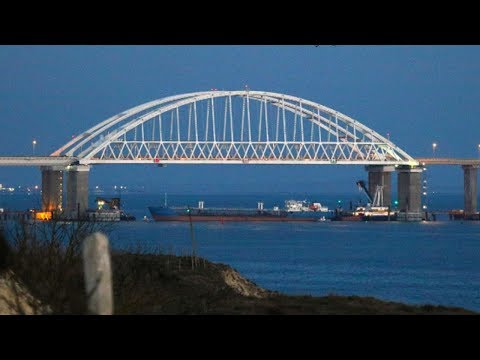
Col. Lawrence Wilkerson says that the latest Ukraine crisis, in which Russia is holding Ukrainian navy boats, was foreseeable and likely, given NATO’s constant encroachment on Russia’s border region
Story Transcript
GREG WILPERT: It’s The Real News Network, and I’m Greg Wilpert, coming to you from Baltimore.
On Sunday, Russian warships used a tanker to block Ukrainian navy ships in what Russia says were entering its territorial waters in the Kerch Strait, between the Black Sea and the Azov Sea. The Strait separates the Crimean peninsula from Russian mainland, and is a vital point of passage for Ukrainian ships crossing between the two seas. The Russian vessels opened fire and then seized three Ukrainian vessels. Two Ukrainian sailors were injured, and the Ukrainian Navy reports that the Russian ship rammed a tugboat that was helping the Ukrainian vessels navigate the strait. Both the U.N. Security Council and NATO called emergency meetings on Monday to discuss the crisis. Meanwhile, Ukrainian President Petro Poroshenko appealed to the Parliament of the Ukraine to grant him war powers, which would give him the authority to declare martial law, and possibly declare war on Russia. Here’s what he said.
PETRO POROSHENKO: Martial law is introduced in order to strengthen Ukraine’s defense capabilities amid increasing aggression, and according to international law, a cold act of aggression by the Russian Federation. Martial law does not mean our refusal to resolve the issue of liberating Ukrainian territory by political and diplomatic means. We intend to keep adhering to all international obligations.
GREG WILPERT: Joining me now to analyze this flareup in tensions between Russia and the Ukraine is Colonel Lawrence Wilkerson. He’s a retired U.S. Colonel and former chief of staff to Secretary of State Colin Powell. Currently he’s a distinguished professor at the College of William and Mary. Thanks for joining us again, Larry.
LARRY WILKERSON: Thanks for having me.
GREG WILPERT: The Ukraine is saying that Russia has no reason to hold its ships, and Russia is accusing the Ukraine of intentionally creating a provocation in order to draw NATO from what we know of what happened. Who seems to be in the more solid position here, legally speaking?
LARRY WILKERSON: Legally speaking I’m not quite sure, because there are a number of protocols that are at play here. On top of everything is the UN Convention on the Law of the Sea, and the designation of territorial waters and shelfs, economic zones and so forth. And the right, even though those things might intersect, to pass through what are called International Straits or international waters, no matter how narrow they may be. Then you’ve also got, underneath that, various protocols and agreements that have been made. In this case, I think there’s one between Russia and Ukraine. There are probably other agreements that impact on the Black Sea, which, as you know, the strait they were trying to pass through is to the north of, or the north side of.
So there are all kinds of international agreements and bilateral agreements about passage through this area. The legal aspects of it really, I think, would boil down to, in many respects, who has Crimea? Ukraine still claims Crimea. Russia now claims Crimea. And if they claim Crimea, then their territorial water, even with unclassed–with respect to unclassed, its definition of straights and so forth–then that territorial water, that is territorial water, even under [unclass], is Russian. If it’s Ukranian, it’s Ukrainian. The Russians are claiming it’s Russian and Ukrainian ships violated it. Ukrainians, I guess, are complaining or asserting the fact that they think it’s still Ukrainian, and so they didn’t violate anything.
But all of that, the legal aspects of it, really boil down–as Mao Zedong said, international law comes out the barrel of a gun. Who has the biggest gun? And in this case, Russia has the biggest gun. It’s also complicated by the fact that Poroshenko has elections coming up, I think, in March. And declaring martial law, what the heck does that have to do with naval affairs? Many suspect that he’s reading his polls and knowing that he’s in trouble, political trouble, and so he’s trying to start something that will help his political chances.
So you have so many different variables here that it’s hard to say who’s right and who’s wrong, except to say that you have to determine whether Russia is right about Ukraine, and ultimately about Crimea, or whether Ukraine is right about Ukraine. And since NATO and the European Union and the United States have been rather in the front of the foxhole claiming that Ukraine is right in many of these disputes, then you’ve got the recipe for real problem. You’ve got NATO’s ships, U.S. ships, other ships that might challenge Russia in these waters. And there again, though, power comes out of the barrel of a gun. Russia has the advantage because it’s operating on interior lines from this area, very close to its own homeland, close to its ports in Crimea. And the United States or NATO would be operating, in the case of NATO, at quite a distance from the United States, quite a distance from its home water.
So this is just another incident in Putin’s ability to poke his fingers in the eyes of NATO, and the United States in particular, since the United States and NATO started encroaching on his near abroad.
GREG WILPERT: Right. Actually, that’s something I was going to ask as well, is the extent to which this might be also driven by domestic politics within Russia. Clearly something’s happening within the Ukraine in terms of the elections and the fact that, as you mentioned, that Poroshenko is behind in the polls. But Putin’s own popularity might be being impacted right now due to a declining economic situation. So I’m just wondering, what role do you think that those domestic factors within Russia might be at play, that this might be a way for him to recuperate some of his own popularity?
LARRY WILKERSON: Well, no question about it. We say domestic politics drives most of Donald Trump’s decision making. And I think that’s a correct interpretation. It also has an impact on people like Poroshenko and Putin. And the plunge in oil prices, my goodness. I looked at a sign this morning, it was $2.19. I never thought I’d see that price again here in Williamsburg. The plunge in oil prices, the benchmarks, has probably hurt Russia pretty badly. They are, as one person said to me recently, a gas station with a capital in Moscow. So Putin, if he’s sinking in the polls, this would be something for him to do that has worked for him in the past. Stick your fingers in Ukraine, which by extension is sticking your fingers in the U.S.’s eyes, and you get a bump in the polls. I wouldn’t put it past him at all.
GREG WILPERT: Now, in 2014, Russia held a referendum in Crimea and ended up annexing the peninsula after it said that 97 percent of the population voted to join Russia. Now, looking at the Kerch Strait between Crimea and Russia, which Ukraine needs in order to access its southeastern coast from the Black Sea, wasn’t such a crisis inevitable sooner or later?
LARRY WILKERSON: Oh, it was. And we have had a number of incidents where a Russian patrol craft, FSB or otherwise, Navy, had come out and challenged Ukrainian ships in accordance with, they said, the agreement that they saw. And they actually, as I understand it, boarded some of these ships and searched them, and caused them commercial damage, if you will, because they held them up so long; didn’t let them get under way for a long period of time. So this is, this has been working up to this more dramatic confrontation that we have now, I think, for some time. And it’s the tit for tat game that Putin is playing with Kiev, and in essence that NATO, the EU, and the United States are playing with Moscow. Ukraine is Ukraine, and it is going to be a member of NATO and a member of the EU. And Moscow says over, over our prostrate body will the whole country of Ukraine–and we’ve taken Crimea, thank you very much, and have invested with little green men and other things in much of Eastern Ukraine. So over my prostate body will that happen.
And Putin has, as I said, the interior lines. It’s much easier for him to operate than it is for NATO or the United States to operate. And as long as that situation exists he’s going to continue to test this. He’s not the equal of us in combination, but he is in a position to test us all the time, and he’s become brilliant at it. He goes into a fissure here, a fissure there, a crack here, a crack there. And if he’s challenged resolutely, he just kind of holds what he’s got or he backs up a little bit. But if he finds more mobility he widens it, deepens it, and exploits it; Syria being a perfect example. And Syria being almost to the point where it’s exterior lines for him.
LARRY WILKERSON: So I have to admire the guy for the brilliance with which he does this, and then, as you said, he turns it into domestic political gain.
GREG WILPERT: But now turning, actually, to the West, the conflict between pro-Russian separatists and pro-European government in the Ukraine has been all about an international conflict already, with constant intervention from NATO, as well as from Russia. Now, NATO Secretary General Jens Stoltenberg issued a declaration, actually, where he declared, quote, full support for Ukraine’s territorial integrity and sovereignty. However, the Ukraine is not yet part of NATO, and thus there’s no obligation to defend the Ukraine. But Stoltenberg’s statement makes it sound like NATO would do just that, defend the Ukraine should a conflict escalate. Now, what do you think? Is that a wise position for the West to take, considering the potential for escalation and outright war?
LARRY WILKERSON: Well, I don’t think it’s been a wise position for the West, quote-unquote, to take, the United States leading the way. But it’s pushed itself and its alliance, NATO, so close to Russia’s borders–I mean, incorporating former Warsaw Pact members into NATO. Putin’s reactions in that regard are perfectly understandable. I’m not saying that the United States and NATO shouldn’t take measures to defend themselves. But why does that include taking over for alliance purposes, now? Commercial purposes, the EU, the common market, so forth and so on, that’s another deal. But taking them over for alliance purposes–we forget. It’s a political alliance, surely. But it’s also a military alliance, and that’s the way Moscow has to look at it.
So their military exercises since about 2013 have been postulated on a NATO invasion of the near abroad, and even a NATO invasion of Russia proper. So this is the way they do their military exercises. Clearly they’re not doing that because they think spending all that money on that preposterous possible situation is just that: preposterous. They think it’s a probability, or at least a possibility.
So we’re giving them the incentive to do this. And to fight over Ukraine–you remember the old expression “Who would die for Danzig?” I keep asking myself, if Americans really were asked to fulfill Article 5 of the NATO treaty for a place like Tbilisi, or even a place like Riga, or any of those countries we’ve now expanded NATO into or proposed expanding NATO into, like Ukraine, what would Americans say when they were told that full conscription was in process, full mobilization was in process, war taxes are going to be levied, and we’re going to war for a city you can’t even pronounce and couldn’t find on a map? That’s what we’re talking about. And oh, by the way, Russia is generally speaking cheek and jowl with that city, whereas we’re ten thousand miles away.
GREG WILPERT: All right. Well, we’re going to leave it there for now. I was speaking to Larry Wilkerson, Distinguished Professor at the College of William and Mary. Thanks again, Larry, for having joined us today.
LARRY WILKERSON: Thanks for having me on.
GREG WILPERT: And thank you for joining The Real News Network. If you like Real News Network stories such as this one, please keep in mind that we’ve started our winter fundraiser and need your help to reach our goal of raising $400,000. Every dollar that you donate will be matched. Unlike practically all other news outlets, we do not accept support from governments or corporations. Please do what you can today.


