

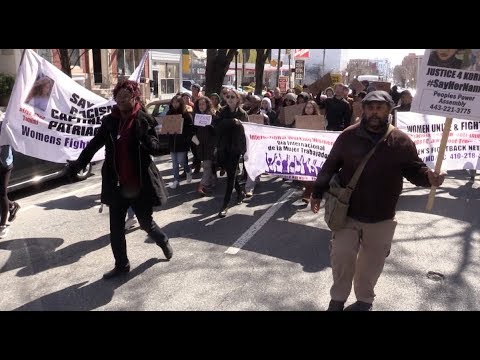
Marchers in Baltimore gathered in solidarity for wage equality, gender empowerment, and more attention to the needs of women around the world
Story Transcript
PROTEST CROWD: We will win. No cops. No KKK. No fascist USA. No cops. No KKK. No fascist USA. No cops. No KKK. No fascist USA.
TAYA GRAHAM: Today in Baltimore, we have the International Women Workers’ March where women are marching, and men, for gender equity and fair pay and a $15 an hour minimum wage at Baltimore City.
MIRANDA BACHMAN: So, the goals of International Working Women’s Day are liberation for all oppressed women and nonbinary people. The day has its roots in socialist struggles starting around the 20th century. It was the first revolution, actually, in February of 1917 in Russia. Women textile workers in a factory, thousands of them basically rebelled and there were strikes and this has been a really powerful movement of women and nonbinary people revolting against fascist, imperialist states.
ABIGAIL JOHNSON: To me, I think International Women’s Day is the one day a year where we can celebrate the socialist movement of women for the equality of classes among women and to bring up women and oppressed genders who suffer under class struggle more so than non oppressed genders. So, I think that’s really what this day is about, is pulling these people up and standing in solidarity with them.
PROTEST CROWD: If we don’t get it, shut it down. If we don’t get it, shut it down. If we don’t get it, shut it down.
TAKIYAH THOMPSON: This bourgeois media apparatus and the bourgeois schools would have us believe that we’ve always been relegated to a secondary role, as if we’ve always been communities that are acted upon but never agents, and I think folks are starting to see through all the lies.
RO: My family’s from India so I’m pretty well versed, I think, in the history of abuse of women across country borders and I feel that this is something that everybody should care about and I think a lot of times feminism is centered here, in America. And I think that it’s important to recognize it everywhere in the world.
PROTEST CROWD: Hey, hey, ho, ho, the BPD has got to go. Hey, hey, ho, ho, the BPD has got to go. Hey, hey, ho, ho, the BPD has got to go.
ABIGAIL JOHNSON: Obviously, McDonald’s and other commercial enterprises like that are only interested in making money. They don’t care about the women who work for them, if they did, they would be paying them a living minimum wage, they would be giving them healthcare, they would be providing daycare services if they have children. And these companies, I mean, through their actions, because they don’t do these things, it’s clear that they actually don’t care about women, so they can flip their M upside for women all they want, that doesn’t help women of color, or queer women, or single mothers in any way.
ALEC SUMMERFILE: So, we see that keep happening. We see radical movements take a stand on anissue and then corporations, because being woke is cool now, or hip, corporations take advantage of that to make money and I really don’t care what McDonald’s does because they exploit their workers and their an evil corporation.
TAKIYAH THOMPSON: I think black folks and LGBTQ youth are standing up because it’s been too long and I think when we have a historical perspective, when we understand history, the folks who have always been leading us in the fight have been black folks, women, LGBTQ, folks like Sylvia Rivera, standing up for trans rights. When we can activate all sectors of the black community, we can really have a push towards liberation and I think that’s a really important.


