

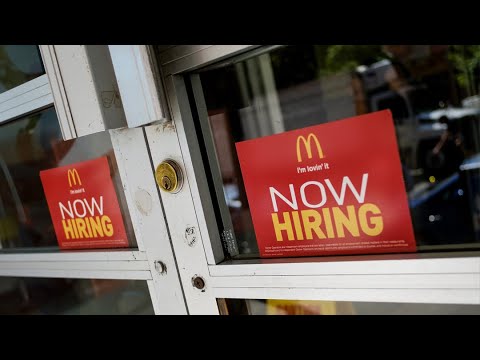
Beneath the rosy employment report lives a reality of low-paying part-time and temporary work with no benefits or security.
Story Transcript
MARC STEINER: Welcome to The Real News. I’m Marc Steiner. Good to have you all with this.
Now, the unemployment rate is at its lowest point in 50 years. Folks are shouting it from the rooftops; The White House rooftops, that is.
DONALD TRUMP: We’ve had tremendous reports coming out on the economy. It’s been incredible, and numbers like we haven’t seen before, and we have the strongest economy in the world, 266,000 jobs. You can add another 40 to that. We’re the envy of the world. Our economy is the envy of the world. We’re going to keep it that way.
MARC STEINER: Okay. So despite the narcissistic antics we just witnessed, what are the numbers really telling us? Inside of those unemployment numbers is a stark reality, that 44% of American workers live or get less than $18,000 a year, more or less. If you’re not one of those workers, let that sink in for just a minute. How do you live on that? Even if two of you are working, and say you have a kid or two, how does that work? Then there’s the gig economy, where the full-time work is not often the case, and workers who would have been counted as unemployed had they not had this temporary work, are now counted as employed. Let’s take a deeper dive into this reality. What are the human and economic realities behind these employment numbers? What do they really mean?
We’re about to talk once again here, Real News, with Dr. Richard Wolff, who is a former Professor of Economics Emeritus at the University of Massachusetts Amherst and is currently a visiting professor in the graduate program of International Affairs at the New School University in New York. His latest book is Capitalism’s Crisis Deepens. Richard, welcome. Good to have you with us.
RICHARD WOLFF: Thanks. Glad to be here.
MARC STEINER: Let’s just begin. What are these? What does the 44% really mean when you see 44% of American workers making $18,000 or less a year and we’re crowing about full employment. Let’s talk about the reality of what American citizens actually face in this economy, this full employment economy.
RICHARD WOLFF: Well, to analyze an economy or even to analyze employment and unemployment in an economy is a little bit like going to the doctor and asking the doctor to analyze your health. If the doctor simply put a thermometer in your mouth and said, “Well, you’ve got 98.6. You’re wonderful. You’re in healthy shape.”, you’d quickly find another doctor because you never point to one or two indices to determine someone’s health. You do a whole battery of tests. You do x-rays and blood tests and all of that. It’s the same with an economy. What Mr. Trump is doing is pointing to one of the very few statistics that look good, and that does look good.
A low unemployment rate is a good thing, but you have to look at other variables, and you’ve yourself just pointed to some of them. It’s one thing to be employed. It’s better than unemployed, but suppose you’re making $10 or $20 or $25,000 a year in today’s economy, you’re a poor person. We count you as a poor person, because the quality of life you can enjoy on that basis is pinched in every way. You can’t promise your children the American dream because you’re not earning it. We now actually have a measure. If Mr. Trump were honest, he would tell us that measure. It’s called the Job Quality Index; it’s prepared at Cornell University by a battery of specialists who study this. And they show, over the last 10 or 15 years, a steady decline in what they call the quality of the job.
Here’s what it means: it pays less than it used to, it has fewer benefits to go along with it than it used to, and it is much less secure than it used to be. Which means you have temporary layoffs, you have odd hours, you often don’t know when you’re going to work, and exactly what you’re going to get paid, for doing exactly what. All of those things are now worse than they were before. Mr. Trump can’t mention it because it gives a whole new dimension to what he wants, which is to push one of the only statistics that he can point to that isn’t in fact, quite grim. It is sleazy politics, and he’s a practitioner of nothing less.
MARC STEINER: And there’s the reality here also… I was reading an article in Axios, some articles about the gig economy and how we don’t take this into account in terms of what these mean for employment, unemployment. So many people in that economy, A) are making low wages. B) they are working part time or they’re temporary workers. Yet, it’s distorted. People are writing how this distorts the actual employment numbers because our economy is changing in the 21st century and we’re still using 20th century definitions.
RICHARD WOLFF: Yeah. But here’s what’s not changing: the desire of employers to get workers at the lowest possible cost, the whole shift from a regularly employed worker to the so-called gig economy or the sharing economy, and there are other fancy phrases. Those are nasty kinds of euphemisms. The truth of it is, if you’re a contract worker, then you don’t have to be given the benefits that regular employees are entitled to. You don’t have to be given the steady work that they’re entitled to. You become more and more at the beck and call of the employer. That’s good for the employer, who can make sure not to pay you unless they are actually getting exactly what they want from you. But it’s not good for the worker, which is why workers fought for so long in American history to have precisely the job protections that the gig economy gets the employer out of.
So yes, it not only disguises unemployment as if it were employment, but it is a part of the deterioration of the American economy. Look, working people don’t just want a job instead of unemployment. That’s like saying they would like to have a crust of bread rather than nothing. Yes, that’s true. But the American working class would like to be able to have a decent life, a healthy life, and give decent education to their children and all the rest. That is being taken away from them, which is part of why you get the anger and the bitterness that is so obvious across the political spectrum.
MARC STEINER: It pushes people right or left, or just staunchly in the middle of just backing away, not having anything to do with it at all because people are so frustrated and angry about what they face day to day.
RICHARD WOLFF: Right. It’s important that these statistics be examined because it shows that that reaction of people, even if we disagree with it, is very understandable given the deterioration in both their own situation and that facing their children that they’re forced to confront every day.
MARC STEINER: We see that wage growth is stagnating. It’s not rising with these employment rates. That’s clear.
RICHARD WOLFF: Yes. It’s amazing. In the past we used to teach in economics that if the labor market gets very tight, that is unemployment is low, well, it gives a bargaining chip to the worker. It isn’t so easy for an employer to find someone else. So the worker, the theory goes, is in a better position to get a higher wage for himself or herself. That’s a very lovely story, but it doesn’t take into account where we are right now. We are in the 10th year after the second worst crash of capitalism in the system’s history. The worst was the 1930s, and 2008 is the second worst. What’s happened now is that people have run out of all of the backstop that they had after that crash.
They’ve run out of their unemployment compensation. If the family, they are part of had some savings, they’ve run out of those. They’ve tapped their friends and relatives for loans. They’ve come to the end of the line, and they’re so desperate now, they’ll take any job. That’s why the unemployment is low, because you’ve converted a large part of our working class into literal desperadoes who are in the position of taking a job with few benefits, no security, and crappy wages.
MARC STEINER: Let me ask you this one final question here, especially in terms of the books you’ve written and things you’ve been talking about for years. I mean, as a political economist, what does this say to the people of America? What does it say to the working class people of this country, when this is reality? How would you describe it in not simple ways but in easily understood ways?
RICHARD WOLFF: I think this is the way capitalism works, and I think that’s what I would explain to them. Capitalism is a system in which the capitalist goes where the profits are the highest. Capitalists have decided that the way to do that is in part to leave the United States, which has taken millions of jobs and moved them to China or India or Brazil and places like that. Number two, to replace American workers with desperate immigrants, which we’ve been doing for a long time, who bring down the level of wages, even though they work very hard. It’s precisely that they work hard and accept low wages that is another assault on the American standard of living. Finally, and the most important, a wave of automation, of replacing workers with computers, with robots, now with artificial intelligence. It’s a massive assault on the American working class from the all three of those things I’ve just described.
The American working class, without knowing the details, has a deep and correct feeling that they’re being undermined, that the system is literally abandoning them. Part of the support for Mr. Trump has nothing to do with his particular policies, which by the way solve nothing. But with the bravado and the boasting, there is a sense that he’s mad too, and they feel some kinship because the conventional Republicans and Democrats have so far pretended none of this is going on and none of this merits a feeling, let alone action to do something about it.
MARC STEINER: Yeah. I think about the… I was reading a stat today about how of the 3.9 million Uber drivers around the world, 1.3 million of those were in the United States. When you think about a million people plus people that depend on them are working for Uber. I mean, that says a lot about who our economy is and where it’s going and where it’s not going.
RICHARD WOLFF: Exactly, exactly. A desperate effort. I have, by the way, students of mine in the university, who the only way that they can pay the school fees, given the conditions of their families, is to be Uber or Lyft or one of these other drivers because they can squeeze in a ridiculous number of hours, often in the middle of the night when they’re not going to classes or preparing their homework. You know, it’s not safe. It’s not good for them. It is a strange way of organizing your educational system. It hampers their education. It is an irrationality piled up on other irrationalities, but it’s a sign and a symptom of a declining economy.
MARC STEINER: Richard Wolff, it’s always been a pleasure to have you here on The Real News. I look forward to many more conversations. We’re going to really be focusing a lot on what this economy really means and how it works. I’ll be looking forward to that and more conversations with Richard Wolff. Richard, thanks so much for joining us.
RICHARD WOLFF: My pleasure, and thanks to you for going into this important material.
MARC STEINER: I’m Marc Steiner here for The Real News Network. Good to have you all with us. Let us know what you think. More is coming. Take care.
Studio: Cameron Granadino, Will Arenas
Production: Genevieve Montinar, Will Arenas, Andrew Corkery


