

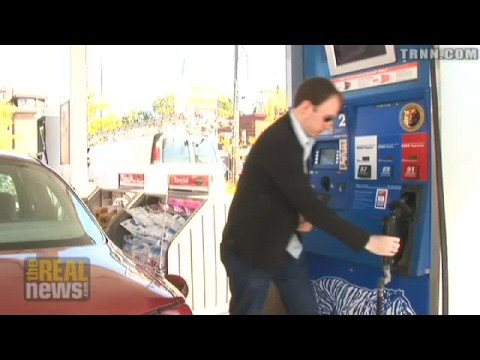
As Canadians get ready to go the polls on October 14, more than 230 academic economists have signed an open letter to the leaders of the federal political parties, urging them to acknowledge that putting a price on carbon is “the best approach” to combatting climate change.
Story Transcript
Canadian economists back carbon tax
Producer: Zaa Nkweta
ZAA NKWETA (VOICEOVER), TRNN: As Canadians get ready to go to the polls on October 14, more than 230 academic economists have signed an open letter to the leaders of the federal political parties, urging them to acknowledge that putting a price on carbon is the best approach to combating climate change. The Real News spoke to one of the originators of the letter, Professor Ross Finnie from the University of Ottawa.
PROF. ROSS FINNIE, UNIV. OF OTTAWA: —in the early portion of the election there was just so much misinformation going out there about the environment in general, climate change, and the policies that were being bandied about—carbon tax, cap and trade, regulation. There just seemed to be a lot of confusion, and people just didn’t really understand what the questions were, what the issues were. And most importantly, perhaps, they didn’t seem to have a good grasp of the basic economic principles that are relevant to thinking about this problem and, most importantly, thinking about the solution. The issues that need to be addressed are founded first of all in the fact that there’s a classic economic problem here, what is called an externality, where the market actually fails, in our jargon, because it doesn’t get you the right result, that problem being is that when people in their individual behavior don’t take the effects of their actions on the environment into account as much as they should. So when I drive my car I’m actually creating pollution, burning carbon, and I don’t necessarily take into account that effect on everyone else when I drive my car. So it’s an external effect, and it leads to overuse of the environment, degradation of the environment. What we need to do, since there’s this problem that people aren’t really taking the environment, the effects of their action on the environment sufficiently into account, we have to do something to change their behavior. And as economists, our favorite tool in our toolkit is prices, ’cause people will respond to prices. So the simple idea is that by putting a price on carbon, and that price going up, people will then look at the price of carbon, they’ll react, they’ll use less, they’ll burn less fuel, that sort of thing, and thus their behavior will change in the way that it has to change. People will change their consumption patterns, and businesses will change how they produce things, right down the line, up and down. Once the pollution, the carbon activity is taxed, people adjust their behavior, and that’s exactly what we need. A carbon tax, in the most straightforward way that’s most apparent, it just adds to the price. [To,] let’s say, a liter of gasoline we’ll add an extra two cents or a nickel or 20 cents or 50 cents on it, and that’ll be the carbon tax. A cap and trade works the other way around. You determine how much pollution or carbon will be released. You put that quantity, and then you basically say, okay, this is how many units of pollution are allowed, and then you sell those units, you auction them off. And so as people want to use their carbon in their activity—let’s say Ontario Hydro wants to produce energy, so they have to buy the right to do what they’re doing because of the pollution—that too will set a price. So the difference there is that on the cap and trade you set the quantity and let the price be determined in the market. Any effective environmental policy will have an effect on consumers. What it will do—and this is a necessity because we have to change the behavior—it’ll increase the price of carbon-intensive goods. So you’ll pay more for gasoline; you’ll pay more for heating oil; you’ll pay more for those sorts of things. But this is absolutely necessary. That’s what we need to change people’s behavior. But with a carbon tax and with a cap and trade, as long as the allowances are auctioned by the government, that brings in revenue, and you can turn around and give all that revenue back to businesses and families. So your average business and your average family is not necessarily any worse off in net terms with the imposition of the tax or the cap and trade and the associated tax decreases they get on the other side. And, in fact, it’s more than that is that that allows us to reduce some of the taxes that are most damaging to the economy. So, for example, an income tax: income tax gets in the way of people working, being productive. So we can tax their cars, then, but to give them a tax break on their income tax, not only does it leave them compensated for, but it will also result in positive—if it’s done right—a more efficient economy, greater wealth. Now, who wins and who loses? There are winners and losers. If you’re a big carbon user and you don’t change your ways, you’ll lose. But that’s the way it should be. If you’re a low carbon user or you manage to reduce your carbon use beyond the average, below the average, then you’ll be a winner, you’ll actually be a net gainer by this sort of shift.
DISCLAIMER:
Please note that TRNN transcripts are typed from a recording of the program; The Real News Network cannot guarantee their complete accuracy.


