

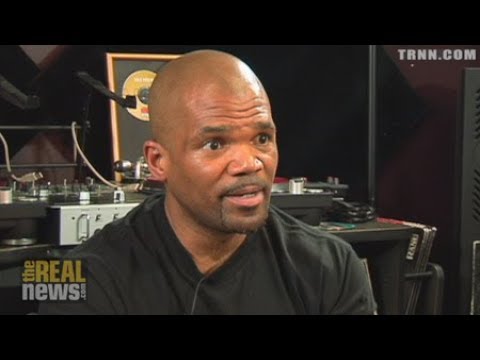
In a series of groundbreaking interviews produced by TRNN, Chuck D interviews fellow rap artists DMC and Joost about politics, the economy and their music while bringing African American history and music into context. Together we explore the current state of rap music and its societal impact.
Story Transcript
CHUCK D, RAPTAVIST, MEMBER OF PUBLIC ENEMY: Chuck D for The Real News Network. This is On The Real Off The Record. Hey, I really—you know, I could be speechless because there’s so much to say about this brother who’s an icon, you know, my idol. He’s just, like, one of the greatest MCs to ever touch the microphone. And since we’re in a time and a day where people kind of look at hip hop icons or they look at the hip hop art form as being the art form around the whole entire planet, you would be remiss to not even think that Run-D.M.C. is the reason that we’re all here. It’s the reason I’m here. And I’d like to, you know, just tell you that D.M.C. is in the house, my brother.
D.M.C.: Yeah, it’s the only place to be, Chuck D.
CHUCK D: D.M.C. in the place to be. In this time and day, you know, President Barack Obama asking for accountability and responsibility, and people looking at hip hop and rap music as being this great communicator—.
~~~
Music Clip: Public Enemy, “Black is Back”
So what they got you think is hot
But the real things in life your soul forgot
Don’t hear it on the radio or MTV
And I damn don’t know about B.E.T.
Black is back
Word
We got to get them straight
Black is back
~~~
CHUCK D: I’ve never heard MCs or rappers actually talking about real things that real people want to hear to real people.
D.M.C.: [inaudible] Well, first of all, you’ve got a lot of people in the business, those certain MCs who are probably 25 and up, but they’re acting and dressing like children. So when Chuck D shows up and speaks on the issues of life, you know, politics, economics, family, education, or when D.M.C. does it, or when KRS-One does it, or, you know, even when somebody like Nas does it, or, you know, especially when Afrika Bambaataa or you hear Flash and them do it, when I go and speak to kids—I go to colleges and I go to high schools, and recently I started going to the middle schools, which is crazy, speaking to the, you know, sixth graders and—.
CHUCK D: And seventh and eighth.
D.M.C.: Yeah, that’s really big there. But a lot of the kids—and, also, a lot of them are so-called “younger peers” of this new generation of hip hop—they look at me and go, “D.M.C., you’re just saying that because, you know, you’re 40 years old now, you’ve been in hip hop for 25 years, and, you know, you’re more educated and more mature.” And I’ve got to look at these young brothers and sisters and say, you know, “That may be true, but I’ve been saying this since I was 12 years old.”
CHUCK D: Right.
D.M.C.: They don’t know that most of the great rappers who, when you say “hip hop”, the first names and ideas in music and images come in your head, they don’t know that most of those rappers have been writing like this since they were probably 12 to no older than, let’s say, 23 years old. You know. And what’s bad about this situation with this hip hop music is when you have the executives or the music business people go, “Hip hop is a young person’s music,” and, you know, you’ve got people in the game who is doing hip hop going, you know, “When I hit 30, 35 years old, I won’t even be doing hip hop anymore.” I think what happened over the years is that they took the value of what hip hop meant to the audience and they threw it in the gutter. I mean, even before hip hop records was made, when you stepped to that microphone, you knew you had a responsibility. You know, you look at Rakim, he could have made a record that said, “I’m Rakim Allah, stick-up kid, and I do all of this,” and he could have probably sold 16 million records, you know, the way some of these artists who talk about those certain issues and conditions in our society. But he said, “I used to roll up, ‘This is a hold up.’” So all the stick-up kids and the drug dealers, that was even more inspiring to them, because here is a guy that is rocking the mic, who is like a god to them, who’s talking about the things that we do or we had to do just to get by. There’s a guy that did it, but hes’ talking about it in a positive way. So these guys were inspired. They say, “Yo, that’s real cool.” But it’s different, because the corporations or the companies or the media don’t realize that hip hop has a sacredness to it, and it was always about responsibility.
CHUCK D: On all parts, because, you know, we were talking, you know, earlier off-camera, and we said what the difference is is that when somebody like Jay-Z says he used to sell crack, in the media, and everybody looking to do their particular job, for whatever it might be, will up-play that; instead of, you know, up-playing the positive aspect, they’ll go back. And whereas somebody like Rakim might have said this is what he used to do, there was always a surrounding care and concern around hip hop that says, yeah, we know that, but we won’t up-play that.
D.M.C.: Exactly. That exactly. If Rakim said that now, they would only focus on “He’s the stick-up kid,” and they would only go at him for more stick-up kid business and the dirt and crime. Like, when I said, “I’m D.M.C. in the place to be. I go to St. John’s University,” they don’t focus on that.
Music clip: Sucker Mc’s, Graffiti Rock, 1984
CHUCK D: It sent so many people to college. It sent so many people to St. John’s.
D.M.C.: Right. I was just—but I was just going to say that, because if there’s an instance I’m on the radio and they do the call-in and say, “Yo, man, I’m from LA. And just for you and Run saying it—you didn’t preach it—just for you and Run saying that, man, I dropped out the gang, I stopped selling drugs. I went and got a GED. I went and got a GED, and I got into community college, and I realized there was a whole world of opportunity that existed for me.” And he said, “That was because of hip hop. Man, I’m in a million-dollar house with [inaudible] outside. That’s just for you saying that.” But when I look at Time Magazines and Forbes, they’ll write about a rapper, “a former crack dealer turned CEO of his own company,” and they’ll play up this crack, and they’ll talk about how many bricks he cooked. And then the rapper’s still rapping about the bricks that he cooked and stuff like that. They don’t realize, like you said, this guy gots a million people looking at him. And for me it’s not a personal attack on these artists, or it’s not against—I don’t even know them personally. But when they write, “former crack dealer who is now CEO,” it makes these kids in the hood saying, “It’s okay to sell crack, ’cause I could be famous,” which is contrary—that’s not true.
CHUCK D: And it’s the bread crumbs that leave that, and anybody that thinks that they want to be an MC, which used to be, like, “Okay, I’ll tell the truth. I have these dreams ever since, you know, rap was alive, if you wanted to go back to records, you know, like, “Hotel, motel, Holiday Inn.”
D.M.C.: But he wanted a Lincoln Continental and a pool.
CHUCK D: Right, he wanted those things, and he didn’t try to figure it out, you know, but dealt with the truth.
D.M.C.: But you knew there was a standard.
CHUCK D: Right. Right.
D.M.C.: You knew, okay, for me to be a rapper, I’ve got to clean up my act. I’ve got to say something positive. You know what I’m saying?
CHUCK D: Can’t use the same word over and over again.
D.M.C.: Over and over. It’s like this. If you make a record about a gun with hip hop—I don’t care about any other music—if you make a record about a gun, you have to, because it’s hip hop—and the record companies, they need to hear this, and the artists today need to—if you make a record about a gun, you have to make a record about not using a gun. If you make a record about a bitch and a ho, you have to make a record about Ms. McGillicutty, because a lot of these rappers, they’ll use the excuse, “Man, we only rap about what we see.” I don’t care if it’s a dirt-poor ghetto in Little Rock, Arkansas, growing up, you knew there was that one lady who got up every morning, went to the bus stop, rode two hours to clean a house, and came back. She sent all her kids to college. Rapper man, your responsibility is to rap about that.
CHUCK D: ‘Cause you see that—not only do you see that, but you know that. And so you’re saying that, you know, these elements surrounding over the last 25 years has led [to] a lot of rappers who basically might believe one thing but feel like they’re forced to say another.
D.M.C.: Exactly. That’s what’s happening. And we didn’t want, really, public approval. It’s like, you know, a lot of rappers say, “Man, I just do that ’cause that’s what the people want. You know, I’ve got to get people to like me.” We didn’t want you to like me. For instance, there’s something you said earlier. When we used to walk the line to go to the MTV Music Awards, like, I was sitting—a couple of years ago, I was sitting there downstairs with a young white kid. He knows Dr. Dre, he knows Jay-Z, he knows Run-D.M.C., but he also knows Led Zeppelin and he loves Rick Rubin. So we’re sitting there watching the VMAs when it first went to Miami. So I’m sitting there, ’cause I was talking about him producing some music for me. And he goes, “D.M.C, what do you think about this? Is this what hip cop came to? And what do you think about this?” And, you know, I don’t pay attention to MTV, ’cause there’s nothing there for me. And I’m looking, and I’m looking, and I’m like, wow, this is crazy, because I’m watching the VJ go—you’ve got the superstars coming up—Game, and 50, and Ludacris, [inaudible] Diddy, and everybody. And they’re coming up the ramp, the red carpet, and they’ve got their cars to do the hopping and rims and stuff like that. And the VJ runs up to them and goes, “Hey, man, what kind of rims is that on your car?” and he does like this. And then a rapper answers him! And then he goes, “Hey, man, what kind of jewels is them?” “Man, this is my Jacob now.” If you look at hip hop, even when they try to tease us, when they [inaudible] do a comedy, they’ll have the three-striped Adidas suits, Adidas, the Gazelles, the whole Run-D.M.C. look. But they’re doing that, even though they’re teasing, there’s a respect there, because this is good. It’s the standard. This is the standard. And I’m looking at them, I’m going, oh my God. Then I thought about Jay, because we used to walk the MTV line, and if a guy was to say, “Jay, is that a Dookie rope on you?” Jay would be like, “Man, you ask me that stupid question again, I’m going to smack you in your face,” because what they used to ask us was this: “Yo, Run-D.M.C., why did you say what you said?” And we was able to relay why we said that. “And why did you make that music? What made you make that album?” Those are the kind of questions we used to get on the red carpet. And just for our audience hearing that, there was always change in the community. See, I try to tell people the reason why rap did what it did, it changed the world: because it was good. Even if it wasn’t NWA or Just-Ice or KRS-One or Run-D.M.C. or Public Enemy, all those different ideas and concepts was put on a record, but it was presented to you in a responsible manner.
CHUCK D: And in respect to the standard.
D.M.C.: And in respect to the standard.
CHUCK D: We’re going to go to another segment. This is Chuck D On The Real Off The Record with the king of rock himself, Mr. Darryl McDaniels, Mr. D.M.C., when we return to burn. Keep it locked, because this is going to be a long, good one. Alright?
DISCLAIMER:
Please note that TRNN transcripts are typed from a recording of the program; The Real News Network cannot guarantee their complete accuracy.


