

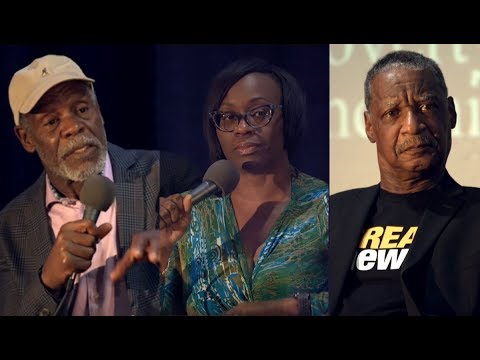
TRNN Replay: During a Q&A with actor Danny Glover, Our Revolution President Nina Turner, and TRNN Executive Producer Eddie Conway, audience members ask about a range of issues such as COINTELPRO, progressive organizing, the Democratic Party, and ways to fight the injustice and inequality bred by capitalism and bolstered by racism
Story Transcript
EDDIE CONWAY: When I was talking about sisters organizing, and I meant, I talked about Gloria Richardson. She was in Cambridge, Maryland back in the late ’60s. Here in Baltimore City we have a Gloria Richardson, also. And that’s Tawanda Jones. She’s been fighting, she’s been fighting for her brother’s justice, Tyrone West, for four years. Haven’t missed a beat, haven’t slowed down. Her life’s been threatened, her job’s been threatened, and she continues to fight. Every week West Wednesdays happen somewhere here in Baltimore. So out of the honor of that struggle I’m going to give her an opportunity to ask the first question. Tawanda?
TAWANDA JONES: Can you all hear me? First of all I want to give thanks and honor for just being here. And I’m most gracious for the words that you just blessed me with just now, and all I keep on hearing. So I really don’t have a question. I just want to let you know I’m keep on going. I’ve been moving ever since they murdered my brother on July 18. For now, for 245 weeks, 1715 days, fighting nonstop for accountability. No, it’s not, we just left West Wednesday, which was held at City Hall. And we took it to where the mayor and where the state’s attorney, and where all the jokes and the folks were. It was our obligation, is our duty to fight for our freedom. It is our duty to win. We have nothing to lose but our chains. So I’m just going to keep on fighting. I’ma keep it moving. I’m never gonna stop. And I feel like there is no justice. It’s just us, holding folks accountable.
And just like Dr. King said, an injustice anywhere is an injustice everywhere. And right now it’s a worldwide thing. And it just needs to stop. So I’m never going to stop until killer cops are in cell blocks. I respect officers like your son, like you worry about your child coming home to you. A good officer. That’s why I call out killer cops. I don’t put them all in one box. Because they’re not. But at the same time, we see a bunch of snakes coming down the street, I’m not going to stand there, watch and figure out who’s poisonous and which one’s not. I’ma keep it moving. So thank you. We’re more than hash tags and body bags. We’re more than being six feet in the dirt and pictures on buttons and T-shirts. Our lives matter. Thank you so much.
EDDIE CONWAY: OK. So is there any questions in the audience for Danny, for Senator Turner? OK. Go ahead.
NKECHI TAIFA: Hi, thank you. I’m Nkechi Taifa. And I’m sorry, brother Eddie, I got here late and didn’t hear part of your presentation. But first of all, thank you, everyone. You know, I felt like I was in church. I mean, you know, just really fired up. But you know, Eddie you were a victim of the COINTELPRO, the FBI’s once-secret legal campaign to destroy the movement. Martin Luther King was a victim of the COINTELPRO. If COINTELPRO had been in Brazil Marielle Franco would have been a victim of the COINTELPRO.
So I guess my question is, in today’s BIE, black identity extremist, the new label that the FBI has put on our leaders, what is it that we can do to ensure that what happened in the past is not repeated today? And that folks today know, in fact, what happened in the past which caused people like you to search over 40 years unjustly, you know, in prison? So that’s my question. It’s about the COINTELPRO illegal abuses by government against people who are talking about everything Dr. Martin Luther King was talking about and more.
EDDIE CONWAY: Yeah, and all I would say is that we have to organize organize organize, and educate. There’s already been people locked up that hadn’t broken any laws but have been identified as black identity extremists. In Texas already these people facing 10 years for that, for having a mindset. That’s an immediate threat to organizers and activists throughout the black community. But the National Defense Authorization Act is an immediate threat to every citizen in the United States of America because it gives the president or his designee the power to lock up anybody any time that they declare that this person is the enemy of the state. That’s what that, that whole terrorist campaign that started after 2001 has led to now. The COINTELPRO of yesterday that was illegal is now legal today for not only blacks but everybody in this audience right now. And so you’ve got to organize, you got to organize and organize and build.
Is there another question? Go ahead.
TALIBAH YVETTE MACON: Peace and blessings. I’m Talibah Yvette Macon. What I really want to ask is a ground-level question. I love my people. I love my community. But we seem to be killing as many of each other as everybody else. What do we need to do, or to stop it. OK? Like you know, if there are gang members and they’re our children, what do we do to go get them? Or some of them. Everybody’s not going to come. But they’re our future and they matter. They matter greatly to me. And we talk about police killing us. But when I’m walking down the street, and I love brothers, and I see some somebody’s children coming and I feel fear, something is wrong with that. So beyond the world, right in our world in this community, we need to save our people, our children, our brothers, their mothers. And I’ve even worked on programs that were just programs, because they really didn’t meet the need of the family. When I talk to people everybody says I’m going to help the youth, I’m going to help the children. But aren’t we all the children of God? So if you don’t start with their families then you’re really not helping the youth, because we need strong families in Baltimore. That’s how I’m feeling today.
DANNY GLOVER: You know, as I listen to the question, I also thought about the extraordinary opportunities that happen in communities every day. Places like Detroit, places like Minneapolis, places like Chicago, where young men and young women are recalibrating what is happening in their communities, whether it’s through the activities of urban gardening, whether it’s through the activities of organizations that are peace zones within the community. All those things are the emerging of, I think, a new, a new dialogue and a new narrative that happens in our community. How we nurture those things is very important, certainly, and we don’t know what the outcome is.
You know, I think at the same time that you justifiably are right in the fear that you have just expressed. We all do that. But we have to find ways in which I think we find those avenues in which we could intersect, engage, and as Eddie keeps saying, organizing, organize. And when we see this happening we know that it is women who are in the leadership, and acknowledge that, that as well.
SPEAKER: One of the things that I do, sister, and I’ve been doing this now for about three years, is that every morning I go to the corner store and get me some coffee. That’s really not about that cup of coffee. But that’s where the young ones are hanging at, right. So I first, I go there and I speak love into them and I speak, and I speak peace. How y’all doing today. You know, what y’all got up for the day, is everything all right. How you feel. And then at some point they begin to trust me. And then I start talking about things that matter to them. Well you know, I just heard that you could get your record expended. Oh, I can? Where can I do it? I’ma bring you some information tomorrow. You meet me up here at the same time. And I start speaking love and information to them, and now they call me Ma and they listen to me. And then I bring up, I bring up things that I read about that’s going on in the community, and I ask them, now, how would you deal with that? Would you, you know, we can’t all take out our pistol, even though we feel like it, you know, but we can’t do that. How are we going to handle this?
And then I, then I tell them the things that as wisdom that I gathered as being my 60-some years old when I wasn’t always, I didn’t have wisdom because I grew up in the street. So bottom line is, I, I was afraid at first. I’m not going to lie to you. But God told me to get up in the morning, because they be down there at 7:00 or 7:30, and stay down there, like you’re going to get your cup of coffee, and speak to, speak love, and speak safety over to these youngsters. And that’s the way I do it. And now I don’t have no fear. I don’t have no fear. And, and I, and I’ve watched them and I tell them stuff like, man, you know, you grown since last summer. I mean, they watch, I said, you must’ve grown about 5 inches. And they know I’m showing love to them.
So we can’t fear our children. I know, I understand what you’re saying, but you have to just take God with you, and you have to say one on one. One. Talked to one. Then he said, what’s he talking to that lady about? Then he’ll come listen because he want to know. Then another one will come listen, because they want to know. Next day, you know, they can’t wait till get down there in the morning to open the door for me. So that’s the way you do it.
SPEAKER: I wanted to ask about the superdelegates and the problems that are created if you have a candidate here in Baltimore that wants to run independently. Because so many of us, me included, are unhappy with the Democratic Party. It’s become a corporate party. And you don’t know where Republicans and Democrats begin. And you’re talking about collusion. I think when you have superdelegates that’s collusion, and they are not getting proper representation.
So I ask this to anybody on the panel, how can we ease the the two-party system, and how can we get rid of superdelegates within the Democrat Party?
SEN. NINA TURNER: Well, thank you so much for that question. First of all, there was a Unity Reform Commission that was formed from the 2016 campaign, and agreement between Senator Sanders and Secretary Clinton’s two campaigns. We met for almost a year. I was on that Unity Reform Commission. And certainly the Bernie 8, as we were called, because there were eight of us that were appointed by Senator Sanders, we were nowhere near the majority. We were outnumbered. But we did come to some consensus.
Now, written within that resolution was the automatic reduction of superdelegates by about 60 percent. Even though the Bernie 8 wanted all of the superdelegates gone, just all of them, because it is unfair to have superdelegates put their bodies and thumbs on the scale before the nominee is even, that happened in 2016. And it doesn’t matter who you are for, fairness is fairness, and it is an unfair system. And I’m here to tell you that the system is rigged. It is real. Not just that system. But the system is rigged.
But one of the things that can be done, the Democratic Party, when they have their summer meeting, they’re going to be taking up the recommendations of the Unity Reform Commission. And people who care about whether or not this party transforms itself should get engaged. And so I want to invite you to go to OurRevolution.com. You can read the Unity Reform Commission’s report. And hopefully we can get them to do away with all of the superdelegates, every single one of them, moving forward. But you have an opportunity. Send an email or call Chairman Perez, and make it known what kind of party that you want to see.
In terms of the two-party system, their corporation, I want folks to know these are private entities. I hope we understand this. They get to make the rules that all of us have to play by. So it is hard in this country, in other countries they have more than two parties, but in this country we have two parties. So we have a decision to make. There will be some of us who will work within that party to try to change it. And there are going to be some folks who go to work outside to bring the pressure on the inside. We need both of those things. But if progressive minded folks, and that doesn’t mean we always have to agree, but progressive-minded folks who want to work to not just transform that party but to take over that party. So when folks say to me, somebody like me, if you don’t like it, leave, I’m not leaving. You leave. You leave. You know, that’s no different than some racist folks telling black folks to leave the country, you know, and to have some Democrats who are the corporatist Democrats say to progressive Democrats leave the party is a slap in the face.
Now we got to, we’ve got to either straighten out this party, and if it can’t be straightened out then we’ve got to take some other course action. But what we not going to do is continue business as usual. So please sisters and brothers, write Chairman Perez, look up and find out who is your representative in the DNC because we will be voting in the fall, summer to fall, about whether or not those superdelegates should still exist. If you put some pressure on them, that kind of pressure that Dr. Martin Luther King was talking about, put the pressure on them then we will see the change. And if they’re unwilling to change or move then maybe we need to change and move.
EDDIE CONWAY: OK. Got time, got time for one last question.
SPEAKER: … Talking about capitalism as a system, a vicious system. Leadership in this country, black leadership, I’m sorry, black leadership doesn’t it speak to that issue. And we think it’s vicious in terms of poverty, criminalization. You know, black folks being messed over, and people of color. It’s capitalism, let’s be clear about that. So when you talk about a third party, that third party has to represent something different, and if you’re not representing something different you can’t buy into the same old stuff. The Democratic Party has been there. You talked about it yourself. And Danny, I totally appreciate your body of work. But African people all over the world are suffering, and people of color, because of capitalism. That’s what Vietnam was about. King couldn’t say it in ’67-’68 because he would be called a communist, or a socialist. But he was clear what he was saying.
So how do you address that? Because I don’t hear it being addressed at this particular group, because our leadership has to be clear about where we’re going, how to get there, and creating something different. Even in Baltimore we had a black political party called Ujima that ran in the 7th District. It was not successful, but it was a beginning, you know, at a local level. So we need to do something about that. Bernie Sanders himself declared himself a Democrat, even though throughout the whole process when he was asked what am I? I’m a Democrat. That doesn’t work. Anyway, that’s that’s part of my question to you, as well as a semi-statement.
SEN. NINA TURNER: I don’t want to monopolize all this. I mean, people can define and declare themselves. You’re addressing it. So all of us can’t address the same things. It’s the differences that make the whole. The Senator said he was a democratic socialist. In other words, we know what pure communism is is that, you know, the government controls the flow of all goods and services. We’re going to never be that in this country because that’s not who we are. But your point about understanding how this system itself suffocates folks and what are we going to do collectively to address it, that means that we have to have people like you who speak up and speak out about it, and you can’t be the only ones doing it. And we also are going to have to take the risk to say that if the system does not change that we’re going to change, and that we’re going to move.
But we can’t expect, this is not just about who the elected leaders are, this is about who we are because they only go and do what we allow them to do. And so I want to give one good example about what just happened recently with the, the the bill that just passed at the Senate to lessen the regulations on big banks, because this is something, I think this is a good example. Now, this just happened. Just happened. I ain’t talking about 10 years ago. I’m not talking about two years ago. I’m talking about almost two weeks ago. And you have 14 Democratic senators who voted for a bill to allow big banks to take even more risks, those same risks that took us under, almost took us under in 2008 when we had to bail them out. And also written in this bill is their ability to redline in black and brown communities. 14 Democrats gave them that vote. So to your point, and then those very banks that benefited from that bill turned around and wrote Republicans and Democrats a thank you letter for the giveaway. And one of those senators was Senator Doug Jones of Alabama.
Now, the reason why I bring him up in particular is because the last time I heard that 98 percent of black women, 93 percent of black men put him over the top in Alabama. And he didn’t hesitate to vote for a bill that he knew would harm black communities, poor communities. And why was he able to do that? Because he has no fear that the black community in particular, not exclusively, because over 90 percent of us, sight unseen, sisters and brothers, do you understand what I’m saying to you? Sight unseen. They don’t have to do anything for us. They know, they can predict, that the black community is the only community that votes without making a demand of the Democratic Party. They can guarantee that over 90 percent of our vote will go to them and there’s no consequence to that.
So to our brother’s point, everybody has to take up the mantle that matters to them. For some it’s the environment. For some it’s income and wealth inequality. For some it’s talking about the, the, the harm of a capitalistic system that does not have humanity in it, and some people will argue that there would never be humanity in capitalism. I’m not necessarily going to go that far. But some of us need to take up our crosses and our mantles, and we make the whole. And all of us will cover the whole thing. But we have to make a demand of these folks and stop letting them fearmonger us to vote for them, because the next person is going to be worse. You know, I had one of my mentors, her name was Councilwoman Fannie M. Lewis, and she used to always say this. It doesn’t mean, it doesn’t matter if you meant to kill me on accident on purpose. Dead is dead.
And that is our message to the Democratic Party. And so we got to demand more as a people. Every other ethnic group don’t just give their votes away like we do, but we do. And what do we get for it generationally? I’m not talking about individual positions. Do you know in the history of this country there has never been an African-American woman elected to serve as governor in the United States of America, yet we just give away our votes. And what about our white allies? Because we can’t do this by ourselves. What about our brown, red, and yellow allies? If people of good consciousness, regardless of their ethnicity, unite there’s nothing that we can not do. So all of us are obligated to call out injustices. There’s only been five black men elected in the history of this country. We got one, we got Ben Jealous running right now. In Maryland. So the question becomes what are we going to do to hold elected officials accountable when they are not doing right by the people and they don’t even get me started on our Native American sisters and brothers who are just, we don’t even talk about them.
So we, we, we, the collective we, we have to change this system, and we can’t be afraid to do it. And that really was what Dr. King’s message was in that particular speech. The question becomes what are we going to put on the line and what demands are we going to make? And when are we going to call out people when they are wrong? This is not about political affiliation. This is about your affiliation to humanity and people want to ask me, are you a Democrat? I’m a hellraiser humanitarian. That’s what I am.
DANNY GLOVER: I mean, as we take this moment 50 years ago, and we translate this moment to where the country was 50 years ago, and many things that Eddie and I remember, where it was students in 1968 in Paris were out on strike, students in Columbia University out on strike, students in San Francisco State were out on strikes. We had the massacre of students in Mexico City during the Olympics. Let’s understand that clearly, that period of time represented a period of time where there was a vicious effort to erase a generation of thinkers who had other ideas about the possibility of what kind of system we can build.
The issue around systems are what are the relationships? Julius Nyerere in African Socialism talked about the systems of relationships, those systems of relationships of cooperation as opposed to systems of relationship of competition. And then all of the human activity and human development have gone further, further, have gone further by the relationship that we’ve, is born out of cooperation. And I think we understand that clearly. We understand that as part of our internal orientation the moment we come in. It becomes cooperation, in that sense, from that sense for the day that we come on this planet, it takes cooperation to get you to walk and talk. It takes cooperation to have you grow from childhood to adolescence to adulthood. It takes cooperation. What are the systems of cooperation that we’re going to develop beyond humanity? Or across humanity, rather. And I think the question becomes whether it looks something like we don’t believe in, something that we’ve been told not to believe in, whether it’s socialism, communism.
The AMA, the time, the time that Medicare was passed, fought it the whole part of the first twentieth century. Why? Because it looked like socialism. It looked like communism. Understand the terminology. And I don’t see all the reasons why this country does not have a universal healthcare plan like every other modern country in the planet is because it looks like communism, looks like socialism. Let’s throw away the terms and talk about what are the relationships that evolve? And those relationships that have evolved have come, that we existed in now, it’s come from, as Dr. James Lawson says, Reverend James Lawson said just the other day, plantation capitalism. Understand that term. Plantation capitalism. What we see now, the wealth, the prosperity, everything that’s happening, King realized that. He realized it was based upon plantation capitalism that marginalized, that disenfranchised those people who were valuable in building the wealth of this country, but also marginalized poor whites as well. Understand that.
Whatever system do we arrive at here, just like the system of capitalism came out of various forces, various political forces, various, various forces in terms of the evolution of technology and the relationship that man has with nature, it became either that what are the systems in our new configuration of who we need to be and what we need to do in being human beings? What are the systems that we evolve? We may want to call it something else. It may evolve into something, it may merge into something. But first we understand that and have the vision and the imagination to go forth, force that, we sit here discussing whether it’s communism or capitalism. Or the virtues of capitalism or the virtues of socialism in everything. What is that system? And how does that system in its dynamics, in its own internal contradictions, force us, push us to grow and evolve and change, and continue it. And understanding those dialectics are changing generationally. Those dialectics are always changing. Those contradictions always changing. They’re never the same.
But we have to make the commitment to that transformation. Where it’s perpetual sustainable activism that would create the systems that we need, the systems that we will embrace as human beings, and elevate our humanity, and build what this young this this young preacher was talking about. He’s young, 39 years old. This young preacher was talking about building that beloved community. What does that community look like. How does it feel? How does it talk about how we share? How does it talk about how we live in the city? James Lee Boggs, married to Grace Boggs, said we were going to be an organizer, out in Alabama. Auto workers. Radical organizer. Telling them we’re going to live in cities. If we’re going to live in cities as we recognized over the 20th century, that the majority of human beings live in cities, what do those cities look like? What are the relationships? How do we now take those relationships, those past relationships, have this, alienated from us from the land, have alienated from each other. How do we take those systems now, those systems, systems that we evolve into, and we grow into, we fight for, and we say keep going forward? Keep going? How do we take those systems that make us and transform our humanity and relationship to each other, relationship to ourselves, relationship to the rest of the planet, even the mother earth. Those are the systems.
When the native people, First Nation people, talked about what this is, what does this Earth look like seven generations from now, they weren’t talking about communism or socialism. They knew that there was a relationship that they had with the land. When native people in the 11th century, native people in the 11th century called a, a conference in the Americas, right here, in the 11th century, long before Columbus, and talked about how to weather the relationship we’re going to have between us. What are the tribal relationships. How are we going to protect and nurture the young. I mean, there were conflicts within that context. Yes, there were conflicts. But they were finding ways of resolving those conflicts. It was based upon cooperation. Cooperation with each other, cooperation with this incredible, fragile, beautiful planet that we live on. But it moved towards something higher and keep reaching for something higher.
So those are the ideas that we have today. This is the idea that King left us with. This is what he left us with. This incredible possibility. The possibility , not the dream, the possibility of who we can be. That’s what it is. The possibility of what we can do. He was, he was very clear about who we are and what ever, and what we can, what we have, what we can do. But he knew that we can go further than that as human beings. And that’s where we are at right now. And we have to take all this, take every single, everything that my sister has talked about. Whether it’s universal health care, whether it is, whether it’s the rights of women and the struggle for women. Whether it’s the idea of being full citizens in this in a democracy, in a participatory democracy. Not a democracy that is driven by simply who we elected, where we hold the politicians accountable, and we’re down there and we’re every day activism, every day fighting for that, that voice, our voice in everything. What does it take to create that and assemble that. And who knows what will happen if we do that. Who may know what would happen.
Every one of us could be in jail because we tried to do that, because we know what has happened to the whole sake of participatory democracies in other places in the world where people really become active, really become citizens, and understand the role that they play as ordinary people, ordinary citizen. Where do we take that on? And where this comes sustainable. What is increasingly, the next revolution is evolution.


