


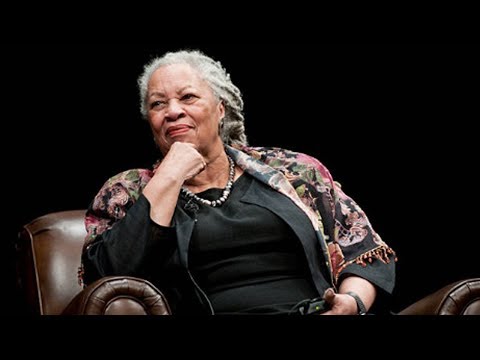
Morrison’s work gave voice to the Black world, to the American experience. A revolutionary who understood the nuance of existence and embodied the struggle of the Black world
Story Transcript
TONI MORRISON: To ask me when am I going to stop and if I can, is to ask a question that in a sense is its own answer. Yes, I can write about white people. White people can write about black people. Anything can happen in art. There are no boundaries there. Having to do it or having to prove that I can do it is what was embarrassing or insulting. In this book, I did.
ERICKA BLOUNT DANOIS: Toni Morrison— a mother, professor, writer, editor and revolutionary— gave voice through her stories to interracial issues, love affairs and everyday life in the black community. She was often asked, would she ever consider writing about the white community, as if her lyrical stories about characters that were equal parts lovable, and alternately, exquisitely flawed, weren’t enough. “Being a black woman writer is not a shallow place to write from. It doesn’t limit my imagination. It expands it.” Born in Lorain, Ohio in an integrated neighborhood, Morrison never was interested in listening to the critics around her. Her interest lied in achieving freedom, and many of her characters reflected that journey. In the way that Zora Neale Hurston captured the lyrical tones and idioms of African American dialect, Nobel Prize winner of Literature Toni Morrison captured the extraordinary in the everyday lives of black characters as they danced, lived, fought, and tried to find meaning in their lives.
TONI MORRISON, READ BY TAYA GRAHAM: At some point in life, the world’s beauty becomes enough. You don’t need to photograph, paint or even remember it. It is enough.
ERICKA BLOUNT DANOIS: It’s easy to forget with her body of work that Morrison was equal parts mentor, mother and editor to a number of other writers when she worked as an editor at Random House. In her tenure there, she edited a collection of writings of Huey P. Newton and James Baldwin. She edited Muhammad Ali’s autobiography. She published writers and activists like Angela Davis, Gail Jones, Toni Cade Bambara and Quincy Troupe. She taught Stokely Carmichael when he was at Howard University, also her alma mater.
She said that if she didn’t physically participate in the struggle for civil rights by marching and protesting, she wanted to provide a voice for it, and that she did. She focused on writers that could contextualize the rich experience of African American life. Her work and her life were revolutionary in and of itself. In her personal life, she raised two sons by herself after a divorce, writing in the early hours each morning.
In her professional life, she became one of the few black female editors at a major publishing house, and gave voice to other black writers. In her public and spiritual life, she paved the way for others to be their best and their worst selves publicly. As her character Sula said, “I don’t want to make somebody else. I want to make myself.” That she did. And in doing so, Morrison made the way for so many others to do the same.


