


The rise of police spending at the expense of recreation centers is under fire from community activists as Baltimore continues to grapple with record levels of violence
Story Transcript
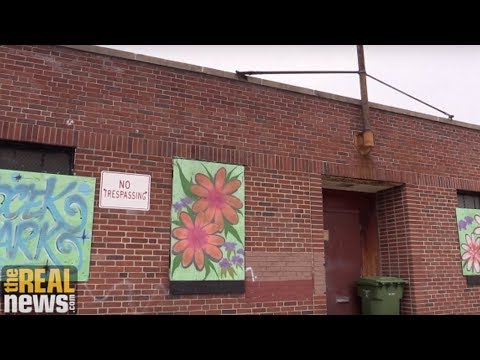
TAYA GRAHAM: This is Taya Graham reporting for The Real News Network in Baltimore City, Maryland. I’m standing outside the Bocek Recreation Center, which has just received some funds from the city to rebuild the center. However, Baltimore City continues to pour money into public safety and policing, which begs the question: what are the city’s true priorities? The concern was raised at The Real News, Real Talk Though discussion last week. Where were all the rec centers and what was the city doing for kids who had nothing to do?
SPEAKER: It’s just washed out. Nobody dances anymore. It’s all about the drugs and the flash and everything like that.
TAYA GRAHAM: To find out, we started, here, in East Baltimore, where the Bocek-Madison Recreation Center has seen better days. Shuttered years ago, the East Baltimore facility has been out of commission since the city began cutting back rec centers decades ago. Today, Baltimore has just 40 rec centers across the city, but Rocky Brown, President of the Bocek-Madison Community Association, recalls when there were over 100 thriving facilities, including this one.
ROCKY BROWN: This spot has been a dead park. This park was dead. We had nothing but drug activities. All of that corrupt stuff that was going in the park, it was considered as a dead park. And for them to rest the money in a dead park, they wasn’t going to do it.
TAYA GRAHAM: That’s why Brown has been pushing for years to reopen it. And last week, he said those efforts paid off when the city allocated over $700,000 to renovate and repair the aging structure.
ROCKY BROWN: The mayor stepped up to the plate. We’re doing a really powerful thing. She came out for a groundbreaking ceremony. We’re supposed to start on it probably this month, or so. It’s supposed to be completed in June of this year.
TAYA GRAHAM: It’s a small victory in an uphill battle to restore the city’s once sprawling recreation center system that appears to have a murky future.
BILL HENRY: It’s just been clear for a quarter of a century that we have not put the amount of money into youth development that we need to help and encourage our young people.
TAYA GRAHAM: For Councilman Bill Henry, the decline of rec centers is telling– a shift towards policing that has played out over two decades.
BILL HENRY: I came to work here in City Hall in 1991 and at that point, we spent about $160 million a year on the police department and we spent a little less than $40 million on rec and parks. And over the next generation, the whole city budget would go on to double. We now spend more than triple that amount on the police department. And yet, we still spend about $40 million a year on rec and parks.
TAYA GRAHAM: In fact, financial reports reviewed by The Real News dating back 20 years, reveal just how much spending on both has diverged. In 2000, the city spent roughly $26 million on recreation and culture, which includes rec centers and $364 million for public safety, which includes fire and police. Nearly a decade later while recreation spending rose slightly to $30 million, public safety spending had ballooned to $460 million. In part, the closure of rec centers was intentional. In 2014, then Mayor Stephanie Rawlings-Blake pledged to close decrepit facilities in order to focus resources on larger centers, including this one in Clifton Park. But that plan has not panned out, leaving some city activists upset. This is the Walter P. Carter school behind me. If there’s any place that is a ground zero for the spate of rec centers in Baltimore City, it’s right here. The school is going to be renovated but the rec center is going to be closed.
SHARON EVANS: Closing this rec right here at 43rd and St. George has been really a heartbreak for me, really a heartbreak.
TAYA GRAHAM: Which is why one community activist says she’s angry.
SHARON EVANS: We don’t have much. This is all we have here for our children and they come. We have had some of the worst children come here. They turned around and become better me’s and that’s what we want. We want to see the children with better means. You take this rec– well, it’s already taken– but we want to build a brand new standalone like this was brand new. We had everything.
TAYA GRAHAM: The rec center at the Walter P. Carter provided the community a focal point, and a place for youth to gather, and a way to keep kids off the streets, which is one of the reasons she has met with Councilman Henry to try to convince the city to rebuild. But if that will happen or if the city will expand recreational facilities, is uncertain. The mayor’s office would not comment. Another councilman, Kristerpher Burnett, has seen modest improvements to several rec centers in the 8th District, which he represents.
KRISTERPHER BURNETT: The most recent upgrade would be the Edgewood-Lyndhurst Rec Center. It was built maybe four/five years ago, maybe a little bit longer. It was before I got in. I wouldn’t call it state-of-the-art, but it’s certainly better than where it was.
TAYA GRAHAM: But he said many of the facilities lack up-to-date technology, critical tools to attract young people.
KRISTERPHER BURNETT: I think the focus needs to be, just in my opinion, needs to be more on what amenities do these centers have that attract young people, right? So one of my rec centers, the Edgewood-Lyndhurst Rec Center, has been very excited because they just got Wi-Fi like two weeks ago. And they are now like, can you help us get the word out because kids don’t want to come to places that don’t have Wi-Fi. Even if they are going to come to play basketball, they’ll leave if they need to get on the Internet or go somewhere that has it.
TAYA GRAHAM: Which is why he said the city needs a more detailed plan, going forward. Part of the issue is financing. A plan proposed by former Mayor Stephanie Rawlings-Blake to lease back city-owned parking garages to fund new rec centers, has changed. Under Mayor Catherine Pugh, that money has been placed in the neighborhood investment fund. The mayor’s office told us, instead of rec center funding, the money will be used to stimulate development in blighted neighborhoods. How the money will be spent will be decided by a board appointed by the mayor made up of business people, financiers, and city officials. The Real News has also learned that the board will decide who gets the money in secret because the body was set up as a separate charity or 501(c) organization, so it does not have to open its decision-making process to the public. But that doesn’t mean Brown will give up his fight to expand recreational opportunities in his neighborhood.
ROCKY BROWN: They weren’t engaged in the kids like they really tried to engage in the homicides and murders now. They’re really paying attention and focused on our youth now. That’s more important.
TAYA GRAHAM: He thinks it’s the key to not just preventing crime, but to strengthen the next generation so they can build a better city for everyone.
ROCKY BROWN: We lose this generation of kids now, we through. That’s my modern thing. The kids need something to do. If they don’t have nothing to do, that’s where the crime, and the violence, and the murders come from.
TAYA GRAHAM: This is Taya Graham and Steven Janis reporting for The Real News Network in Baltimore City, Maryland.

