

Advocates say a new bill to create safe consumption spaces for drug users would save lives and money. But in a blue state that has rejected progressive ideas in the past, will lawmakers embrace the strategy?’>
Story Transcript
TAYA GRAHAM: This is Taya Graham, reporting for The Real News Network, in Annapolis, Maryland. There’s a crisis on the streets of Baltimore, which harm reduction advocates have a solution for, but will the Democrats in Annapolis support it?
RICKY MORRIS: I walk down the streets in the neighborhood I live in, and you can smell a stench, and the stench is from people laying there dead in old houses.
TAYA GRAHAM: As the opioid crisis continues to claim live and across the country, there’s an idea that has growing support among people who understand the roots of the problem.
REGINY V.: It’s been imperative for years that we treat people with compassion. Now is the time to do it.
TAYA GRAHAM: They’re called safe consumption spaces, facilities where drug users can safely take heroin under the supervision of medical professionals.
HARRIET SMITH: What that means is, a facility that is supervised by medically trained personnel would be set up for people that use drugs to come in and use their drugs there, under supervision.
TAYA GRAHAM: It’s an idea that has taken hold elsewhere. San Francisco may be the first in the nation to take this bold step and open its first safe injection sites this July. The proposal in Maryland would allow community organizations, hospitals, and health centers to open safe consumption spaces throughout the state.
REGINY V.: This is a space where you can access safer consumption, needs, and services. Completely community run, it does not need to be run by the city or the state. I’m definitely with staff who are peers.
TAYA GRAHAM: Advocates say the idea will save lives.
REGINY V.: It also reduces disease transmission, because there are safer use supplies available, syringes, needles, cookers, cottons, things like that as well.
TAYA GRAHAM: And provide a conduit for treatment, in a state where fentanyl deaths nearly doubled last year.
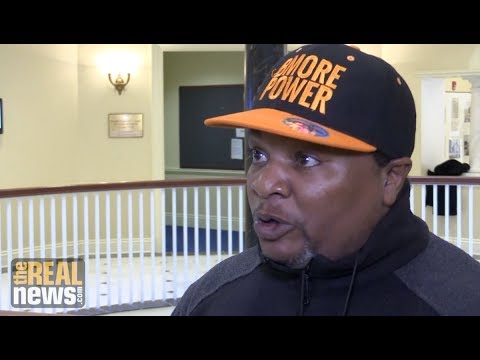
RICKY MORRIS: I was walking an ally and seen a lady from a doorway, lying there unconscious, and I learned how to use Narcan, so I applied it, and wound up saving her life.
TAYA GRAHAM: Baltimore resident Ricky Morris says he understands the problem first hand.
RICKY MORRIS: I OD’d myself years ago, and just think, if no one was there to help me, and I lost my life, I wouldn’t be here today for my children. I wouldn’t have had a chance to do better, turn my life around, so give people the opportunity to evolve and do it.
TAYA GRAHAM: And there is another benefit to safe spaces. Last year, we spoke to Johns Hopkins Bloomberg School of Health professor, Susan Sherman. She co-authored a study that calculated, a single safe consumption space could save the city 7.8 million dollars a year, by cutting down on emergency room visits, transmission of diseases like AIDS, and enhanced treatment opportunities.
SUSAN SHERMAN: If that doesn’t appeal to you, keeping people alive, and you know, it’s cost effective. It actually saves a lot of money in terms of ambulance coming for overdoses, in terms of people being in the hospital, so that’s also an external benefit.
TAYA GRAHAM: However, like most progressive proposals, safe spaces face a formidable political obstacle, Democrats. The Real News has covered a variety of ideas, which have failed to even get a vote.
DON MORHAIM: Current narcotic overdose crisis is just the tip of the iceberg, but it’s called attention to a failed policy long ignored.
TAYA GRAHAM: Among them, an earlier proposal to decriminalize drugs like heroin, and provide safe consumption spaces.
DON MORHAIM: Decriminalization of small amounts of all drugs, as has been done for marijuana in this state, so that people are not stigmatized for life.
TAYA GRAHAM: And a modest proposal to allow a single civilian on an internal police disciplinary board.
JUSTIN READY: I feel like, yes there are reforms that are needed, were needed, that you’re working on, I’m sure, but I also feel like there’s maybe a little bit of not wanting to take responsibility for some of the things that have happened that have caused the police departments to be a little bit … to have trouble.
TAYA GRAHAM: And in 2017, The Real News caught the bail bond industry wining and dining legislators to beat back bail reform. Looming over the effort to stem overdose deaths, is the power of big pharmaceutical companies. In fact, Baltimore City has sued Purdue, the manufacturer of Oxycodone, for flooding the streets with lethal pills.
ANDRE DAVIS: Opioid complaint against the number of defendants seeking damages and injunctive relief on behalf of the city for the harm that’s been done. In so many different ways, you all are fully aware of it, I’m sure, to the city, to the people of the city, to the financial well-being of the city.
TAYA GRAHAM: Still, advocates are hopeful that the urgency of the crisis will lead to real solutions.
REGINY V.: I’m seeing that there’s also more of an understanding that the criminal justice approach does not work.
TAYA GRAHAM: The question is, is anyone here listening?
RICKY MORRIS: Give people the opportunity to evolve and do it, and learn from their mistakes, and just have them in a safe environment where their life can be saved.
TAYA GRAHAM: This is Taya Graham and Stephen Janis, reporting for The Real News Network in Annapolis, Maryland.


