


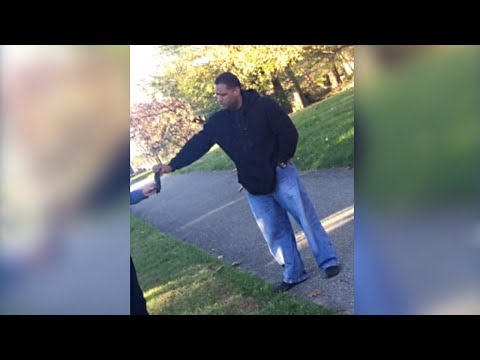
The nearly deadly encounter between an unarmed teen and an off-duty Baltimore police officer still haunts the family, but the recent controversy involving the city’s civilian review board may leave them with nowhere to turn
Story Transcript
TAYA GRAHAM: This is Taya Graham, reporting for The Real News Network in Baltimore City, Maryland.
Is American policing resistant to reform? The Real News investigated a recent case to try to find some answers. The terrifying encounter with an off duty Baltimore police officer was captured on video, a cop who pulled a gun on a city teen without identifying himself.
JAWONE NICHOLSON: I thought I was going to die, because I didn’t know who he was. To me, he was a regular dude on the street. I mean, he was dressed like me.
TAYA GRAHAM: An incident that still haunts the intended target, Jawone Nicholson.
JAWONE NICHOLSON: He pulled the gun and then we put our hands up like this and started walking away, and he followed us.
TAYA GRAHAM: And his mother, Erica Hamlett.
ERICA HAMLETT: He can be doing everything right, everything right, and that man had every opportunity to kill my son. And from the lies that he’s told since the incident, he would have had no reason not to tell a lie to make it seem like my son provoked him to do what he did to him. Dead men don’t tell tales.
TAYA GRAHAM: But also, has become a symbol of the city’s apparent inability to reform police in a department under federal consent decree, and raises questions on how to fix it.
ERICA HAMLETT: So I’m glad that my son made it out alive. And people keep saying, “Well, he living, what you mad for?” Because of what he did.
TAYA GRAHAM: The near deadly series of events started last year when Jawone was waiting at a bus stop after school. A stranger who did not identify himself started to question him.
JAWONE NICHOLSON: He came up and he never and identified himself as an officer. He asked us why we was over there, asked us a few questions, and then he pulled his gun.
TAYA GRAHAM: Jawone called county police, who disarmed the cop, but the family was stunned when they learned the potential assailant was a city cop.
ERICA HAMLETT: I’m looking at him like maybe he’s a kid and he was trying to rob them. That was my thought, like somebody’s trying to rob my son when I was running to him. And when we approached, and he was coming towards them, my son’s like “Mom, don’t say nothing to him.” And I’m like, “No, what’s going on, who are you?”
TAYA GRAHAM: Hamlett filed a peace order against the officer, which a judge approved. During the hearing, the officer said he felt threatened by the teen, who he thought looked suspicious. We contacted his lawyer who did not respond. But since then, Hamlett says efforts to hold the officer accountable have revealed a system that is hostile to civilians.
ERICA HAMLETT: His lawyer brought up stacks our Facebook posts because he couldn’t find any criminal record on us because I don’t have a criminal record, my son doesn’t have a criminal record. So he went to Facebook and pulled up all the posts, all my Facebook posts, and said my son was big and he was aggressive. If he was so big and aggressive, then why would you even approach him in the first place?
TAYA GRAHAM: And a department she believes where her concerns seem to fall on deaf ears.
ERICA HAMLETT: They treated us like we were criminals. And I was like, “I’m not doing that, we’re not criminals, we’re here to give a statement because we filed a complaint.” And then they asked me to refrain from social media, don’t do any interviews. And then –
STEPHEN JANIS: With the media? They told you that? What did they say?
ERICA HAMLETT: He said, “Can you refrain from speaking to the media. We know you’ve spoken to the media.” Because I’d already done an interview with Jayne Miller by then.
TAYA GRAHAM: Which is why she is even more troubled by the current conflict surrounding the agency of last resort for her, the Civilian Review Board. The civilian body is supposed to offer residents an alternative opinion to internal police investigations. The board has little power and cannot mete out punishment, but that truism has not kept city officials from attacking the board’s independence. Recently, the city’s top lawyer asked members to sign a second nondisclosure form.
ANDRE DAVIS: The statue desperately needs to be revised, and that is the source of the conflict between the City Law Department and the existing Civilian Review Board.
TAYA GRAHAM: A move that board member George Buntin says was not only redundant but filled with vague language.
GEORGE BUNTIN: The new one that was presented to us by the city solicitor had a lot of language, it was very vague, it seemed very open to interpretation later.
TAYA GRAHAM: Since the board refused to sign it, the police department stopped turning over complaints as required by law, a move Davis justified during a recent hearing in Annapolis.
ANDRE DAVIS: The Civilian Review Board right now is very frustrated because they want to be able to engage with the public and share more with the public about what they are doing and the outcome of their cases. But here it is. The procedures established under this subheading, this is the Civilian Review Board, may not be construed to affect or change the methods and procedures for suspension or dismissal of police officers.
TAYA GRAHAM: But David Rocah, legal director of the Maryland ACLU, an organization that has a non-voting position on the board, says the action is illegal.
DAVID ROCAH: What the City Solicitor is not free to do is attempt to hold them hostage by preventing them from doing their job until they sign this ridiculous confidentiality agreement that misstates the actual confidentiality obligation.
TAYA GRAHAM: And recently, Davis released this letter, which states the city will begin turning over complaints. The city’s uneven experiment with civilian oversight began in 1999 after a State Senator was illegally detained by police.
CLARENCE MITCHELL IV: State Senator Joan Carter Conway used to have a business on Monument Street, she was doing accounting. And there was a young child that was hit by a vehicle not far from her office. So she walked out of her office to check on this child, see what was going on. The ambulance already arrived and there were folks there. So the ambulance driver is telling her, “Backup, ma’am, stay out of it.” She said, “Well you know, I just want to see how the child is doing.” Police show up and they see her interacting with this emergency personal vehicle. Police didn’t ask any questions, walk up, “Get out of the way, lady.” She goes, “Wait a minute, who do you think you’re talking to?”
Because you know Joan Conway, she’s not going to take that. Next thing you know, the cop is putting handcuffs on her, sitting her on the curb. This is a sitting State Senator. So as a result of that arrest, her attorney at the time, Baltimore City Councilman Martin O’Malley was her attorney, got her out of jail, she actually had to get out of being booked. And at that point, that’s when we initiated the discussion of a Civilian Review Board.
TAYA GRAHAM: One of its architects, former State Senator Clarence Mitchell IV, says it was supposed to be a starting point for civilian oversight, not a long term solution.
CLARENCE MITCHELL IV: There were incidences that were driving the need for civilian oversight because the internal affairs and the State’s Attorney, this is an African-American State’s Attorney, Pat Jessamy, refused to make a case against Officer Smoot, even though you have videotape.
TAYA GRAHAM: He thinks more civilian control is the best long-term answer but needs to be strengthened. It’s an idea that has support in Baltimore, where the police department is under consent decree with the Department of Justice, including Councilman Brandon Scott.
BRANDON SCOTT: Going to a structure that has a board of police commissioners of which the chair of their board will be a citywide, elected compensated official that citizens can directly hold them accountable, in addition to some appointees who will oversee that person who’s the law enforcement. This is a process that’s done in Los Angeles, it’s done in Kansas City, in St. Louis, in Detroit, where they elect the majority of their board.
TAYA GRAHAM: But the current debate does little to help Erica Hamlett and her son, Jawone Nicholson.
ERICA HAMLETT: I apologize to him often, because I have to tell him that I’m fearful. It’s not something – sometimes it’s so bad that I can’t even control it.
TAYA GRAHAM: Her son still has trouble coping with the aftermath of his encounter.
JAWONE NICHOLSON: I just look at it like I’m glad I didn’t charge at him. I just threw my hands up. You got that.
TAYA GRAHAM: And with nowhere to turn, the tight-knit family can only wait and hope that a system that seems intent on protecting police will someday answer to the people.
ERICA HAMLETT: When I have called Baltimore City Police, I’ve never had a good encounter with them, never, and us being the victim.
TAYA GRAHAM: This is Taya Graham and Stephen Janis, reporting for The Real News Network in Baltimore City Maryland.

