

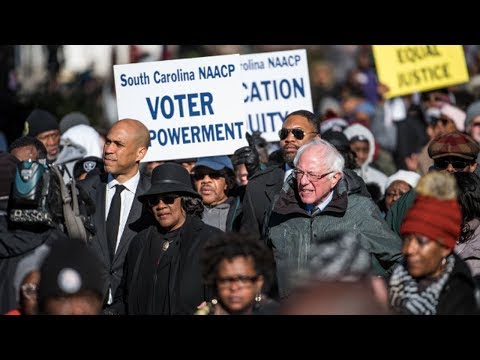
Jacqueline Luqman, Editor-in-Chief of the Luqman Nation talks about potential presidential candidates and how they can serve the black community, realistic goals, and what the black community should demand from them and issues to focus on
Story Transcript
JACQUELINE LUQMAN: Power concedes nothing without a fight. I don’t expect the Democratic Party to roll over and just play nice.
[TRNN INTRO]
EDDIE CONWAY: In light of the government shutdown, it’s become more apparent the importance that both policies and personalities play in our day to day lives. To help us figure out who would be the best presidential candidate to help change conditions in the black community, we recently spoke to Jacqueline Luqman, Editor-In-Chief of Luqman Nation.
What is it we’re looking for in the Black community in general? I mean, are we looking for Bernie Sanders or Cory Booker, some other personality? What is it we want?
JACQUELINE LUQMAN: I would hope that instead of looking for a personality, we’re looking for policies. And whether those policies come from a President Bernie Sanders or whether they come from a President Cory Booker or President Elizabeth Warren, none of those–two of those, by the way, I don’t think are even plausible. I don’t think people are looking for personalities.
We’re looking for solutions to the issues that the Black community has been fighting for decades and decades; mass incarceration, police abuse, corruption in the police department, poor quality affordable housing or lack of affordable housing, lack of access to decent healthcare, jobs, decent paying jobs with decent benefits, quality public education for our children. These are issues that we have been fighting, along with employment discrimination, housing discrimination, discrimination in the financial sector, that we’ve been fighting for … I’m going to correct myself. Centuries, not decades. Centuries. And we shouldn’t be looking at a politician, necessarily, but who among those politicians are talking about those policies.
EDDIE CONWAY: Well, that’s what I was going to ask you. I mean, it’s like a field of 20 plus now. Who has the policy in that field, that you can see right now, that you might think would be beneficial to the Black community if they came out in force and supported it?
JACQUELINE LUQMAN: The obvious front-runner right now is Bernie Sanders because his policies are the most progressive, obviously. But he has gotten better with focusing on issues specifically relating to not just Black people, but the Native American community, which is also very hard hit by a lot of the same issues for a lot of the same reasons. Bernie had to be pushed a little bit on that messaging for those particular people. He had to be pushed to not just talk about an improvement in economic policies in general, but to focus on how specific economic policies need to be focused toward the Black community because of the unique challenges that we face that are outside of general income inequality, and worse than general income inequality.
The problem that I think voters are running into, and that Black voters will run into with all the other candidates, is the issue of lip service. You have candidates like Cory Booker who talk a good game, but when you look at his policies, the policies that he has supported, here’s a man who voted against reducing pharmaceutical prices. That’s a critical issue, not just for general Americans, but especially for Black people, especially poor Black people and elderly Black people. We have a very significant concentration of people who do not have health insurance, have subpar health insurance, and our elderly population is particularly vulnerable to high drug prices. To have Cory Booker talk a good game about Black politics but not vote for a policy that would directly help Black people, that’s the kind of lip service among the rest of the field that we have to be very, very careful that we don’t fall for.
EDDIE CONWAY: But let’s just back up a minute about Bernie Sanders and his economic policies that might help the Black community. Are you aware of anything that he’s supporting at this point in terms of economic support for the Black community?
JACQUELINE LUQMAN: Interestingly enough, Sanders has been engaging a lot of people outside of the traditional progressive left who have been educating him, so to speak, on different solutions to these unique issues that Black people face. There was an amazing report that was published by Duke University. Some of the coauthors were Sandy Darity, Darrick Hamilton, Antonio Moore, and they outlined the different myths for how to address the racial wealth gap. In the solutions to that policy were some of the issues that these people have been talking about for decades, like baby bonds and different kinds of specific economic vehicles that most politicians wouldn’t want to call them reparations, because reparations is like a dirty word in politics almost. But they are forms of reparative justice that would help Black people the most, but would not be limited to just Black people, but they would absolutely help the bottom stuck among us.
And Bernie Sanders has been educated on these policies and he’s come into agreeing with some of them, and I think he has included some of them in his platform. So that’s hopeful. He’s on his way to having that kind of conversation about our economic plight that we need for a politician to have. And as far as electoral politics on a national level is concerned, I think right now he is the best shot at having that conversation that we have among this current field.
EDDIE CONWAY: OK. What about the sister, though, that’s running?
JACQUELINE LUQMAN: Oh, Kamala Harris.
EDDIE CONWAY: Yes.
JACQUELINE LUQMAN: Well, I think this falls into that category of not falling for lip service. Kamala Harris being a Black woman does not negate the problems with her policies as Attorney General of California. We have Steve Mnuchin because of her, because she refused to prosecute the person who, at the time, was the head of the largest financial institution that caused the most damage in the subprime lending crisis in California. All the documentation was there, he should have been prosecuted, many in her office wanted him prosecuted. She would not do it. And this was not just a Kamala Harris problem, this is also a problem with the Obama administration, so I’m not just picking on her. But there were also her very troubling policies on mass incarceration. She criminalized truancy in California. So even though she is a Black woman, that does not mean that we ignore her actual history in regard to legislating and the effect that that legislation has had on the Black community.
EDDIE CONWAY: So down on the ground now, say for instance, what’s your general sense? Because I know the Democratic Party–I want to say “plays” with the Black community as if it’s their toy, and so they’re going to put forth somebody like Biden or somebody at this point. What’s the feeling down on the ground right now?
JACQUELINE LUQMAN: I think a lot of Black people are realizing, coming to the full realization, that the Democratic Party really does not take our issues seriously. And this is not to give any kind of credence to the argument from the right that Black people need to leave the Democratic plantation. They say that for reasons that are just as disingenuous as the reasons that the Democrats ignore our policies. They don’t care about our votes or our issues, either, they just want to stick it to the Democrats. But I think most Black people who are aware of the issues, especially poor Black people, especially working class Black people who live in cities that are run by Democratic leadership, but their issues aren’t met.
Their public schools are still underfunded, they still have a problem with police brutality, they still have a problem with uncontrolled gentrification, they have no voice in their city councils. They recognize that their Democratic Party doesn’t listen to them, so a lot of Black people, I think, are looking at this field of Democratic candidates and kind of deciding who to hold their nose and vote for because they want to get rid of Donald Trump. I think that’s just the honest to God’s truth. At the same time, I do believe more people are looking at third party options, especially in state and local elections. And I think more Black people are going to seriously look at Bernie Sanders, even if he runs as a Democrat, which if he runs, he most likely will. At least they feel like at least he’ll listen. At least we–I hate to use the term “have a seat at the table,” because that almost means nothing now. You can have a seat at the table and not have any influence, any say over what they feed you.
So Black people are realizing, no, we want more than a seat at the table, we want more than someone to just hear what we have to say. Who is the person who will give us the best shot at having some of these issues addressed? And for most of this field of twenty Democratic candidates, twenty possible Democratic candidates, most Black people who are looking at the future for their children and what their children and grandchildren, our progeny will have to face, our posterity, we know that most of those people don’t care about the kind of life our posterity will live. So we’re narrowing it down to who we have a shot with to make life better for our future. And that’s, I think, less than five. And I really do believe that as far as electoral politics on the national level is concerned, that Bernie Sanders has the best shot, or let me change that, we might have the best shot of getting something close to that with Bernie Sanders if the Democratic Party does not do to his campaign what they did last time.
EDDIE CONWAY: Well, since the electoral college is kind of like out of the first round of voting, that should give him a level playing field at least, shouldn’t it?
JACQUELINE LUQMAN: I hope, I hope. Now, I don’t trust the Democratic Party. Let me just lay that out right now. I’m not a Democrat, haven’t been a Democrat probably since maybe the second, third year of Barack Obama’s term. After the last election, after the last Democratic primary, I don’t trust the Democratic Party not to come up with another way to thwart what is supposed to be the level playing field now that the superdelegates in the first round of voting is eliminated. That’s a battle that was hard fought and won by progressives in the party, and kudos to them, but we’re talking about the Democratic National Committee. Power concedes nothing without a fight. I don’t expect the Democratic Party to roll over and just play nice this time around, just because the progressives were able to enact a rules change. The rules mean nothing to these people. So I am hoping for the best, but I’m bracing myself for the worst.
EDDIE CONWAY: And I think what’s really–I mean, you look at twenty years out, but what’s really a concern for the Black community, as well as the United States, as well as the planet, is climate change. Is anybody talking about climate change and how that’s going to impact our future, our children, our grandchildren?
JACQUELINE LUQMAN: I mean, Sanders is talking about climate change. I think maybe I heard Elizabeth Warren mention it once they’re there. There are not a lot of candidates who are serious who are serious contenders who are really talking about climate change. And that is a critical issue, especially for Black and Indigenous and First Nations people, because the people who contribute to climate change the least and who are the poorest are the people who are already suffering the effects of climate change today. We’ve seen that in the recent hurricanes, in the aftermaths in Puerto Rico, in Houston. We actually saw it in Katrina and we didn’t realize it then, that the problem was that big.
When we look at climate change from an international perspective, we see that it’s already happening in Africa and in Latin American countries. Many of the people who are coming, trying to seek asylum in the United States, who are the targets of Trump’s racist tirade about building this wall, are actually climate refugees. They’re farmers whose land is no longer tenable to grow the crops that used to sustain their communities. So climate change has evolved from what we used to think of, of environmental issues as this kind of elitist, hippy sort of issue, to an existential, survival issue of human survival that is experienced by the least among us, and they’re the people who contribute to it the absolute least.
So these issues have to be framed, all of these issues, economic issues, climate issues, issues of war, militarism, all have to be framed from how do we solve these problems and relieve these pressures for the people from the bottom up? Because that’s how justice works, it works from the bottom up. Power operates from the top down. And if you can placate or make the people at the top comfortable and you can make a few people in the middle comfortable, then everybody else on the bottom gets nothing and they continue to suffer, but the pressure rises. So if we want to relieve the pressure, the economic pressure, the climate pressure, the educational pressure, the militaristic pressure in this country, and we’re just focusing on this country, it has to be done from the bottom up. And… not hearing that kind of language from most of this field.
EDDIE CONWAY: OK. We’re going to continue this conversation and we’re going to look at the candidates and the policies and issues up to the 2012 election. So thank you for joining me.
JACQUELINE LUQMAN: Thank you for having me.
EDDIE CONWAY: OK. And thank you for joining The Real News.


