


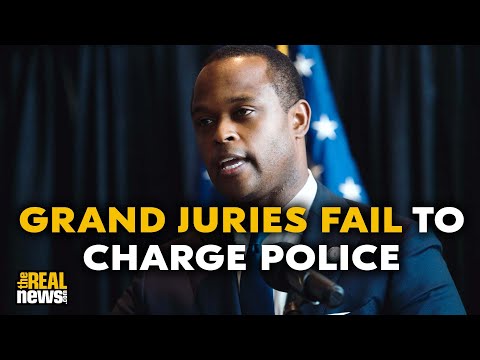
Breonna Taylor’s family was hoping for justice today, but the grand jury under the direction of Kentucky Attorney General Daniel Cameron came back with a decision that devastated them. Only one of three officers involved in the March shooting of Breonna Taylor was charged. Former officer Brett Hankison was charged with 3 counts of wanton endangerment, not for firing into Taylor’s home but for blindly firing into another apartment. Louisville residents have taken to the streets to protest the criminal justice system’s failure to value Black lives.
Transcript:
Taya Graham: Hello, my name is Taya Graham, this is Stephen Janis, and we’re here with the Police Accountability Report, Breaking News Update. One of the three officers involved with the raid that caused the death of Breonna Taylor in March of 2020 has been charged not with murder, not with manslaughter, but with reckless endangerment. Why were they charged with reckless endangerment? Not for the death of Breonna Taylor, not for the shots that were fired into her apartment, but for the shots that were recklessly fired into the apartment of a neighbor, endangering three people. Here to talk about it is Stephen Janis. So first tell me about what you heard from the Kentucky Attorney General, Daniel Cameron.
Stephen Janis: Well, Daniel Cameron said that the grand jury indicted Brett Hankison, who is one of three officers who fired into the apartment complex where beyond the Taylor lived. None of those bullets, according to the investigation, hit Breonna Taylor, but instead went into an adjoining apartment where three people were actually living at the time. And so the charges are related to three people who were living in that apartment at the time. They are three counts of wanton endangerment, which is a fourth class felony, but has nothing to do with actually the death of Breonna Taylor. It’s just because he endangered their lives.
He allegedly was in the parking lot, actually, when the raid was occurring, ran up to the window where he couldn’t see, and fire blindly. This officer, Hankison, has also been fired for reckless disregard for human life, and wanting endangerment is a similar charge for the reckless regard for human life which could lead to substantial risk of death. So that charge has, as you point out, nothing at all to do. The charges were handed down by a grand jury that was in panel to supposedly independently investigate this. But of course, there are questions about that right now.
Taya Graham: So, tell me a little bit about what you know about grand juries. There’s this saying that a prosecutor can get a ham sandwich indicted when they present it to the grand jury. Tell us how grand juries work, and are they actually independent?
Stephen Janis: These are extremely passive instruments. I mean, they are just people like you and I who were called into serving a grand jury, not legal experts, not investigators, and they are completely swayed by the information presented by the prosecutors. The prosecutors basically control what they see and hear, and the prosecutors are the ones who can propose statutes. And the Attorney General was very evasive about what statutes he proposed, what crimes he proposed, if he proposed any against the other officers.
Now, what’s really interesting about that is that the FBI has a completely conflicting ballistics report from the Kentucky state police because the state police said they could not determine which bullet killed Breonna Taylor of the six bullets that hit her, but the FBI determined that Myles Cosgrove’s bullet actually killed Breonna Taylor. So the question was, was the grand jury presented with a homicide count, or a murder count, or a manslaughter count? And he would not answer that question. I think that’s very revealing. We don’t know. The other question he wouldn’t answer about the grand jury was the racial composition of the grand jury. He said that he was not going to reveal that because grand juries are secret, but-
Taya Graham: He wanted to protect the grand jury, but I don’t really see how revealing that demographic information either about gender or race would injure the grand jury in any way.
Stephen Janis: No, I don’t think that that revealing… Giving their names and addresses might be one thing, but saying it was 30% African-American, I think, would be absolutely not disclosing anything that could harm anybody. So grand juries are not what they’re cut out to be. They are always posed by prosecutors as being these independent bodies, but they are swayed by the prosecutor. The prosecutor makes a decision what they see, and what they hear, and the evidence presented to them, and the context of the evidence. So, no, I think grand juries are farcical in some ways.
Taya Graham: Something that I think we need to add that the mainstream media hasn’t been paying much attention to is the fact that this Attorney General Daniel Cameron is a Republican who recently spoke at the Republican National Convention on Trump’s behalf, and he was also named shortlisted one of 20 on a list of possible Supreme court justices to be nominated by Trump. So do you think that these partisan politics might be injected in any way, especially because he kept on saying the words mob and mob justice? I feel as if he was trying to conflate protests, which may have had some criminal behavior, some criminal elements may have involved, but continuing to talk about mobs and mob justice, I feel like he was conflating peaceful protests with criminal behavior.
Stephen Janis: Yeah. I mean, if he uses that kind of language that Trump has used about protests, or saying they’re mobs, or they’re antifa… Using that kind of language and that rhetoric, I think, raises great doubts about his impartiality and about the way he conducted this investigation. One of the interesting things about what he said, and I think raises a lot of questions, was that he was not looking into the process for obtaining the warrant, which has been very controversial. Remember the investigators obtained several no-knock warrants that night. They had already arrested the suspect. It was an a old boyfriend of Breonna Taylor’s, they had already found drugs and confiscated most of the evidence, but he said, interestingly, that the FBI is looking into the how the warrants were obtained, because the very controversial aspect of the case is the fact that they obtained a no-knock warrant for someone who wasn’t even a target of the investigation, who was home with her boyfriend, and then pounded on the door.
Taya Graham: And I would like to add that the New York Times reported that 12 witnesses from the apartment complex were interviewed to ask if they heard the knock, and if they heard police announced themselves. And 11 of the 12 witnesses said that they did not hear the police announce themselves after they knocked.
Stephen Janis: And what [inaudible 00:05:26] is Attorney General Cameron said that they presented to the jury the evidence of one witness who said that that person had heard them announce themselves, which would have been very important in terms of predicating a crime, because that one witness became determinative in terms of what the grand jury was hearing. And it’s very interesting that other media organizations have combed that apartment complex and asked people, and found only one person who will corroborate that. So that’s a critical point about grand juries, too, is the fact that the grand jury was presented with the fact that they did announce themselves. Let’s remember Kenneth Walker, who was Breonna Taylor’s boyfriend said he never heard them say, “Police.” We’ve already played those recordings. So yeah, that raises great questions.
Taya Graham: And just to reiterate what Stephen said, Kenneth Walker, who was Breonna Taylor’s fiance, defended their home when he heard someone knock and then the door of their home was taken off its hinges. And Breonna Taylor was shot by at least six bullets. AG Cameron said that she lost her life within two minutes of being shot. This was a young woman who was an EMT, who wanted to become a nurse practitioner, who had a fiance, wanted to get married, and wanted to have children. And her life was taken away brutally in less than two minutes. So officer Brett Hankison has been charged with three counts of reckless endangerment. They are felonies. They could possibly carry a maximum of five years each, and we’ll see whether or not he’s actually brought to any kind of justice. I’m Taya Graham. This is Stephen Janis. This is Breaking News Update for the Police Accountability Report. Please be safe out there.
Production: Stephen Janis
Post-Production: Stephen Janis


