


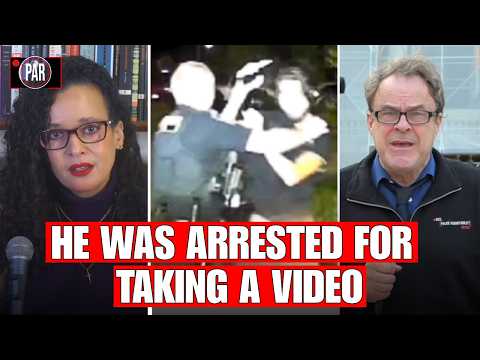
When Ismail Khan stepped outside his Conroe, Texas, home to film police arresting his sister, he never imagined he would end up in handcuffs himself. But after questioning a Montgomery County sheriff’s deputy, requesting his badge number, and recording the encounter, Khan was taken to the ground and arrested for interfering with public duties and resisting arrest.
In a very revealing exchange captured on body cam, Khan asks an officer if he was arrested for taking a video. The deputy’s answer? Simply, “Yes.”
Khan says he suffered injuries during the encounter and spent approximately eight months fighting criminal charges.
But his story raises a much bigger question: Why are people being arrested for interfering with police when they attempt to document law enforcement activity?
According to an investigation by Houston’s KPRC 2, interference-with-public-duties charges in Montgomery County increased by nearly 700% between 2017 and 2025, with the majority of resolved cases resulting in dismissal- so why the large uptick in these charges?!
In this episode of the Police Accountability Report, Taya Graham interviews Ismail Khan about his experience, examines the body-camera footage, and joins investigative reporter Stephen Janis to investigate how interference charges can affect the public’s ability to hold law enforcement accountable.
We also examine the broader implications of expanding police power, surveillance technology, and the constitutional right to document government officials in the course of their duties.
Credits:
- Production/Post-production: Taya Graham, Stephen Janis
- Written by: Stephen Janis
Transcript
The following is a rushed transcript and may contain errors. It will be updated.
Taya Graham:
Hello, my name is Taya Graham and welcome to the Police Accountability Report. As I always make clear, this show has a single purpose, holding the politically powerful institution of policing accountable. And to do so, we don’t just focus on the bad behavior of individual cops. Instead, we examine the system that makes bad policing possible. And today, we will achieve that goal by showing you this video of a man who was arrested by cops while standing in his own driveway, a detainment that included handcuffs, charges, and violence. And it’s now part of an ongoing battle between the police and an innocent man. But before we get started, I want you watching to know that if you have video evidence of police misconduct or brutality, please share it with us and we might be able to investigate for you. Please reach out to us. You can email us tips privately at par@therealnews.com and share your evidence of police misconduct.
And also please like and comment. I really do read the comments and appreciate them. And you see the little hearts I give out down there. And commenting and sharing can even help our guests. So please take a moment to let us know your thoughts and you might be able to be the PAR comment of the week. Okay, now that’s out of the way. Now, police in America have unprecedented power. In a country that purports to treasure freedom, the presence of law enforcement with great legal latitude to detain, cage, and otherwise disrupt our lives creates an uneasy, often uncomfortable reality that our rights are often provisional. And no case embodies this reality more acutely than the video I’m showing you right now. It depicts the arrest of a Texas man who is doing nothing more than the very American act of asking an officer a question.
But as you’ll see, he paid a steep price for that privilege. Now, the story starts in Conroe, Texas, where Ismail Khan was inside his own home when he heard a commotion outside. He walked out onto his driveway only to stumble upon an unfolding scene of an officer pointing a gun at his sister. Let’s watch and as we do, I’ll talk to Ismail about what we’re seeing. Ismail, first, thank you so much for joining us.
Ismail Khan:
Of course. Thank you.
Taya Graham:
So why was there an officer outside your home and who summoned him? And as you answer, let’s watch the body camera so that you can explain what we’re seeing.
Speaker 3:
Right on Anilac Run. Why?
Ismail Khan:
So actually the police were not called. My sister was just being pulled over for a traffic stop. So what happened was on April 25th, 2025, my family and I were looking for her. So she was reporting and then by the time of that incident on April 27th, 2025, she had already been located. So what happened was is she didn’t pull over as quickly as he wanted her to, but she put her hazard light on because during that time, this is when they were ramping up ice operations and all that. So she was a little bit paranoid too. So she just wanted to pull up in front of the house so that she could have a witness.
Speaker 3:
Stay in the car. Can you put your hands up on that car for me please? Sir, put your hands up on the car. Why
Ismail Khan:
Me?
Speaker 3:
Because I need to find out what’s going on to me. Put your hands up, come back to me. Put your hands on the hood of my car. We’ll talk later. Put your hands on the hood of my car now.
Taya Graham:
Okay, so the officer who pulls up is really aggressive. He’s already pulled a weapon and is pointing it as it appears at both you and your sister. Why did he take such a risky action without evidence of a violent crime? Let’s watch again as you talk about what we’re seeing.
Speaker 3:
Put your hands on the hood of my car. We’ll talk later. Put your hands on the hood of my car now. Put your hands on the hood of my car right now. I need you to put your hands on that car, please. I’m asking you nicely.
Speaker 4:
Stop escalating it.
Speaker 3:
Put your hands on the hood of my car. We got a couple of people that are being non-compliant right now.
Ismail Khan:
I honestly have no idea why they were aggressive. To me, it looked like the officer that initially pointed the gun, he wanted to use the gun. It didn’t look like he wanted to deescalate it.
Speaker 3:
Give me just a second. Can you turn around and put your hands behind your back please? Turn around and put your hands behind your back now. Turn around and put your hands behind your back now.
Speaker 5:
Okay. I am cooperating literally.
Ismail Khan:
So I felt that he wanted to shoot something.
Speaker 3:
Turn around and put your hands behind your back now.
Ismail Khan:
I honestly don’t think that that situation warranted a gun and I have no idea why he pointed a gun at her.
Speaker 3:
Get away from me. Get away from me right now. Get away from me. Get away from me now.
Taya Graham:
So you do something that apparently makes the officer even more aggressive, which is frankly pretty routine. You ask for his badge number and for a supervisor. What happens when you ask that question?
Ismail Khan:
I just wanted to get it on video of what was going on because I saw that he was acting aggressively at first. So that’s why I had started taking a video and that I asked for his badge number and to call for his supervisor. And then as seen in the footage, she actually gets mad when I ask for the supervisor.
Speaker 6:
No, he’s going to arrest you.
Taya Graham:
Stop fighting back. Stop fighting back. So you approach with your phone and the interaction quickly turns violent. Let’s watch as you tell us what’s happening and what you’re thinking.
Speaker 7:
Get away from me right now. Get away from me. Get away from me now. Get away from me.
Speaker 6:
Smile. No, he’s going to arrest you.
Speaker 3:
Stop fighting back. Stop fighting back. Put your hands behind your back now. Put your hands behind your back now. Kyle, don’t fight back. Listen to
Speaker 5:
Me.
Speaker 3:
Do not fight your
Speaker 5:
Back.
Speaker 3:
Put your hands behind your back now.
Speaker 5:
Help. Help. Get on your stomach. Please help. Please help.
Ismail Khan:
I think that he was just fearful and that he isn’t… I don’t think that he had what it took to be a deputy or a copy because he’s immediately resorting to pulling out his gun, which tells me that he’s just scared of every interaction. Or that also tells me that he just wants an excuse to use his weapon on somebody. And they’re also, I guess, trained on escalation, so it doesn’t seem like he had any intentions of deescalating the situation. So when he tells me to get on my stomach, he’s doing it because he’s scared that I’m a criminal or something.
Speaker 7:
Get on your stomach. Please help. Please help.
Ismail Khan:
Please. Nobody, please
Speaker 7:
Help.
Ismail Khan:
Yeah. And I knew that since he was a little bit jumpy that it’s better if I just comply with his commands before he just pulls out his gun and shoots one of us.
Taya Graham:
Ms. Miles, somebody help, please. So the officer takes you to the ground and handcuffs you, but he’s really rough and doesn’t, as far as I can tell, still doesn’t have a basis for arresting you. How did you feel about the fact that he wasn’t justifying the arrest while being so aggressive? And did you sustain any injuries? Let’s watch what the officer does and you tell me a little bit more about it.
Ismail Khan:
He’s actually grabbing me by my collar so that he can do a move to throw me to the ground, and I think that’s actually what caused my shirt to rip. I would characterize it as extremely aggressive and unwarranted and based off of emotion because he got his feelings hurt.
Taya Graham:
Okay. So they put your sister in the police car and it seems like she’s under arrest. What did they charge her with and what happened to her eventually?
Speaker 7:
Stand up now.
Speaker 6:
Please. Miles, stop talking back. Please stop talking back. It’s Mile, please talk.
Ismail Khan:
So at that point, she was charged with a felony evading allegation, and so she took deferred adjudication. She didn’t want to risk it at trial, which is understandable. So now she’s still on probation. But yeah, they actually had her do very strict probation measures here in Montgomery County and they’re known to be very, very ruthless and they require you to come in and do a bunch of drug tests. And her charge is not related to a drug test or anything like that. So she got moved to Harris County. She moved to Harris County and then they were more lenient with her. So she’s allowed to walk around and be free. Her probation will be over in a couple months.
Taya Graham:
So the officer approaches you while you’re on the ground. He asks you to ID yourself or give your name. Now you don’t provide it. Why didn’t you want to ID yourself to this officer?
Speaker 3:
What’s your name, sir? What’s your name? Because you’re under arrest. What’s your name? I’m going to ask you one more time, then I’m going to charge you with an additional charge or fail to ID.
Ismail Khan:
I just felt like the whole basis of the arrest was already… It didn’t have any substance to it. So I felt that him trying to get my identification was very deeply unfair and I just did not want to go to jail at that point.
Taya Graham:
There’s a strange moment when you have a pretty pointed exchange with the officer. You say that the officers all flared up and he responds rather pointedly to your comment. What did you say and what did you think about his response?
Speaker 3:
Do I seem flared up to you? Do I seem flared up to you?
Speaker 4:
Yes.
Speaker 3:
I do.
Speaker 4:
What’s your problem?
Speaker 3:
What are you talking about?
Speaker 4:
What’s your fucking problem? I’m asking you a fair question. Why are you Patrick?
Speaker 3:
I think we’re going to be better off if you just stay quiet, dude.
Ismail Khan:
Yeah, so I asked him, “Why are you so flared up?” Because he was visibly flared up and then he was like, “Do I seem flared up to you?” And I said, “Yes.” And from his mannerisms, you can tell that he just was going on a little power trip and a little ego trip.
Taya Graham:
Now he said he was charging you both with interference and taking a video, which he also said was interfering. Let’s watch a bit and tell me what you thought about the charges at the time and his justification for arresting you.
Speaker 3:
Are you trying to get me to fight you or what are you –
Speaker 4:
Why did you throw me on the ground?
Speaker 3:
Because you’re under arrest.
Speaker 4:
For what?
Speaker 3:
Interfering with public duties.
Speaker 4:
By taking a video?
Speaker 3:
Yes.
Speaker 4:
You’re literally in so much trouble.
Speaker 3:
Am I?
Speaker 4:
Yeah. Okay. What’s your fucking badge number?
Speaker 3:
13139.
Ismail Khan:
I do not believe that that assertion was credible because interference with public duties requires you to physically obstruct with an officer and stop him physically from doing his duties or in any way, shape or form prevent him from carrying out his duties in his official capacity. So what I was doing was I was filming and I had kept my distance as visibly seen in the dash cam. So there’s no way that they can actually realistically charge me with interference with public duties.
Taya Graham:
So when the officer takes you to the patrol car, there’s an altercation. What happened and why did the officer threaten to tase you? Let’s watch and then get your response.
Speaker 3:
Walk back here to this door. Help me get his hands behind his back
Speaker 8:
Please.
Speaker 3:
He’s cuffed in the front.
Speaker 8:
I tried to tell you what’s going to happen. I’m going to tase you if you resist anymore. Do you understand that? Would one of you mind getting his leg for me?
Ismail Khan:
So what happened was he actually started shoving me towards the vehicle by my neck. So all that I did was tell him to stop doing it and I kind of went like that. I was like, “Don’t push me.” So he used that as a resisting during transportation charge. So that’s why it resulted in me being thrown to the ground and then those other deputies coming in and then forcefully moving my cuffs from the front to the back.
Speaker 3:
All right. We’re going to get up and walk you again. If you fight us again, you’re going to go to the ground again, all right? Or would you rather us carry you? Stand up. Just put him in your car, man.
Taya Graham:
Honestly, when I watched that interaction, it looked painful. Was it? And did it cause any more injuries? Let’s just watch a little bit of it and then talk about it as we watch.
Ismail Khan:
Oh yeah, it was definitely painful because what he had done was he put his full body weight on my jaw as the other deputies were repositioning the cuffs from the front to the back. So by that moment I had actually had scars in my wrists because he put the cuffs on so tight. So yeah, when he put his full body weight on my jaw and they were doing that, I felt like my neck was going to snap.
Taya Graham:
So who is the officer who initiated this use of force? He was not the same officer who arrested you, correct?
Ismail Khan:
That was the second officer that arrived on the scene, Devin Mays. So when he came on the scene, he didn’t even know exactly what was going on. He just immediately resorted to matching his friend’s aggression and was like, “I’m going to tase you if you keep resisting.”
Taya Graham:
Now, finally, after you’re placed in a patrol vehicle, the officers have a conversation on body camera where they acknowledge that they knew your sister was a missing person. Does that raise questions for you as to why they pulled weapons and responded in this way when they knew this?
Speaker 3:
Do you know what’s up with this?
Speaker 8:
I don’t know. They put a case number on our thing. I have no idea what it’s about. I know this flock hit’s been hitting like three or four days now.
Speaker 3:
Yeah, she hit in the woodlands, got behind her. She’s in my car. He was in the driveway, wouldn’t put his hands up or anything like that. He started interfering. Go to take him to the ground. He’s trying to kick me. So taking him from interfering. She’s probably going for evading, dude, because we went like six miles running stop signs and everything else. I just want to see what’s going on with y’all’s case.
Speaker 9:
I’ll read it and we’ll just remove it from missing.
Speaker 3:
Is there anything to it or is it just kind of – I don’t know.
Speaker 9:
There’s a report on it, so I’m going to read it. All right.
Speaker 3:
I appreciate it. She’s a missing person and I go to stop her and she just took off.
Speaker 4:
Where’s she at?
Speaker 3:
She’s in my car.
Speaker 4:
Oh yeah, he’s secured.
Speaker 3:
I was. Once I got them both detained, I tried slowing everyone down, but when we moved him to the next car, he wanted to twist off again. Hey, is a missing person LPR hit? When I went to stop her, she just kept going like five miles, six miles, running stopwatch signs and stuff. So it’s going to be a pursuit.
Ismail Khan:
So I believe that the way it works with our county is that they only care about one thing and that’s making money. They don’t actually care if you’re innocent or guilty. So it’s actually very popular in our county for people to make false arrests. And a lot of people had actually told me that the same thing happened to them too, where they got arrested for filming and they tried to sue the deputies and a lot of people are in pending litigation too. And our county does not like to lose either, so it’s actually become a trend.
Taya Graham:
Ismail, thank you so much for joining us and we wish you and your family the best in your fight for justice. And now I’m joined by my reporting partner, Steven Janis, who’s been researching the case and reaching out to the police department. Stephen, thank you so much for joining me.
Stephen Janis:
Hey, thanks for having me. I appreciate it.
Taya Graham:
So Stephen, before I ask you about what police are saying, what do you think about this arrest? I mean, what are your thoughts about the legality and what it indicates about law enforcement practices in general?
Stephen Janis:
Well, I’ve seen this kind of case before and it’s very disturbing every time I watch it. In other words, you start filming police and for some reason they think they have the law on their side that they can arrest you for actually filming them. I think that’s absolutely contrary to the First Amendment. I find it very problematic. And I think in this particular case, the officer demonstrated that he had sort of this sense that he had all the power in the world to be able to go out and arrest someone just for pulling their camera up and filming the police, which is legally allowed.
Taya Graham:
Now, there’ve been some developments since we interviewed Ismail. Can you share them with us?
Stephen Janis:
So just before we shot the par, Ismail contacted us. It looks like the Montgomery County State’s Attorney’s Office or the disciplinary arm of this Montgomery County Sheriffs are not going forward with disciplinary charges against these officers. I think Ismail had filed a complaint and wanted to see some follow through from law enforcement. Once again, law enforcement fails to hold itself accountable.
Taya Graham:
And there was also some excellent reporting by local media about Ismail’s arrest and this idea of interfering. Can you talk about their findings and what does the law actually say?
Stephen Janis:
So tell you, there’s some great local reporting on interfering arrests by KPRC, which an investigation found that interfering arrests had gone up in Montgomery County almost 700% between 2017 and 2025. The statute itself is pretty explicit about saying you have First Amendment rights. You can be arrested, for example, for I think pushing officer or literally physically interfering, but it says the First Amendment rights are protected. Of course, we all know famously Turner v. Driver established a right to film police in Texas or in that district, the Fifth Circuit, which I think would include Montgomery. So it’s really interesting and I think raises a lot more questions. Why are police arresting so many people for bogus interference? Because almost 50% of the charges on average over those years were dropped. So it raises a lot of questions that are still unanswered, but we’ll keep working on it.
Taya Graham:
Hey Steven, I noticed you’re wearing a very intriguing pullover. Is that your new outdoor outerwear? And where can I get one?
Stephen Janis:
So yes, Tay, you are correct. I have official police accountability report outerwear, and actually people show me a lot of respect. I get discounts on drinks, all sorts of stuff, camping gear, things that I need to stay outside as much as possible. And this is very warm and yeah, what?
Taya Graham:
I am going to have to get one for myself, so make sure you save one for me.
Stephen Janis:
Okay. I promise I will get one for you. I didn’t mean to leave you out. It just came to my address first, so I’m kind of happy and I’m going to keep wearing, but I promise I’ll get you one soon.
Taya Graham:
All right. I’m going to hold you to that. And Steven, thank you again for your reporting. Now, this is a part of the show where I have my say about what we just watched, a segment where I often try to link the abusive power we just witnessed with a broader critique of the system in general. But today, I’m going to go a little bit further than drawing vague parallels or revealing allegories. I’m going to push the parameters of this rant just a little bit to make a point that I feel needs to be explained, understood, and comprehended if our democratic republic is going to survive. And this point is not just about policing. It’s not just about a couple of arrogant cops who though it was not just okay, but actually unavoidable to aim their weapons at Ismail and his sister for failing to stop at a stop sign.
What this is about is something deeper, bigger, and more consequential than, as we say, the bad behavior of individual cops. And it’s something that needs to be said now. On this show, which we have been producing for almost seven years, there’s always a singular point we make from the start to finish. Something we do that is more important than all the investigations put together, and it’s this. Policing, as we’ve been told, is not just about stopping crime or fighting bad guys or enforcing public order. It’s not one of an array of government agencies designed to serve the public hardly. Policing is simply power, not just the power of the electoral variety or administrative or corporate. It’s an entirely different type of power, which is what makes holding it accountable and curbing its appetite so difficult. Let me explain. Recently, police departments and local governments across the country have been installing Flock cameras in our neighborhoods and our roads to track license plates.
It’s a pretty scary technology that, thanks to AI, allows law enforcement to monitor the movements of all of us in exacting detail and terrifying accuracy. So terrifying that the system can store and pinpoint every place and everything you did during a 30 day period, and in some criminal cases, even longer. It’s a marriage of technology and surveillance that means the government has the power to literally document every single move, stop, visit, and trip with very few restraints. But that’s not the end of what Flock can do because apparently for a group of cops across the country, it can help you chase a romantic partner. A recent story in the Washington Post revealed dozens of officers across the nation have used Flock, not for criminal investigations or to fight drug trafficking. No, they used it as a hostile digital Cupid. That’s right. Cops confronted with an omniscient technology chose to track the locations of ex-boyfriends and girlfriends and prospective romantic partners armed with a questionable tool of unspeakable power.
They simply decided to aim it at the people they wanted to screw, literally. The abuse has been so widespread and so pervasive that Flock told the Post they were installing new safeguards to prevent officers from using it from pursuing romantic partners. The scandal has also led to indictments and charges against multiple officers. But I think this misuse of Flock points to another problem beyond the lack of law enforcement discretion, a deeper problem about the special brand of police power that I’ve already discussed that warrants further attention. Simply put, police power in its current form is anti-democratic. In its current state, as it is presently fashioned, law enforcement power works against the preservation of our free society, not to sustain it. It is in essence capable of undermining our constitutional rights in ways that are not as obvious as we might think. I mean, take Flock cameras as the example.
To put a camera on every corner, on every street to monitor the movement of Americans would have been unthinkable to the people who wrote our constitution. The potential for abuse and the presumption that the technology would be used for questionable ends is too obvious. And I think they would have ruled it out from the start. And yet, without considering these broad implications, police departments across the country started purchasing Flock systems with abandon. The New York Times estimates up to 7,000 police departments have purchased Flock systems. That is roughly a third of the total number of local law enforcement agencies across the country, a third. Before we even ask the question, not just can we, but should we? So what’s illustrative about the spread of Flock is not just that we, meaning our country, adopted them wholesale before a fulsome debate could occur, but it is also worth noting the government agency which facilitated and advocated for its spread, namely law enforcement.
I make this point because it is through the cover of policing that our government’s most anti-democratic policies spread. Just take a look at this list. Mass incarceration, policing, the generationally traumatic drug war, policing, massed officers arresting US citizens, federal policing, confiscation of property without due process, policing, zero tolerance and mass arrests, policing, illegal shooting and killing of civilians, policing. And I’m not even mentioning administrative warrants being used by the federal government to search the social media accounts of people who criticize, that’s right, criticize the government and policing. Do I need to read the First Amendment? Maybe I should just for reference for the government officials who apparently haven’t. Congress shall make no law respecting establishment of religion or prohibiting the free exercise thereof, or abridging the freedom of speech or of the press or the right of the people to peaceably assemble and to petition the government for a redress of grievances.
But of course, who cares about that when you have to stop troublemakers from writing Facebook posts that say you’re bad at your job or send you an email saying that you’re really, really bad at your job and a few days later, send FBI agents to show up at the door of the critics. All this actually happened. And if you don’t think that’s possible, let’s not forget about Larry Bouchard who was jailed for 57 days for posting a comment about the killing of Charlie Kirk. That’s right. Jailed for a Facebook post and all of this, every single intrusion on an exclusion of our rights is at the behest of policing. All of the concerted efforts to surveil, harass, or otherwise diminish our right to free movement and though is curtailed to please police, all of it, every single last aspect of it to keep law enforcement happy.
So when we witness questionable arrests like that of Ismail and his sister, or when we watch police rip a man out of his car under the pretext of a broken taillight, or when the government seizes our property without due process or throws us in jail for sharing our thoughts, however offensive, it is the contemporary institution of policing that makes it all possible. This doesn’t mean we don’t need police. It doesn’t mean we’re against the idea itself, but what it does mean is that with the special and unusual powers we grant law enforcement comes the special and unusual abilities to hold it accountable. What it also means that in a country that values freedom and rights above all else, we must be cautious of how much we empower people with guns and badges, which is something we promise we will continue doing if we’re nothing else than to make sure that not another single right that we hold dear is cast aside to embolden and empower the American law enforcement industrial complex.
I promise that we will continue to expose it. I’d like to thank my guest, Ismail, for sharing his experience and standing up for his right to record, and we really wish his family the best in recovering from this. And of course, I have to thank Intrepid reporter Stephen Janis for his writing, research and editing on this piece. Thank you, Steven.
Stephen Janis:
Tay, thanks for me. I appreciate it.
Taya Graham:
And I have to thank mods of the show, Noli D and Lacey R for their support. Thanks Noli D, and a very special thanks to our accountability report, Patreons. We appreciate you and I look forward to thanking each and every one of you personally in our next live stream, especially Patreon associate producers, John ER, David Kaye, Louie P, and super friends Shane B. Pineapple Girl, Chris R, Matter of Right, and Angela True. And I want you watching to know that if you have video evidence of police misconduct or brutality, please share it with us and we might be able to investigate for you. Please reach out to us. You can email us tips privately at par@therealnews.com and share your evidence of police misconduct. You can also message us at police accountabilityreport on Facebook or Instagram or at eyesonpolice on Twitter. And of course you can always message me directly at TayasBaltimore on Twitter or Facebook.
And please like and comment. I do read the comments and appreciate them. And we have a Patreon link pinned in the comments below for accountability reports. So if you feel inspired to donate, please do. We do not run ads or take corporate dollars, so anything you can spare is greatly appreciated. My name is Taya Graham and I’m your host of the Police Accountability Report. Please be safe out there.

