

Tom Ferguson: Obama-GOP bill a weak stimulus plan but a big give away to the super rich
Story Transcript
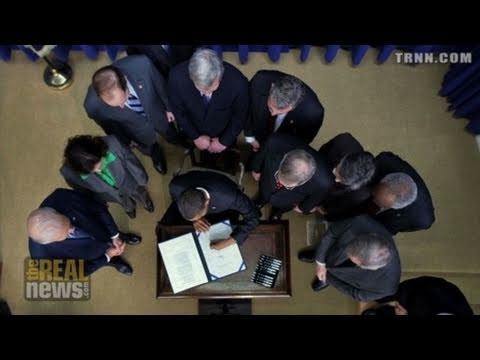
DANYA NADAR, TRNN: On Friday, December 17, 2010, President Obama signed into law an $850 billion tax cut package after receiving clearance from the US House of Representatives. On Wednesday, the Senate overwhelmingly passed the legislation by an 81 to 19 vote, and on Thursday the House approved the bill by a vote of 277 to 148 members. The Middle-Class Tax Relief Act [Tax Relief, Unemployment Insurance Reauthorization, and Job Creation Act] provides a two-year, across-the-board extension of Bush-era tax cuts, a 2 percent rollback of Social Security payroll taxes, extends unemployment insurance for 13 months, and brings back the estate tax at 35 percent for 2 years on estates of more than $5 million. The bill also ensures that tax rates won’t rise on almost all Americans on January 1, 2011. Prior to signing the bill into law, President Obama spoke about the importance of this legislation to middle-class Americans, to stimulating the economy, and to job creation.
PRES. BARACK OBAMA: First and foremost, the legislation I’m about to sign is a substantial victory for middle-class families across the country. They’re the ones hit hardest by the recession we’ve endured. They’re the ones who need relief right now. And that’s what is at the heart of this bill.
NADAR: The Real News spoke to Tom Ferguson, senior fellow at the Roosevelt Institute, and asked him who he thinks benefits from this new law.
THOMAS FERGUSON, PROF. POLITICAL SCIENCE, UMASS BOSTON: The question here of who wins and who loses on this, I think it’s real clear who actually wins. It’s America’s superrich, ’cause the real issue was not whether there was going to be a tax cut for middle-class and poor Americans. President favored that. The Democrats in Congress favored that. The remarkable thing here is the president effectively dealt with the Republicans, undermined his own party, especially in the House of Representatives, and then awarded a tax break to the people who garnered most of the income in the United States, the increase in income in the United States, over last 10, 20, or even 30 years. So who won? The superrich. That’s obvious. There is something–there’s about $60 billion worth of unemployment compensation there. You know, that’s got to help, sure, people who are unemployed. The striking thing here, though, you want to pay attention to is how the White House has just–was so slow on this. They spent most of the year messing around on unemployment benefits. They didn’t do anything. When they finally decided they were going to lose the election, they did an extension earlier, and they only put the extension through to November 30. That’s why they had to do this again. A couple of other striking things about this bill. I mean, they did chop the Social Security tax for a couple of percent for a year. Now, that’s a really interesting thing, because what it’s going to do is put them in the position, as the tax goes back at the end of the year, of opening themselves to the charge that they raised taxes in an election year. And, you know, my take is that’s going to make it hard to just let it go back up. And Social Security is not, as we’ve sometimes discussed on this program, in any real danger at all, not for decades. But it will make the short-run finances of Social Security look worse. My reading of this is the White House in fact is operating here to try to squeeze cuts in Social Security either soon or in a year or so. I really think that this is an extension of the deficit commission politics there. Now, in terms of, you know, do we get an economic stimulus?, yeah, we do, and, you know, as somebody who thinks we haven’t had a big enough economic stimulus, I’d favor that. Here’s the thing, though. If you’re going to stimulate the economy, tax cuts are about the worst possible way to do it. In the end it’s going to be the unemployment compensation, maybe the chopping of the Social Security tax itself, and maybe some of the accelerated depreciation provisions, and things like that in the bill. It’s not going to be–most of the tax cuts are going to end up–that go to the superrich are going to be saved. This is a lousy way to get a stimulus. I think the real value of this whole business is it shows you how cheap is all the talk about the deficit, because two weeks ago they were all talking, oh, deficit, deficit, deficit, we’ve got to cut it, blah blah blah. At, you know, basically the first sign of a proposal from the Republicans, the White House and Republicans agreed to let’s just cut taxes. I mean, this shows you the worthlessness of American political rhetoric and, you know, the startling fact that the White House didn’t even try to make much of an argument on this in favor of a sort of traditional Democratic bill.
NADAR: Many members of the House who voted against the bill, such as Representative Anthony Weiner, expressed concern that President Obama and lawmakers will face enormous election-year pressure in 2012 to extend the cuts again or to make them permanent.
End of Transcript
DISCLAIMER: Please note that transcripts for The Real News Network are typed from a recording of the program. TRNN cannot guarantee their complete accuracy.


