

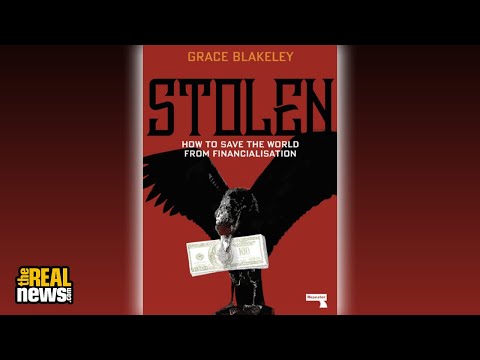
Labour Party advisor and author Grace Blakeley discusses her just released book, Stolen: How to Save the world from Financialization.
Story Transcript
GREG WILPERT: Stolen: How to Save the World from Financialization. This is the title of a recently released book by Grace Blakeley. She is an economic commentator and a member of the National Policy Forum of Britain’s Labour Party. We caught up with her in Washington, DC on one of her stops on her U.S. book tour.
Her book is divided into seven chapters. The first discusses the economic history of the world before financialization took hold. Chapters two, three, and four discuss the financialization of the corporation, the household and the state. Chapter five covers the roots of the 2008 global financial crisis, and chapter six looks at the post financial crisis world. The book concludes with a set of ideas for getting beyond financialization and towards democratic socialism.
I began by asking Grace to explain what she means by financialization of the corporation.
GRACE BLAKELEY: The idea of financialization is the kind of the growth of a financial institution, so banks which lend money and investment firms, people that kind of operate in stock markets, undertake investment in various different parts of the economy. So it’s kind of the logic of lending and investing, and so those institutions themselves grow, but also, the main kind of idea is the logic of finance kind of infiltrates different areas of the economy. So different sectors become financialized. As you said, I look at the financialization of the corporation, the household and the state, and starting with the corporation.
In fact, the financialization of the corporation takes off in around the 1980s, when you get a big kind of deregulation of stock markets, and kind of deregulation of other financial institutions and investors, and that leads to, along with the removal of restrictions on capital mobility, the ability of money to kind of flow around the world, and the rise of the kind of institutional investor. So big asset managers, their own big chunks of the stock market, often based on the fact that they’re investing people’s retirement funds. So they’re buying up lots of shares, and they’re able, often, to wield quite a lot of power over these corporations.
So as institutional investors grew in the ’80s and ’90s, they started to kind of enforce this logic of shareholder value, and they were helped along by kind of corporate raiders, activist investors, the kind of baddies that you had emerge in the ’80s who would take out loads of debt, buy up corporations, strip out the assets and then sell them off on the cheap. So the kind of logic of shareholder value, which basically is the idea that the only responsibility of a corporation is to maximize value for shareholders, kind of became really dominant in the ’80s.
There was just such a discipline on shareholders to just pay out as much money as possible to do share buy backs to have in their corporate plan, a plan to make sure shareholders were getting as much money as possible. The cooperator kind of came out of existence, and you started to just see, the kind of next wave of financialization that came after that was this huge wave of mergers and acquisitions activity that led to a really monopolistic form of capitalism that we have today.
That kind of financialization, it was driven by a bunch of different events in the ’80s, but it’s now very much institutionalized, and has led to a series of problems, really, with Anglo American capitalism. The first one being there is reduced investment. So rather than kind of building factories, investing in research and development, companies will just take their earnings and distribute them to shareholders, but it’s also led to falling wages, because obviously, you’re trying to maximize profits, to try to maximize returns to shareholders, you’re trying to cut costs at the same time. So investment in the U.S. is pretty low and it’s falling, and the average worker is no better off today than they were in the late 1970s. So this is all being driven largely by the financialization of the corporation.
GREG WILPERT: The notion that the corporation has become financialized is something that many economists have observed before. Less common is the observation that the household and the state have also become financialized. I thus asked her what she means by the financialization of the household.
GRACE BLAKELEY: It’s about political economy. So it’s about politics and economics, because the problem that that financialization of the corporation created was, obviously, rising inequality. When you tend to get rising inequality, you get lower levels of spending at the bottom, which kind of tends to reduce growth and slow the economy down a little bit. So the logic of the financialization of the household was basically to replace wage growth with private debt and with private asset ownership. So deregulating the banks meant that they could issue lots of debt to households. Households could then go out and spend more money than they were earning, which kept the economy going, and it also allowed them to buy houses and buy other assets that would then increase in value because so many people were trying to buy them. So obviously, that led into the housing boom.
Really, the kind of logic of this, for those kinds of neoliberal leaders like Thatcher and Reagan who were really pushing financialization, was to create a class of kind of mini capitalists who owned a bit of property through their 401k through their house, that made them kind of have an incentive to support the status quo, even if their wages weren’t rising as much as they had before. They had this wealth, and there was an incentive to protect that wealth. So that was the kind of political underpinnings of the financialization of the household. Ultimately, of course, it leads up to the financial crisis, because you have such high levels of private debt, such high levels of inflation in the stock market and house prices, that it creates this big bubble that ultimately crashes in 2008, to the detriment, largely, of ordinary working people.
GREG WILPERT: She then went on to explain what is meant by the financialization of the state.
GRACE BLAKELEY: You would have thought before this that the state would step in and say, “Too much borrowing, the economy’s unstable, we need to regulate the financial system properly,” but really, Wall Street in the U.S., the city of London and the U.K. had its core so deep into the state at that point, in various different ways, that this regulation just didn’t come about. Actually, there was quite a lot of deregulation of the finance sector throughout the ’90s and aughts.
Obviously, in the U.S., you had the repeal of the Glass-Steagall Act, which ultimately led up to the financial crisis. At the same time in the U.K., and to an extent, in the U.S., you had the kind of incursion of private investors into state spending, whereby rather than spending money itself, the state would have private investors undertake that spending on its behalf through public-private partnerships, private financing initiatives, these sorts of things. That kind of allowed finance to basically have a subsidy from taxpayers, as well as being less regulated and all that sort of stuff. So yeah, you kind of see all the ways in which the power of the finance sector starts to change the behavior of lots of different other actors in the economy, and ultimately, it leads up to the crisis and to the kind of stagnation that we’ve seen since then.
GREG WILPERT: I was puzzled, though, why she referred to the processes as financialization instead of neoliberalization. That is while the idea that the economy and the corporation has become financialized is not unusual, most discussions of this topic referred to the concept of neoliberalism as the overarching term for describing the phenomenon of the growing role of finance capital, of privatization, and of the increasing predominance of self-employment and the household that becomes an enterprise to itself.
GRACE BLAKELEY: For me, neoliberalism is the ideology. So it’s the set of ideas that surround this. It’s the idea that human welfare is best maximized through the freeing up of markets and that the state should play a role in creating those markets where they don’t exist, but finance, that growth is almost the result of that. It’s the economic model that emerges from the application of neoliberalism, and that tells you something about neoliberalism, which is that it’s an ideology that’s promoted by a set of interests, primarily in the financial sector, who expect to benefit from the imposition of this ideology.
So I see them as basically running alongside each other, but it’s really important that we understand the, the structural kind of factors that emerge from the imposition of neoliberalism, rather than just seeing it as an ideology that we can just attack. We need to understand the power relations that sit underneath it.
GREG WILPERT: Grace’s book does a good job of explaining how the financialization of the corporation, the household, and of the state led to the global financial crisis of 2008. Since this is a topic we have covered at The Real News on many other occasions, I decided instead to focus on how she sees the post-crisis world. After all, immediately after the crisis, there was a general belief that neoliberalism and financialization had run their course and would be replaced with something else, but this has not happened, it seems.
GRACE BLAKELEY: In the aftermath of the financial crisis, many on the left are kind of like, “Well, this proves that everything we’ve been saying for long time is right, so obviously we’re going to get socialism now,” but of course it doesn’t work that way. The ideology that was associated with the finance growth of neoliberalism was also really, really powerful. It was associated with this idea that history was over, capitalism had won, and people really did believe from the end of the ’80s through to the financial crisis that things would continue to get better and better and better. That doesn’t just get undone overnight. It takes a while to accustom yourself to the fact that things aren’t just going to go back to the way they were before, because in the depths of the crisis, it was still possible to believe that if we just did the right things and we just listened to the experts, things would go back to the way they were before the crisis and everyone would go back to having massive homes and loads of debt and whatever.
It’s only been 10 years later, more than 10 years later, after we’ve had wage stagnation, productivity stagnation, rising inequality, ongoing housing crises, ongoing financial instability, all sorts of problems with the economy that people are starting to think, “Right, okay, things are never going to go back to the way they were before.” That’s actually a more revolutionary moment than in the midst, the depths of a crisis. In the depths of a crisis, people are scared they kind of want to cling on to stability, whereas after a long period of stagnation, people are more likely to say, “Right, I’m not going to benefit from the status quo anymore. I’m going to put my weight behind radical change.”
I think that’s the position that we’re really in today. I think it’s why we’re seeing so much political turmoil. It’s because an increasing number of people realize they have so little to gain from the status quo, especially young people. Many of them are never going to be able to buy their own houses, and even if they do, they’re kind of eeking out this precarious existence where they’re not getting paid very much, they’re paying loads of money just to survive, and they’re working really hard, ultimately, for a life that isn’t particularly satisfying, and on top of that, climate breakdown. So I really think that a lot of people are starting to say, “Enough is enough. Let’s think about some radical changes.”
GREG WILPERT: I agreed with her that the legitimacy of neoliberalism has been and continues to be questioned throughout the world. However, the structures of neoliberalism, that is the financialization aspect, remains in place. For example, the International Monetary Fund, the World Bank, the World Trade Organization, and the financial structure of the world all continue to force their neoliberal policies on the rest of the world. I thus asked her what this means for her proposal to push for democratic socialism.
GRACE BLAKELEY: I see this project that, the kind of socialist project in general, the kind of ideas I put forward in the book, as being based on an analysis of power relations as they exist today and charting a route to get from here to there. There is absolutely no way that neoliberalism is going to crumble before our eyes and we’re going to be able to just rebuild something brilliant out of the spoils. We have to work out how best to challenge its dominance and rebuild, and basically use that strategy to rebalance power away from capital and towards labor. I don’t think that policies are going to deliver us socialism. I think people will deliver us socialism, they will deliver us socialism by demanding socialism.
So control over the state and controlling these institutions, what it primarily does is it gets out of the way of these big movements. You’ve seen the way in which the IMF, the World Bank, et cetera, have tried and failed to impose neoliberalism on a bunch of different countries. In Latin America, recently, we’ve had protests in Ecuador, Chile, Argentina, et cetera, and yet you’re starting to see that the dominance of these institutions, which has proven previously unassailable, erode. I think that’s part of a wider movement around the world, the people questioning the legitimacy of these institutions. So yes, the structures are still in place, but as more people realize that they have more to gain from challenging the status quo, as the status quo ceases to function properly, as we move into the next recession, cracks in the system are going to open up, and it’s up to us to make sure that we’re building a powerful, strong political movement in all of our different countries, in all of our different communities and all around the world, to take advantage of those cracks when they emerge to push forward.
GREG WILPERT: I then asked her about this vision for democratic socialism, what it would look like, and its broad contours.
GRACE BLAKELEY: The goal of the proposal in the book is not just to reduce the dominance of finance to get back to a nice form of capitalism. It’s ultimately delivering democratic socialism. So moving from a system of private ownership of the stuff we need to produce things and the protection of that system by the state, that’s capitalism, towards a system of socialized ownership of the stuff we need to produce things, and it’s democratic control by ordinary people, by workers, by communities. The proposals in the book are basically aimed at, going back to that strategy question, opening up cracks in the system and allowing people to move in and take advantage of those. The best way to do that under conditions of financialization is to really kind of attack the power of the finance sector.
So the kind of line in the book that I usually like is that a socialist government needs to take on the banks the way that Thatcher took on the unions or Reagan took on the unions. It’s using the power of the state to push back against your opponent and actually giving power to the people who support you. So that involves a big program of properly regulating the banks, controlling the amount of credit they can create, controlling the ability of money to flow all around the world. It also involves the creation of a new public banking system, as well as a green new deal that kind of pushes investment into areas of the economy that are going to help us greener over the long run.
It means reforming our tax system so that we’re taxing wealth, increasing taxes on the rich, and it means giving power back to working people who can then mobilize to take advantage of this. So repealing anti-union legislation, providing de-commodified stuff. Basically providing everything that we need to survive free at the point of use. So free transport, free utilities, cheap housing, all those sorts of things. Basically to enable people to organize, and also doing things like writing off or refinancing people’s debts, as well. So yeah, the plan is structured, basically, around the idea that the best way to get from here to there, there being democratic socialism, here being financialized capitalism, is to socialize ownership by taking on the finance sector and by reducing the power of private bankers, private investors over our economy, and promoting the power of ordinary people.
GREG WILPERT: Returning to the strategy question, I suggested that since her proposal for democratic socialism implies a radical disempowerment of those currently in power, any government that tries to embark in such a course would face the immediate problem of capital flight. I mentioned, as an example, the experience of Venezuela under president Hugo Chavez, whose government not only had to deal with a coup in 2002, but also with massive capital flight. Of course, Britain or the U.S. are quite different from Venezuela because their economies are far larger and more diversified. Still, capital flight could be a real problem, even for highly developed economies, because these are highly integrated into global financial system.
GRACE BLAKELEY: The case of the U.S. and the U.K. is completely and utterly different from Venezuela. Firstly, in the U.S., you have the global reserve currency. People have no choice but to hold dollars, ultimately. So they are going to have to hold dollars, they’re going to have to hold dollar denominated assets. There is no way that if you had a socialist government … You’d probably get a little bit of capital flight, but ultimately, people would realize they have to hold dollars because that’s the reserve currency in which transactions are settled. Everyone has to have them. So demand for dollar denominated assets is never going to evaporate in the same way that it could in Venezuela or other places. There’s kind of a similar situation in the U.K., because for a lot of reasons, people need to hold sterling.
Yeah, the city of London, particularly has a lot of sway in the international financial system, and a lot of people still want to hold British assets. So those two countries, and others in the rich world, still have a relative amount of autonomy, as you say, in order to be able to push back against that. It is, you’re right, not going to be enough. You would need to impose capital controls, I think, which now would be relatively easy to do if you could just add a tax on capital flows. I think you’d also need to create a public financial system over the long term so that you weren’t just relying on private banks to direct investment, you had a state, because ultimately, obviously, the only reason private banks can lend is because the state gives them the power to do that on its behalf, whereas if you had a public banking system, things would be quite different.
Really, Venezuela is a case of capital flees. The government can’t afford to service its debt anymore because it borrows in a foreign currency. The exchange rate tumbles, they can’t afford to buy anything anymore, and obviously becomes very heavily dependent on oil exports just to be able to service its debts. In the U.K., if that happened, we borrow in our own currency. The central bank owns, now, a third of British sovereign debt, so we basically control a huge amount of our own debt. There’s always going to be a relatively high amount of demand for certain British assets like treasuries. When it comes to the currency, the U.K. has had an overvalued currency for a very, very long time, which has really damaged our manufacturers and various other parts of the economy.
So rebalancing that, along with a strategy, obviously, to reduce our import dependency, that should be part of a kind of green new deal type thing. It would not be a bad thing for the economy. So there’s stuff we need to do. We need to be prepared for it. More than anything, we need to be prepared for the media impact that would surround that, because it would lead to a kind of pushback from people saying, “You’re scaring off the money.” In terms of the extent to which it would constrain our ability to act, it’s much more limited, but we have to come to terms with the fact that that is not the case for most of the global south.
So I think a big task of any socialist government in the U.S. or the U.K. would be to push back against that by providing emergency funding to socialist governments in the global south that were attempting to do some of these things, and that would ultimately start to really shift the balance of power in the international system.


