

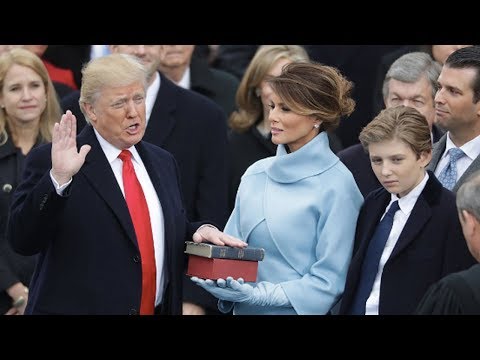
Democrats failed to offer strong economic solutions to the problems people were facing after the economic collapse and people saw little difference between the two parties, driving them to vote for Trump, says Thomas, Ferguson, co-author of, “The Economic and Social Roots of Populist Rebellion: Support for Donald Trump in 2016”
Story Transcript
SHARMINI PERIES: It’s The Real News Network. I’m Sharmini Peries, coming to you from Baltimore.
Many millions of Americans are anxiously awaiting tomorrow’s midterm election results. So then, this is a good time for us to dig into how the electorate behaved during the 2016 election and why. A just published research paper takes a closer look at survey data and election results from 2016 to answer the question, which factors were driving Trump’s victory in 2016? Were they social anxiety issues or economic distress? The paper, titled The Economic and Social Roots of Populist Rebellion: Support for Donald Trump in 2016, was published by the Institute for New Economic Thinking. But it makes an attempt to dig into this question.
I’m now joined by the Institute’s Research Director, Thomas Ferguson. He’s one of the five coauthors of the study. Thomas Ferguson is also Professor Emeritus at the University of Massachusetts Boston. Professor Ferguson, good to have you with us.
THOMAS FERGUSON: Thank you.
SHARMINI PERIES: Your paper, Professor Ferguson, contrasts social anxiety and economic distress. So let’s start off with an explanation of the difference, and then what are the key findings that you have learned? That we will dig into further, but just give us the first highlights of them.
THOMAS FERGUSON: Yeah, pretty simple. Look, we were distressed because we kept reading that economic forces had essentially nothing to do with the election. That point is being repeated all over, it’s been repeated by economists, by many political scientists. It’s hardened into a kind of common sense there. If you read The New York Times, you will see many assertions of that as though it’s obviously true. We didn’t think it was true, and so we start to look into the American National Election Survey, which is the big survey out of the University of Michigan. And so, when we started it became clear right away that this much told story is not true.
For sure, there is a lot of racial resentment and quite a lot of gender related, and I’ll be perfectly blunt, misogyny going on in that election from some voters. Absolutely, for sure. But it’s very easy to sort of go back over things and then find that economic issues were also quite important in the outcome. And when we sort of put the whole thing together, working through first the Republican primary, this is basically a paper about Trump, and then the general election, it was pretty easy to see the issues, for example, like imports, or in other words, relief from imports, read protectionism, that was a Trump appeal it resonated with a lot of people.
There were even people voting for Trump in some places that thought they wanted actually the government to do more about income inequalities. The reason for that was they were pretty obviously not impressed by what the Democrats had actually done in power. There were an awful lot of people who were dismayed, feeling that the country was going off track. And that partly could be things more than the economy, but for sure that’s also heavily an economic story. And we actually created sort of separate files of different types of ways people could either switch from Obama to Trump, you could do that with the data you had.
In other words, look at people who said they voted for Obama in 2012 and switched to Trump. And yes, it’s recalled data, there’s some error in that, but it’s not enormous. And you can also see who voted Obama in 2012 and didn’t vote this time around in 2016. And then, you can also see people who came in from the cold, meaning they hadn’t voted at all in 2012 and had in 2016. And again, imports and a variety of other economic issues, including sometimes disgust with the Affordable Care Act. Now, particularly for people who voted for Obama, they were pretty much political liberals. It’s pretty clear they weren’t opposed to the idea of affordable care, they were just disappointed with the actual amount of affordable care assistance they got.
Moreover, we also found that in two of those three groups of switchers, as we were just calling them, a lot of people have trouble seeing differences between the major parties. This is just to say that the Democrats weren’t offering a strong economic appeal. And so, where we came on that is, yeah, the economy really did matter. The other thing we found that was really striking is that it turns out that especially when you looked at the voters who switched one way or the other, including just not voting in 2016, not for voting for Obama, it made a big difference if there was a Senate race in your state. And the striking thing about the Senate races in 2016 was for the first time in the history of the Republic, every party that won the electoral vote in that state also won the Senate race.
And in an earlier paper, Paul Jorgensen, Jie Chen and I had conjectured that it was actually a dual wave of money, meaning late money by Trump which we documented, and then also the efforts by the Republicans to pull out the Senate, as they were really afraid they could lose both the presidency and the Senate. We thought it might well be a dual wave of money that put Trump over. That’s what we’re finding out of our data in this paper now at individual voter levels. It really matters if you had the Senate races, pretty powerful force. That’s basically, we think, the power of money in politics because you’re talking really large sums there. And that does – it probably helped him. Ironically, a lot of people who backed the effort to keep the Senate were folks who didn’t particularly care for Trump, Republicans who didn’t. Well, turns out they maybe helped him get in through reverse coattails, as we talk about in this paper.
SHARMINI PERIES: All right, Thomas, sorry to keep pressing on this. I know your particular study was in relation to the 2016 election, but we, on the eve of this election, the midterm, we cannot not extrapolate from those findings that you had in that study to explain what might or might not happen tomorrow. Now, Trump regularly tries to take credit for the booming stock market and historically low unemployment rate. Now, if this is the case, could economic concerns become less of an issue in the 2014 midterm election than they were in 2016?
THOMAS FERGUSON: Okay. Well, this is a question has several complex components and a simple answer is not easy to give. First thing I would want to note there is that in our paper, we show you how a lot of people in the Republican primaries, the racial and gender anxieties were really quite powerful for Trump. It helped him win the primary there didn’t cost him much. In the general election, those often cost him votes, actually. There were a lot of people who finally decided for Trump who had real misgivings about him, and sometimes just for votes, including I think a fair number of women, in particular, white women, who as a majority of those who voted did go for Trump there.
Now, I’m going to try to put this clinical fashion. Trump’s heavy campaigning on questions of gender, I think, directly and indirectly, probably is repelling even more of those people. On the other hand, the economic issue is probably telling for him. Now, there’s a lot of things going on in the economic issue. It does not help, I think, that everything is sort of muddled, I think both in the major media but also by the Democrats very bluntly. If you notice, some might pay a lot of attention to it, a week or two after the election, you certainly saw all the mainstream, conventional Democratic economists saying it was time for the Federal Reserve to raise rates, that we were nearing full employment.
I and others, I’ll count myself on the left here although I’m not offering this as a political judgment, just clinical, thought that was wrong. There were lots and lots of people still on the sidelines, people who’d dropped out of the labor force. And Trump, obviously, and the folks doing the sort of supply-side pushing in the Republican Party, have always disputed that. Now, Trump then proceeded to supercharge the economy with what were admittedly crazily loaded tax cuts for the rich. But in the short run, they do loose up the economy. And you had a cyclical recovery already underway from Obama, that was going to happen with or without Trump. But I do that think the Trump emphasis on pushing for growth has had an impact though. The tax thing did super-stimulate the economy in the short run.
And I think everybody has found out that their models of potential output, which is the economic case here for Fed rate rises, they were all wrong. They really did underestimate what the American economy was capable of doing. And in that sense, this is a real mixed story here, it’s not so clearly – I don’t, for instance, accept the case that the American economy is on a sugar high. If you had Sanders in there, he wouldn’t have done the crazily loaded tax cuts for the rich that Trump did, but you could have stimulated the economy with sort of normal government programs, paid for them if you’d like, you’re really worried about the deficit. It’s a balanced budget, multiplier type stuff where you tax at the same time. And you could push people back to work.
I take it that, if you like, conventional economics of the center on both the left and the right, is looking pretty stupid after two years of Trump. And this point actually probably needs to be made. So where does this leave us? It means, I think, that Trump’s going to pick up a lot of credit for the economy, some of those tax cuts will start to disappear for the average person very soon after the election, and you’re going to have a huge hue and cry about the deficit in coming years because it’s gonna swell enormously. But there you have it. I mean, this is unfortunately a complicated mess.
SHARMINI PERIES: And for those out there who might be voting for Trump, will he be able to sustain this kind of growth and unemployment rates?
THOMAS FERGUSON: Well, if I had a guess I’d say what they’ll do is try to do another tax cut ahead of 2020. I don’t think they can just go on with another round of what they just did, so crazily loaded to the rich, without cutting expenditures. And that’ll cost them, and there are expenditure cuts even slated to come. And there will be another giant effort to cut down the deficit. I mean, could you do it? Yeah. I think the lesson we’re all learning from this is that if you are willing to use the levers that normal market economies have, you can get much better output. On the other hand, are these guys going to be able to do it? I doubt it. Will they try? Yes.
SHARMINI PERIES: All right, Thomas Ferguson. I thank you so much for joining us and we hope you can join us for our election coverage.
THOMAS FERGUSON: Yeah, I said I’d do it for a while at 11 because I will need to go to sleep. I need beauty rest, as anyone watching us will quickly conclude just from looking at me.
SHARMINI PERIES: I doubt that. I thank you so much for joining us, Thomas.
THOMAS FERGUSON: Bye bye.
SHARMINI PERIES: And thank you for joining us here on The Real News Network.


