

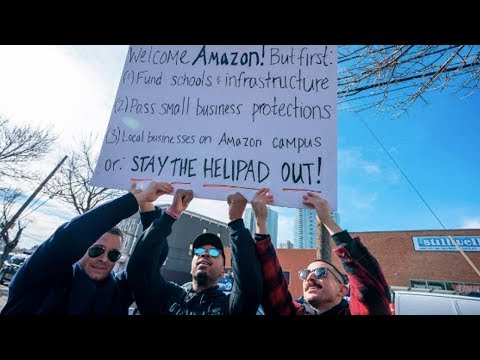
The contest for Amazon’s HQ2 prompted hundreds of cities to put in tax break and subsidy bids. Former financial regulator Bill Black says these deals never pay off for the communities involved
Story Transcript
GREG WILPERT: It’s The Real News Network, and I’m Greg Wilpert, coming to you from Baltimore.
After a year-long competition and search, the company Amazon announced on Monday that it will split its second headquarters between two cities: New York City and Washington, D.C. According to Amazon, this means that these two locations will be splitting 50,000 new high-paying jobs and $5 billion worth of investment. Two hundred and thirty eight cities across North America from Canada, the U.S., and Mexico participated in the competition to provide the best tax incentives and subsidies for Amazon to create its second headquarters, in addition to the one it already has in the city of Seattle.
Leaked reports show that some cities and states offered as much as $8.5 billion in tax breaks for Amazon to come to them. So far it is still unknown how much the states of New York and Virginia offered to Amazon. But New York State Governor Andrew Cuomo even said that he would change his name to Amazon Cuomo if this would sweeten the deal.
Joining me now to discuss the Amazon HQ2 decision is Bill Black. Bill is a white collar criminologist, former financial regulator, and associate professor of economics and law at the University of Missouri Kansas City. He’s also the author of the book The Best Way to Rob a Bank Is to Own One. Thanks for joining us again, Bill.
BILL BLACK: Thank you.
GREG WILPERT: As soon as Amazon’s decision to locate its second headquarters in New York and in Washington, D.C. was announced, the newly elected House Representative from Queens and the Bronx Alexandria Ocasio-Cortez sent out a few tweets criticizing the move. She said, quote: “Amazon is a billion dollar company. The idea that it will receive hundreds of millions of dollars in tax breaks at a time when our subway is crumbling and our communities need more investment, not less, is extremely concerning to residents here.” She then added, quote: “Displacement is not a community development. Investing in luxury condos is not the same thing as investing in people and families. Shuffling working class people out of a community does not improve their quality of life.” So in other words, Alexandria Ocasio-Cortez raises two issues here; that of gentrification and of lost tax revenues. What do you think? Do the benefits of perhaps $2.5 billion in investment and 25,000 new jobs justify these costs?
BILL BLACK: Well, I also teach public finance. So the standard answer in research is that these tax competitions are at best zero sum games. In other words, the cities are put in competition against each other by wealthy corporations and cities as a whole can’t possibly win through this. Indeed, cities as a whole must see tax revenues go down as a result. And even when there is an occasional seeming winner, of course it only comes at the expense of other folks.
In terms of, you know, is development a good thing or a bad thing? Development, if it’s constructive and builds the economy, creates jobs and such, certainly can be. You obviously want to look at the housing situation in all of these circumstances. But of course the big winners in terms of states were not the states that bid the most in this Christmas-comes-early competition. The ones that really tried to buy Amazon with our dollars, disgracefully, were the governments of Maryland and New Jersey, in particular. Fortunately for their citizens, they lost.
GREG WILPERT: So aside from the downsides of lost tax revenues and gentrification that I mentioned earlier, there’s also the question of whether this was even a serious contest. In other words, perhaps Amazon engaged in this contest simply to drive down taxes and increase subsidies. What do you think? I mean, is this a game that they’re playing?
BILL BLACK: Well, that is a serious contest. That’s why they do these things. But there’s another thing, and that is Amazon, of course, makes a great deal of money off of information. It gets information in myriad ways through all of its sales. It knows more about people’s spending habits than anybody in the world. And it sells that information to many people to be able to make money.
So Amazon also found a way to get some of the most confidential information about planning in, as you said, something like 220 major cities, and everything it wanted to know about their transportation grids, which of course since Amazon is so heavily involved in delivery was also incredibly valuable. So yes, there were other things going on in this bid, and the information probably was the biggest single benefit that they got.
GREG WILPERT: So what do you think can be done about the competition between cities and states? I mean, it’s basically a beggar thy neighbor approach, and apparently it’s common practice for companies to engage in, to engage cities and states in these bidding wars for their business. As a matter of fact, there’s a famous case right where you are on the border between Missouri and Kansas where these two states often compete for company headquarters. What can be done to keep this from happening?
BILL BLACK: Not much. The states would have to cooperate with each other. And in today’s political times that would be suicidal for the governors. They would be attacked in the primaries as people who sat by while Kansas, you know, robbed Missouri, or vice versa. And you have powerful players like the Koch brothers who very much want to keep this competition going.
And by the way, it’s also infamous in the context of sporting teams. Like, the worst possible thing that you want is for somebody to, is an NFL team to pick your city, and then you have to pay literally billions of dollars to get them to come. The only thing worse is the Olympics, which is a financial disaster, but is always sold on the basis of, oh, you’re gonna make a ton of money.
GREG WILPERT: I’ve also heard proposals that perhaps Congress ought to intervene. That is, on the federal level a law could be passed, perhaps, that would prevent states and cities from competing against each other, with basically the idea being that this is a form of corruption the same way that it would be a form of corruption if a foreign government did something like this. What do you think of that idea?
BILL BLACK: Too sensible.
GREG WILPERT: Too sensible?
BILL BLACK: Yeah. There’s no way, politically. The Republicans would portray it as an anti-business measure, and they would primary anybody that voted for it. So it’s not going to happen, as I said. Very much the opposite. Entities like the Koch brothers through ALEC, which is its legislative arm, they spur these competitions, and they will seek to defeat anyone in public office who has a sensible approach to public finance.
GREG WILPERT: And finally there’s also the issue of how these decisions are being made or implemented; that is, in a highly undemocratic manner, in a sense of secret negotiations people don’t know about. So who in the end really benefits from all of this?
BILL BLACK: So we do know just a couple days ago, or maybe even today as we’re talking, that there was a secret codicil to the deal with Virginia, Virginia to agree to give Amazon 48 hours notice of any journalist seeking a copy of the deal so that Amazon would have time to go into court and seek a protective order. So yes, these are folks who don’t have the slightest- well, actually they have pretenses towards democracy, but they are completely antithetical to democracy and to openness. You can make much better deals if you keep it private, and if you get to suggest, you know, somebody else is paying more money.
Although again, in the end, I would emphasize it wasn’t the two states that offered basically to hock the entire state that won these competitions. So it could get worse. If it wasn’t Amazon, if it was somebody else that was purely interested in the tax dollars, as opposed to other things like airports and such, New Jersey and or Maryland would be $7-5 billion poorer right now.
GREG WILPERT: Right. But I imagine Amazon got a better deal by making this competition out of New York and out of Virginia than if it hadn’t even started this competition, don’t you think?
BILL BLACK: Oh yeah. There’s no question that they started the competition for the reasons we’ve been talking about. You’re going to get a significant amount of money, and the guesstimate between New York, Virginia, and there’s a small deal in Nashville, Tennessee, is that they’re going to get $2.8 billion, roughly, in public money. My point simply is they could have gotten roughly $7 billion or more in some other states, so it probably wasn’t a fake competition in the sense that they were simply trying to go for the biggest subsidy. They still wanted cities that made more sense in terms of travel, seems to have been a big indicator. For example, their site isn’t in Washington,D.C. Yeah, it’s in Virginia, and it’s- part of the deal, we now learn, is to create a land bridge from Crystal City, Virginia, which is where the site will be, and the airport. So this is going to be an Amazon thoroughfare or overpass.
GREG WILPERT: I guess maybe they’ll rename the airport to the Amazon airport. We’ll leave it there for now. I was speaking to Bill Black, associate professor of economics and law at the University of Missouri Kansas City. Thanks again, Bill, for having joined us today.
BILL BLACK: Thank you.
GREG WILPERT: And thank you for joining The Real News Network.


