

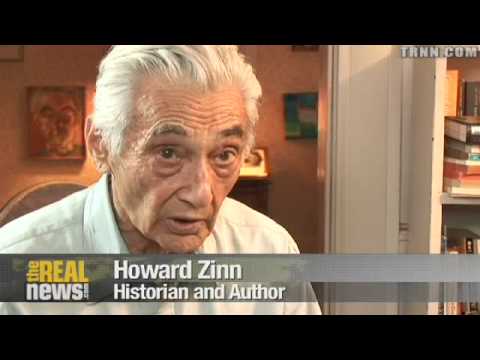
Howard Zinn says vote against McCain, vote for Obama. Even though Obama does not represent any fundamental change, he creates an opening for a possibility of change. Obama will not fulfill that potential for change, unless he is enveloped by a social movement, which is angry enough, powerful enough, insistent enough, that he fills his abstract phrases about change with some content. We need direct action, because only that kind of indignation is going to have some effect on the people in Washington.
Story Transcript
TEXT ON SCREEN: Howard Zinn is an American historian, political scientist, social critic, activist and playwright. He is best known as author of the best-seller ‘A People’s History of the United States.’ Zinn has been active in the Civil Rights and the anti-war movements in the United States. PAUL JAY, SENIOR EDITOR, TRNN: Thank you for joining us. Our interview with Howard Zinn. Thank you, Howard. HOWARD ZINN, HISTORIAN AND AUTHOR: Oh, glad to be here. JAY: So we’re just a few weeks away from the election. Obama’s ahead in the polls, although Obama supporters are still holding their breath and talk about October surprises and this and that. You’ve written about the election process as not being as democratic as it would like to call itself or people would like to call it. On the other hand, you still end up with the idea that people should participate, should vote, and I don’t think you quite said “holding your nose,” but with some reservation people should vote against McCain, vote for Obama. Explain what your thinking on this is. ZINN: Yeah. Well, you know, I’m very skeptical about the American political process, which only gives voters a very limited multiple choice test. You know, A or B? Or A and A-prime? The Republicans or the Democrats? And almost always the Republicans and the Democrats are so close to one another in policy, I mean, not identical, but fairly close in policy, so that the person who wants bold changes in the way our society is going is not going to find them represented by either the Democratic or Republican candidates, and that’s still true with Obama and McCain. However, there are certain moments in history when even a small difference between the candidates may be crucial, may be a matter of life and death for large numbers of people. I mean, when the French had a change of presidency in France during the Algerian War, it made a difference in their bringing the Algerian War to an end. And I think that there are such moments, and I think this may be such a moment in American history. That is, we’ve gone through an insufferable eight years with the Bush administration, probably the worst administration in history, and, I mean, two wars in one presidency, and a total disregard of the Constitution and the Bill of Rights, and a shattering of the economy. And in this situation, we are desperate for change. So even though Obama doesn’t represent any fundamental change, he creates an opening for the possibility of change. That’s why I’m voting for him; that’s why I suggest to people that they vote for him. But I also suggest that Obama will not fulfill that potential for change unless he is enveloped by a social movement which is angry enough, powerful enough, insistent enough that he fill his abstract phrases about change, fill them with some real, solid content. JAY: The Nader supporters and some of the other third-party candidates will say, “Well, there is an alternative.” No. I interviewed Ralph Nader and I made the argument to him that there isn’t a feasible alternative, and he says, “Oh, yes there is. It’s not feasible only when people keep saying it’s not feasible.” But what do you say to Nader and the other third-party candidates who say, well, the only way to break this paralysis of the two-party system is to start voting outside it?” ZINN: Well, you’re not going to break the paralysis of the two-party system within the party system. In other words, you’re not going to break it in the electoral system by putting up a third-party candidate whose showing will inevitably be pitiful and will therefore only be a demonstration of the weakness of the movement outside of the electoral arena. If you choose to go into the electoral arena, you’d better go in with strength. If you’re going with weakness, you are not doing a progressive movement any good. To me it is a waste of Ralph Nader’s energy to throw himself into the electoral process, ’cause his energy is best used by building a movement, by doing what he has done for most of his life very effectively, reaching out to millions and millions of people who will not vote for him but who really believe in his ideas, and help him to organize those people so that whoever is elected as president will then have to face a constituency, a citizenry which demands change. JAY: Now, how does that movement develop now? I mean, let’s assume that Obama is going to win this election. If the polls are right and there’s no, you know, extraordinary event—which I suppose nobody can rule out—but the world as we know it today, it looks like Obama’s going to win the election. And I say that with some reservation, ’cause if something big happens in four days, it’s going to make this interview dated. So we’d better publish quickly. But given that, how does an independent movement develop? What are the obstacles to a national movement of the type you’re talking about? ZINN: Well, the obstacles are a kind of resignation that things will go on as before. That’s always the obstacle to change. The obstacle to change is not that people don’t want change. People want change. But most of the time, people feel impotent. However, at certain points in history, the energy level of people, the indignation level of people rises. And at that point it becomes possible for people to organize and to agitate and to educate one another, and to create an atmosphere in which the government must do something. I’m thinking of the 1930s; I’m thinking of Franklin D. Roosevelt coming into office not really a crusader. Roosevelt came into office, you know, with a balance-the-budgets history. It was not clear what he was going to do, and I don’t think he was clear about what he was going to do, except that he was going to be different from Hoover and the Republicans. But when he came into office, he faced a country that was on strike. He faced general strikes in San Francisco in Minneapolis. He faced strikes of hundreds of thousands of textile workers in the South. He faced a tenants movement and an unemployed council movement. And he faced a country in turmoil, and he reacted to it, he was sensitive to it, he moved. That’s what we will need. We will need to see some of the scenes that we saw in the ’30s. JAY: And how do we get there? ZINN: How do we get there? Well, we get there by somebody starting it off, like the four kids in Greensboro in 1960 who started off the sit-in not knowing whether it would spread. We need somebody who is losing their home because they can’t afford to pay their mortgage, we need them surrounded by their neighbors who then do not allow them to leave, do not allow their furniture to be taken away. This is what happened in the ’30s. In other words, we need direct action, we need civil disobedience, we need to raise the level of tension in the country, because only that kind of indignation is going to have some effect on the people in Washington. JAY: And in terms of building a movement that could give rise to a third party that actually had a chance—and in many countries of the world, parties do come and go—first of all, why haven’t we seen some of that which one did see in the ’30s? There were other parties that had some kind of weight. And are we entering with this financial crisis a period where something like that might be possible? ZINN: Well, third parties can have an effect on the existing parties. I mean, in the 1930s it wasn’t a third party that won; it was the fact that there was a movement throughout the country. Part of it was socialist and communist, but a lot of it would be working people and tenants and so on, and they had an affect on the Democratic Party, which up to that point had not been a very militant or very energetic party. As a result it had lost elections in the 1930s to non-entities like Harding and Coolidge. But I think it’ll take the kind of energy that we had in the ’30s to not necessarily create a third party that will win office, but that will transform the Democratic Party into what might be a third party, almost in the way that the Republican Party before the Civil War was transformed into a party that would do away with slavery or at least try to do away with slavery, even though that was not its primary objective. JAY: If we’re looking at four years, maybe eight years, of a Democratic administration, and if that Democratic administration follows the previous course we’ve seen from most of the people that are going to be leading it, then this movement is going to be directing a lot of its target or arrows at the Democratic administration. ZINN: Unquestionably. If we have a Democratic administration, that administration has to be the target of a new social movement. Problem with the years of the Clinton administration is that whoever in the United States really wanted to go beyond the Clinton administration in foreign policy and domestic policy became complacent, and they did not organize, and there was no real movement in the country in Clinton’s time, as there had been in 1960s, to push Clinton into any good direction. That will have to be different when Obama and his administration come into office. JAY: Well, there’s a new reality asserting itself, and I think everyone’s marching into uncharted waters here with the current financial crisis, which seems to be as profound as some of the most dire predictions are. And in the next segment of our interview, let’s talk about your views on the roots of this crisis and where we might be headed. Please join us for the next segment of our interview with Howard Zinn. DISCLAIMER: Please note that TRNN transcripts are typed from a recording of the program; The Real News Network cannot guarantee their complete accuracy.


